





 Português
  Inglês
  Espanhol
  4 min de leitura
  0 comentários



While The World Looks To The Stars, China Makes Leaps Toward What Could Be The Biggest Astronomical Discovery Of The Century. The Asian Giant, Who Has Already Surprised The World With Its Technological And Economic Advances, Is Now Aiming For A New And Ambitious Goal: To Find A Planet That Is A True Replica Of Earth.
But why this search? And what does it mean for the Future of Humanity? The answer lies in an audacious mission planned for 2028 that could change everything we know about our existence in the cosmos.
In 2028, China plans to launch a space telescope dedicated to finding what scientists call “Earth 2.0.” This new planet would essentially be an exact version of ours, with similar characteristics, orbiting a star similar to the Sun.
This project is a continuation of NASA’s Kepler mission, which, although successful, failed to identify a planet identical to Earth in all aspects.
-
A bright yellow mushroom imported from Asia escaped from a cultivation farm in the United States in 2010 and is now aggressively spreading across 25 states, destroying entire communities of native fungi in American forests.

-
Buried under China, a colossal machine weighing 20,000 tons began operating as the largest neutrino detector on the planet and, in just 59 days, surpassed results that science took half a century to achieve.

-
Iran enters the center of a climate alert after the war emitted 5.6 million tons of CO2 in two weeks, surpassing the annual pollution of entire countries.

-
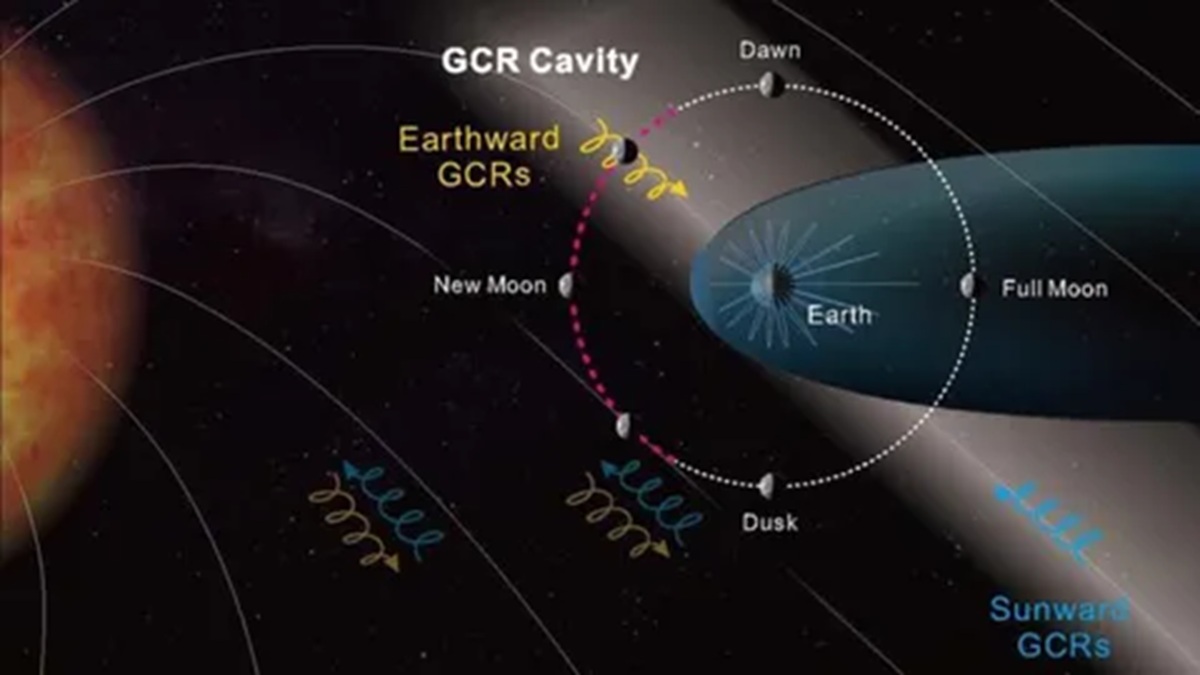
Lunar exploration may change after a Chinese probe finds a “cavity” of radiation that reduces the impact on astronauts by up to 20% at certain times on the Moon.

The Earth 2.0 Mission: The Chinese Telescope
The mission, dubbed Earth 2.0 or simply ET, is an initiative of the Shanghai Astronomical Observatory, affiliated with the Chinese Academy of Sciences.
The proposal was detailed in a scientific paper published in the Chinese Journal of Space Science (CJSS). Unlike its predecessors, the ET telescope will be equipped with six smaller 28-centimeter telescopes, all with an enhanced wide-field imaging capability.
The combination of these devices will allow the mission to monitor approximately 2 million stars simultaneously over four years.
Unlike Kepler, which had limitations in detecting planets with characteristics exactly like Earth, the Chinese telescope precisely seeks these conditions.
It will be positioned in an orbit around the Sun, similar to those of other space telescopes, such as the European Gaia and the American James Webb. With this strategic location, the ET will have a much larger field of view, covering the same region of the sky that Kepler investigated, but with significantly higher sensitivity.
The Differential of The ET Telescope and The Detection of Exoplanets
China’s big bet lies in the unique capability of the ET to detect not only Earth-like planets but also wandering exoplanets that roam space unattached to a star.
This will be possible thanks to an additional 35 cm telescope, specifically designed to identify phenomena known as gravitational microlensing.
In these events, smaller objects in deep space amplify the light of more distant stars as they pass in front of them, creating a kind of “natural lens.”
This process will allow the telescope to detect even exoplanets with the modest size of Earth, further expanding knowledge about the number of these celestial bodies in the Milky Way.
According to experts, this technique can revolutionize astronomy, enabling the creation of a detailed census of wandering exoplanets, which to date have been little understood.
This discovery could be the first step toward better understanding the distribution of planets in the universe and even the possibility of life in other systems.
Comparisons With The European Plato Mission
The European Space Agency (ESA) is also developing a similar project called Plato, scheduled for launch in 2026. Plato will feature 26 relatively modest-sized telescopes (12 cm aperture each), aimed at discovering Earth analogues.
However, the Chinese ET differentiates itself by its technology for detecting gravitational microlensing, something not present in Plato. This additional capability gives the Chinese mission a potentially broader reach in identifying exoplanets.
China In The Lead Of The Space Race?
The Earth 2.0 mission is yet another step for China in its growing influence in the field of space exploration.
In recent years, the country has heavily invested in space technology, with the declared goal of becoming a superpower in this area.
With the possible discovery of a “new Earth,” China could redefine its role in the history of space exploration, not just as a participant, but as a leader.
The search for a new habitable planet is just the beginning of an era where China may dominate the exploration of worlds beyond our solar system.
But what does it mean to find an Earth 2.0? Would we be on the verge of colonizing another planet? Or would this open doors to better understand our own? The answer, as often happens in science, is still beyond the horizon. But one thing is certain: China is determined to lead this discovery.






Seja o primeiro a reagir!