





 Portuguese
  English
  Spanish
  4 min of reading
  1 comment


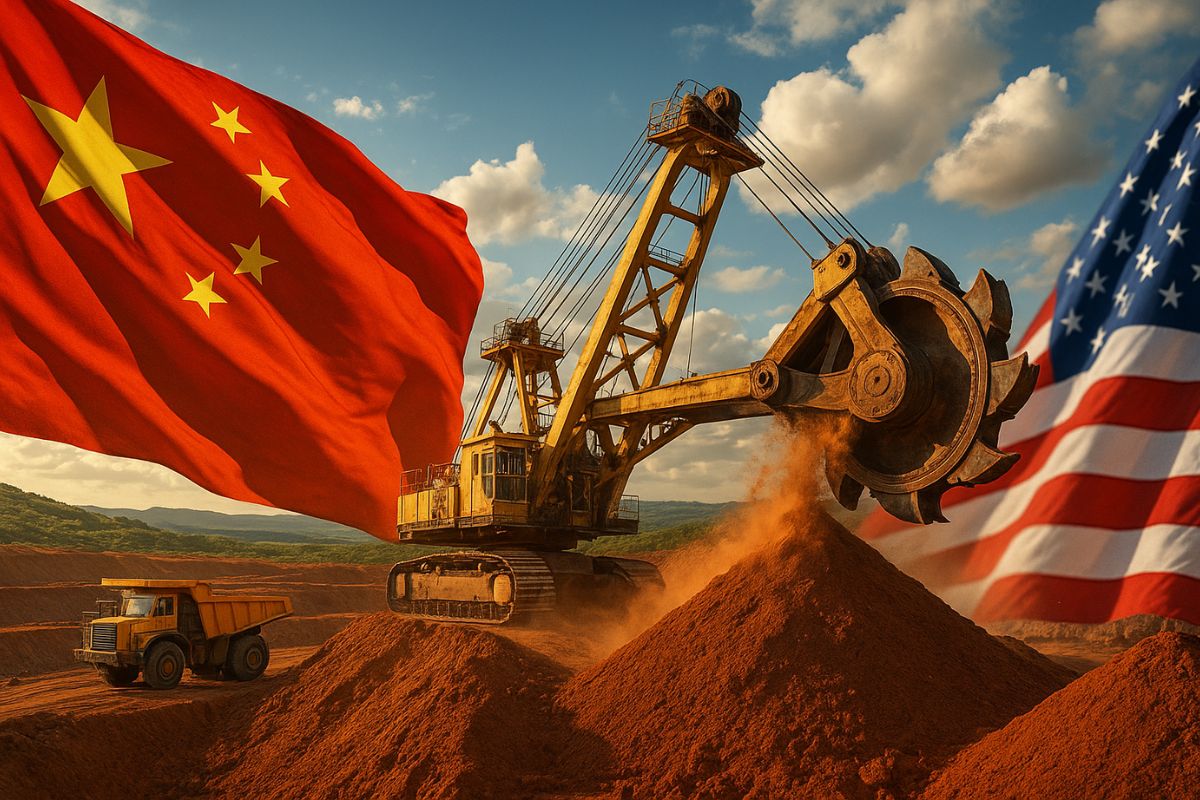

With Accelerated Investments and Focus on Supply Security, the Chinese Strategy Consolidates Presence in Key Assets While Brazil Tries to Transform Its Position from Supplier to Technological Protagonist.
The recent advancement confirms that China Dominates Mining in Brazil as part of an industrial policy aimed at ensuring a continuous supply of strategic raw materials. The movement goes beyond purchase contracts and targets direct participation in assets, with an appetite for niobium, tin, and nickel projects, as well as lithium, copper, and iron ore.
For authorities and sector specialists, according to the Times Brasil newspaper, Brazil occupies the center of the geopolitical board of critical minerals today. The prevailing view is that Chinese presence can accelerate investments and production capacity, as long as the country climbs the value chain and avoids dependence on a single investor.
Why China Accelerates in Brazilian Minerals
The strategy is based on the principle of supply security. Industry, electronics, defense, and energy transition require a stable flow of inputs and China prioritizes diversified sources outside its territory. In this framework, assets in Brazil reduce the risk of bottlenecks and ensure scale.
-
50 viaducts, 4 tunnels, 28 bridges, and 40 kilometers of bike paths: BR-262 in Espírito Santo will receive 8.6 billion reais for the largest engineering project in the state’s history, inspired by the Immigrant Highway in São Paulo.

-
Brazil produces too much clean energy and doesn’t know what to do with it: over 20% of solar and wind capacity was wasted in 2025 while investors flee and 509 renewable generation projects were abandoned in the last year.

-
Piauí will produce a new fuel that replaces diesel without needing to change anything in the truck’s engine and reduces pollutant gas emissions by half: truck drivers from all over the Northeast are already celebrating the news that will arrive later this decade.

-
A new Brazilian shopping center worth R$ 400 million will be built in an area equivalent to more than 4 football fields, featuring 90 stores, 5 cinemas, a supermarket, a college, and parking for 1,700 cars, potentially generating 3,000 jobs.


Another factor is technical. The Brazilian mineral portfolio covers critical links in the energy transition, from copper for networks and motors to nickel for batteries, in addition to niobium and tin, essential in alloys, semiconductors, and solders.
The proximity of deposits and existing infrastructure shortens ramp-up times, reinforcing the economic rationale for entry.
Where and in Which Minerals Influence is Growing the Most
The current market reading indicates a strong advance in niobium, tin, and nickel, with increasing interest in lithium, copper, and iron ore.
In niobium and tin, Chinese participation is already significant, and in nickel, there is a race for participation close to half of the capacity. This composition backs a chain that extends from metal alloys to high-tech components.
For Brazil, the opportunity map includes new processing hubs and beneficiation projects.
Without local beneficiation, the country continues exporting added value abroad; with it, it creates qualified jobs and multiplies tax revenue.
How Much and With What Investment Dynamics
The recent cycle has been marked by expansion of foreign capital, with annual leaps in investments and acquisitions.
The logic is one of portfolio consolidation and vertical integration, combining long-term contracts with equity positions in mines and plants.
This movement reduces cost volatility for processors and manufacturers and increases cash predictability for projects.
For local operators, the presence of a buyer-shareholder brings financing and scale, but requires robust governance to balance interests, especially regarding local content, technological transfer, and socio-environmental performance goals.
Strategic Dispute with the United States and Implications for Brazil
In the background, the competition between China and the United States for critical minerals adds pressure for agreements. China dominates mining in Brazil at a faster pace, and the U.S. seeks counterbalances with memoranda, funding, and public purchases.
The likely outcome is greater bargaining power for Brazil, as long as it translates this position into clear demands for industrialization.
Diversifying partners is a consensus among sector analysts. Simultaneously negotiating with China, the United States, and the European Union expands options for price, deadlines, and technology.
Without diversification, the risks of concentration and dependence grow, with future impacts on industrial autonomy.
Governance and Public Policies: From Sectoral Council to Efficient Licensing
The announcement of federal coordination instances for strategic minerals signals priority. The challenge is to transform coordination into operational guidelines, with local content goals, models for technological sharing, and predictable regulatory windows.
Swift licensing with technical criteria is critical: predictability attracts capital and reduces financing costs.
Effective sectoral policies combine updated geological maps, competitive concessions, credit for processing, and applied R&D.
Without this bridge, the cycle remains limited to primary extraction, and Brazil loses the opportunity to capture downstream value.
Risks and Counterparties: How to Protect National Interest
Concentration of off-takers and controllers can increase exposure to external shocks. Mitigation involves supply clauses to the domestic market, disinvestment rules in case of non-compliance, and auditable ESG and local content targets.
Contractual transparency and public access to key data reinforce the social legitimacy of projects.
In the socio-environmental field, continuous monitoring and cleaner open-pit mining technology reduce externalities. Without environmental and social performance, the reputational and legal cost increases and raises capital expenses.
Paths to Capture Value: From Ore to Product
To move beyond the extractive cycle, Brazil needs to anchor beneficiation, refining, and intermediate manufacturing plants.
Partnerships with knowledge transfer in rare earth separation, special alloys production, cathodes, and battery precursors create regional ecosystems that retain income and build labor.
Government purchases, targeted credit, and R&D agreements with universities and institutes accelerate the learning curve.
China Dominates Mining in Brazil because it executes a long-term strategy. To rebalance, the country needs a similarly continuous policy, with metrics and periodic evaluations.
The Chinese presence accelerates the clock of Brazilian mining, but the positive impact depends on how much the country captures the value beyond the mine.
China Dominates Mining in Brazil as part of its industrial policy, and the Brazilian response must combine partner diversification, local content requirements, and technological transfer targets. Without this, the window of opportunity closes at the port.
Do you see the Chinese expansion as a driver for industrialization or as a risk of dependence on critical minerals? What must be included in an agreement to ensure that Brazil climbs the value chain? Leave your analysis in the comments and tell how this movement is already affecting your market.









My firend suggested I might like this website. He was totally right. This post actually made my day. You cann’t imagine just how much time I had spent for this information! Thanks!