





 English
  Francês
  Alemão
  Italiano
  Japonês
  Norueguês
  Portuguese
  Spanish
  4 min of reading
  0 comments


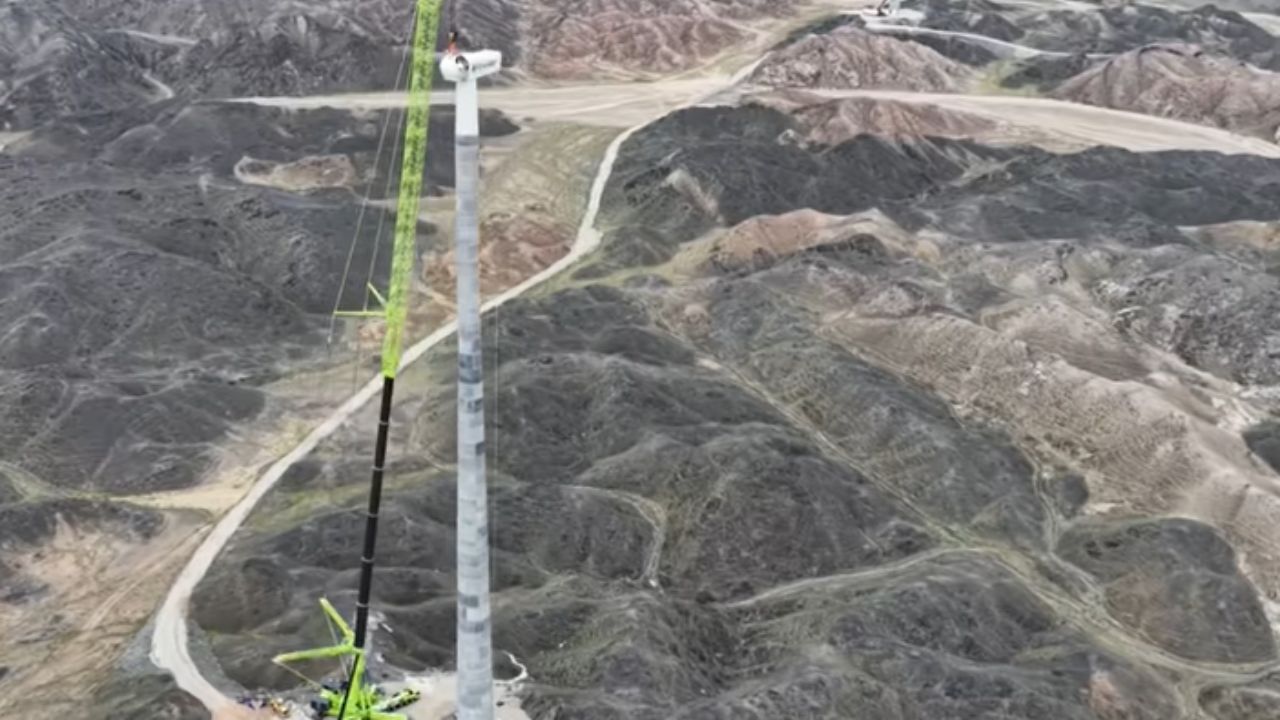
In The Heart Of The Gobi Desert, The Construction Of Giant Wind Turbines Turns Into A Logistical War Operation With 160-Ton Trucks, Parts Over 150 Tons, And Assembly At Altitude, Wind, And Total Isolation.
The scene seems exaggerated until you see it up close: China is assembling giant wind turbines in the Gobi Desert and, to do that, it needs to move a 108-meter blade weighing 30 tons as if it were a piece of porcelain. The route includes mud, heat, rain that washes away roads, and winds that halt maneuvers at the last minute.
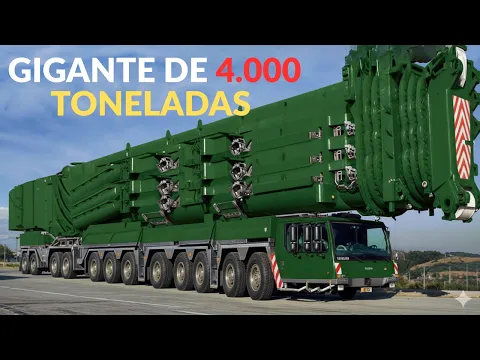
The most impressive point is not just the size. It’s the method. A 4,000-ton crane arrives with 28 support trucks, undergoes its own assembly, climbs mountains, and becomes the base to install a 6.25 MW turbine, capable of generating over 6,000 kWh in just 1 hour at full load. It’s heavy infrastructure with millimeter precision.
Why Giant Wind Turbines Are Going To The Gobi Desert
The Gobi Desert is vast, windy, and sparsely populated, an ideal setting to produce energy where there is space and constant wind.
-
Explorers find Roman treasure trapped between rocks on the seabed for nearly 1,600 years and reveal a desperate attempt to hide 53 gold coins during the invasions of the Empire.

-
Archaeologists discover Roman vase buried for over 2,000 years with more than 175 intact gold and silver coins, revealing a desperate strategy to protect wealth during the collapse of the Empire.

-
With 241 meters, 48 thousand tons, and a structure designed to accompany aircraft carriers at sea, the Chinese ship that refuels fleets in motion was born to push Beijing away from the coast and has become the hidden gear of its naval projection.

-
“Discreet” city in the interior of SP stands out among the smartest in Brazil thanks to a national ranking.

The logic is simple: turn an isolated territory into a generation hub, bringing electricity to distant regions and reinforcing the wind energy matrix.
At the same time, building far from urban centers creates a challenge: everything has to be brought there, from cement to giant parts. And it is precisely this “far from everything” that makes the operation so complex.
The 108-Meter Blade That Changes The Transport Game
Transporting a 108-meter blade is not just “carrying a big load.” It’s managing risk all the time. The piece weighs 30 tons and requires an adapted truck that can reach 160 tons to prevent the entire assembly from tipping in curves and uneven terrain.
The path doesn’t help. In some sections, rain washes away the road for days, delaying the entire logistics.
In others, strong winds prevent the final maneuver and force the team to unload, reposition, and wait for conditions to improve. A 108-meter blade does not forgive mistakes.
How The 4,000-Ton Crane Becomes A Factory In The Middle Of The Desert

Before lifting any turbine part, the 4,000-ton crane must be assembled as if it were its own project.
The “big wall” of the equipment comes in seven sections, and each stage requires alignment, coupling, and safety checks.
With the stabilizers positioned and the base completed, the crane rotates, tests functions, and repositions itself with precision.
It’s not just brute strength, it’s control engineering. And the operation doesn’t happen with just one piece of equipment: auxiliary cranes come in to lift parts and prepare the ground for the main giant.
Assembly At Altitude: Tower, Nacelle, And Wind Control
The tower exceeds 170 meters and has no internal elevator. Workers climb step by step up the stairs to the top. The nacelle, cited as the heaviest part, weighs over 150 tons, and the wind can turn the assembly in the air.
To prevent this, teams distribute in various directions pulling wind ropes and stabilizing the movement.
Safety depends as much on technique as it does on human coordination. After the nacelle, the wheel and blades come in, with special attention to the final fitting.
What A 6.25 MW Turbine Delivers In Practice

Each installed turbine has 6.25 MW of power. In one hour of operation at full load, it can generate over 6,000 kWh of wind energy, enough to sustain a large amount of consumption depending on the local context.
The real impact is in the scale: a “forest” of turbines turning in the background represents continuous clean generation capacity, especially useful in remote areas that need reliable electricity to grow.
The Invisible Side: Isolated Workers And Construction That Never Appears
While the result turns into numbers and megawatts, the process becomes a hard routine: sunrise and sunset on the construction site, mud, heat, wind, nights of assembly, and days of delays due to destroyed roads. The construction is not just metal, it’s human resilience.
In the Gobi Desert, the infrastructure does not arrive ready. It is assembled piece by piece, with repeated effort, heavy equipment, and a clear goal: to make energy reach places that were once just empty.
Do you think projects like these giant wind turbines in the Gobi Desert are worth the cost and risk, or should the investment be closer to the cities?






-

-

-

-

-

-

21 pessoas reagiram a isso.