





 Portuguese
  English
  Spanish
  5 min of reading
  0 comments


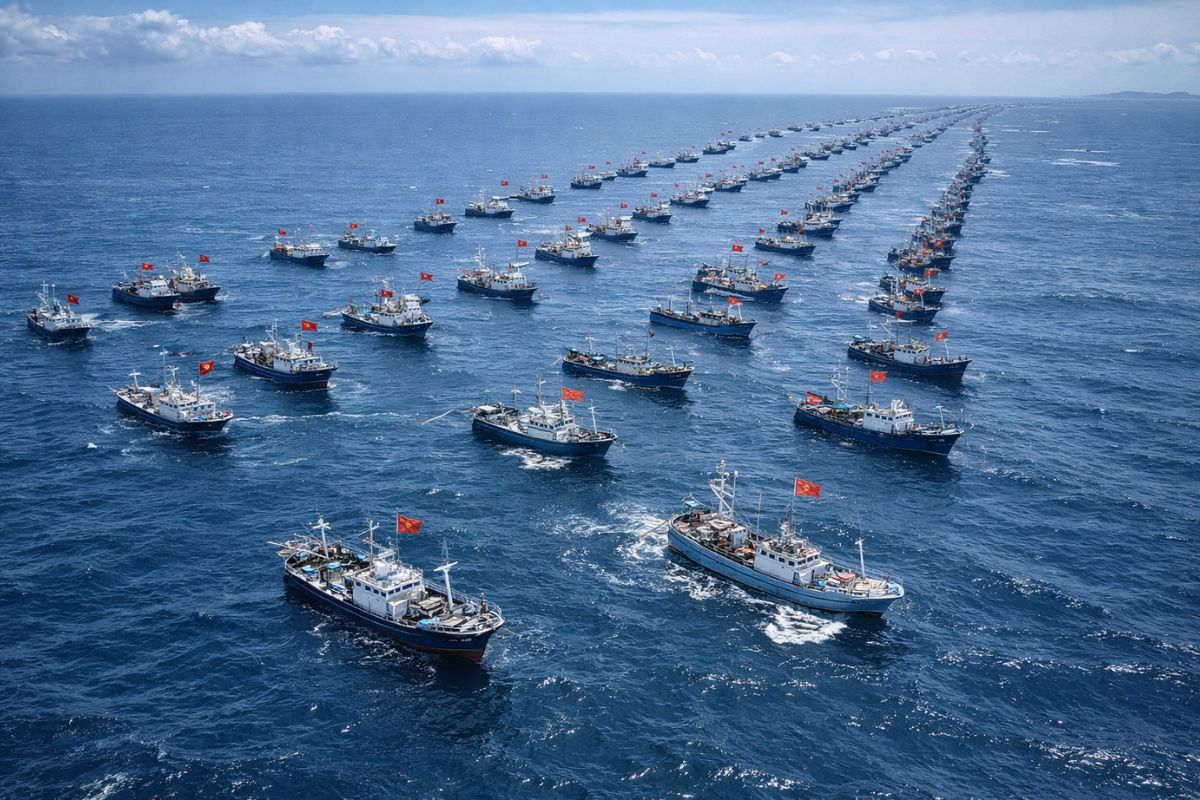
Satellite images show that China gathered about 1,400 fishing boats in a compact formation in the East China Sea, maintaining position for more than 30 hours in a maneuver that U.S. Congress analysts classified as a gray zone threat and raises questions about fishing, geopolitics, and the environmental future of an already fragile sea
China gathered about 1,400 fishing boats in a compact formation that stretched approximately 320 kilometers in the East China Sea in mid-January. Satellite images and ship tracking data showed the vessels converging over several days, maintaining position for more than 30 hours and then dispersing. U.S. Congress analysts classified the maneuver as a new threat in the gray zone, because formations of this type can impede navigation without a single warship being present.
According to the U.S.-China Economic and Security Review Commission, a similar maneuver had occurred weeks earlier, on Christmas Day, when about 2,000 boats formed long lines in the same waters. China contests this interpretation and claims that the East China Sea is an important fishing area and that the period from November to February corresponds to the peak of the winter season. But experts continue to use the term maritime militia to describe what happened, and the question remains whether this was fishing, military exercise, or a strategic message. Possibly, it was all of these at the same time.
What satellite images revealed about China’s boat formation

The images showed the vessels converging to the same area over several days, positioning themselves in a geometry that analysts described as incompatible with conventional fishing activity.
-
Where there was only sand and wind at 40 degrees, China built a megacity of 500,000 inhabitants with farms, wineries, and universities in the middle of the desert using melted glacier water from hundreds of kilometers away.

-
Theories about UFOs have resurfaced strongly after an aerospace scientist and a general linked to the Roswell case mysteriously disappeared in the United States within a few months, and even the FBI was called in to investigate.

-
Neither in the refrigerator nor in the fruit bowl: this is the correct way to store lemon.

-
It has only 11 thousand residents: Brazilian Tuscany impresses everyone with mountains of 1,900 meters and wide views of valleys.


The scale of the formation, the alignment of the boats, and the time they remained in position do not resemble the normal behavior of a fishing fleet. Cargo ships navigating through the region had to divert or zigzag to pass between China’s vessels.
Liu Pengyu, spokesperson for the Chinese embassy, stated that it is normal to observe a high concentration of fishing boats operating in the East China Sea during the peak of the winter season.
The official position of China is that the boats were engaged in legitimate fishing activities in waters that the country considers part of its natural operating area. The discrepancy between this version and what the satellite images show is what fuels the international debate.
What is China’s maritime militia and why does it concern the Pentagon

The Pentagon states that China’s maritime militia is a component of the country’s armed forces that operates under military control, even using civilian vessels. In peacetime, this militia helps assert Beijing’s maritime claims in disputed areas.
According to a Pentagon report, China has built at least 235 large steel-hulled fishing vessels for militia-related operations since 2014.
This strategy is classified as gray zone operations: actions that fall below the threshold of declared military conflict but exert real pressure on other countries.
The same boats that bring fish to market can be used by China to control access to disputed waters and pressure competitors without a single shot being fired.
It is this ambiguity between civilian fishing and military power projection that makes the 320-kilometer formation so concerning for security analysts.
The East China Sea was already a zone of tension before the boats
The boat formation did not occur in calm waters. The East China Sea is one of the most tense waterways in the world.
The Pentagon’s 2024 report points out that Chinese coast guard ships entered the waters around the Senkaku Islands on 352 days in 2023, the highest number since Japan nationalized the islands in 2012. These islands are simultaneously claimed by China, Japan, and Taiwan.
When you add to this pre-existing tension a civilian fleet of over a thousand boats operating in coordinated formation, navigation in the region ceases to be routine.
The 320-kilometer barrier created by China in the East China Sea does not need weapons to be effective: the mere physical presence of hundreds of vessels is enough to alter routes, cause delays, and pressure rivals without any international treaty being technically violated.
The environmental impact that no one is discussing
The East China Sea is not just a geopolitical chessboard. It is a living ecosystem under pressure. A 2022 study published in the journal Frontiers in Marine Science indicated that China implemented fishing management measures in the region due to declining stocks.
In 2023, another study found that two important fish populations in the area, Pacific mackerel and eel, were being overfished and in decline.
A 2024 study published in the journal Marine Policy went further: it concluded that China’s gray zone actions in the East China Sea, the Taiwan Strait, and the South China Sea could reduce fishing space and decrease catches in neighboring waters.
When large fishing fleets become tools of state strategy, the ocean ends up bearing part of the cost.
Even if not all the boats in the formation were fishing at that moment, the pattern shows that fishing capacity is being incorporated into a system that contributes little to alleviating the pressure on a sea that already needs stricter management.
Fishing, exercise, or message: what the formation of China’s boats really means
The most honest answer is that it was probably all at the same time. China’s boats may be fishing, they may be training coordination capacity for military use, and they may be sending a message to Japan, Taiwan, and the United States about who controls those waters.
This deliberate ambiguity is exactly what defines a gray zone operation: the adversary cannot distinguish civil activity from military action, and any strong response risks appearing disproportionate.
For China, this strategy has low cost and high impact. Fishing boats are cheaper than warships, do not provoke diplomatic crises of the same level, and can be denied as civil activity at any moment.
For the rest of the world, the 320-kilometer formation in the East China Sea is a sign that maritime disputes in Asia are entering a new and more difficult phase to contain.
A barrier that does not need weapons to function
China placed 1,400 boats in formation at sea and created a 320-kilometer barrier without firing a shot, without mobilizing the Navy, and without violating any treaty.
It is fishing, it is exercise, it is a message, and it is environmental pressure on an ecosystem that is already in decline. The overlap of military, economic, and environmental interests in these waters is what makes the episode so difficult to classify and so impossible to ignore.
Do you think this boat formation is legitimate fishing, a show of force, or something completely different? How should the world react to gray zone operations that no treaty anticipated? Leave your comments and share this article with those who follow geopolitics and maritime issues.







Seja o primeiro a reagir!