





 Portuguese
  English
  Spanish
  4 min of reading
  0 comments


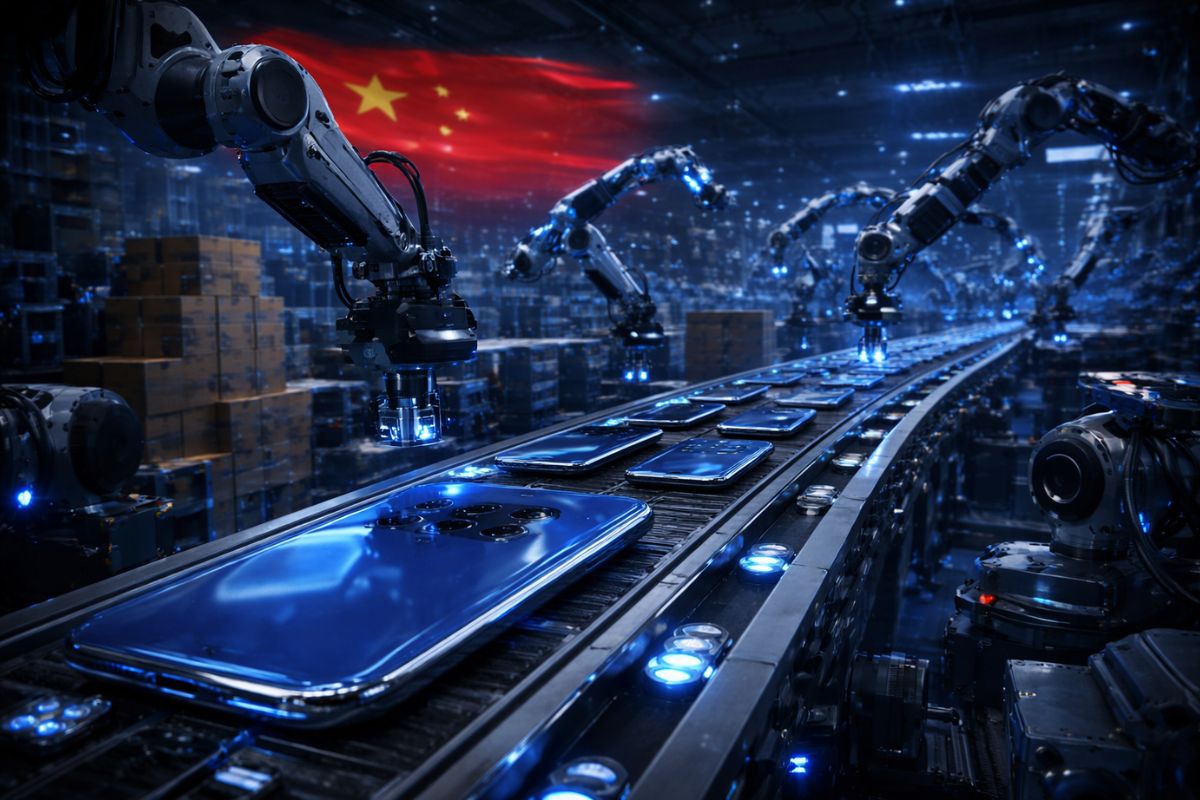
The ghost factory of Xiaomi in Beijing operates with total automation and without workers on the assembly line, producing high-end smartphones every few seconds. But the speed raises questions about the electronic waste generated by such accelerated production of disposable devices.
Xiaomi has launched what it calls a next-generation ghost factory, a facility in Beijing capable of operating 24 hours a day in the dark, without human intervention on the assembly line, and with the capacity to produce 10 million high-end smartphones per year. The unit uses 96.85% of internally developed equipment and 100% proprietary manufacturing software, numbers that the company presents as proof of total control over its production chain.
The project represents a milestone in Chinese industrial automation, but it also ignites a debate that goes far beyond efficiency. If a ghost factory can assemble a phone every few seconds, the important question is not just about speed but about what happens to millions of devices when their owners decide to replace them in increasingly shorter cycles, feeding a mountain of electronic waste that already concerns international organizations.
How the Xiaomi ghost factory works

The facility, launched in July 2024 in the city of Beijing, is what the industry classifies as a ghost factory, meaning an industrial plant designed to operate without continuous human presence on the factory floor.
-
A thousand-year-old caliphate city may be hidden beneath a pasture in Spain where anyone could walk by without noticing anything, but LiDAR technology has revealed terraces, walls, and a planned urban grid beneath the surface.

-
In 2028, Earth will cross debris left by the Swift-Tuttle comet in 1479, and the world’s most famous meteor shower could turn into a storm of hundreds of shooting stars per hour, a phenomenon that hasn’t occurred since before Columbus arrived in America.

-
China launches the world’s most advanced weather satellite with 6 scientific instruments, a lightning detector, and artificial intelligence capable of predicting storms, tornadoes, and hail with unprecedented accuracy.

-
Scientists drilled 523 meters of ice in Antarctica with water at 75 degrees and found 218 meters of sediments that prove that where there is now half a kilometer of ice, there was an open ocean millions of years ago.


Robots, sensors, automated inspection systems, and artificial intelligence control all stages of assembly, from positioning components on the board to final quality testing.
Xiaomi highlights that the ghost factory achieved a waste diversion rate of 99.35% in 2024 and received a three-star “Zero Waste to Landfill” certification from TÜV Rheinland, one of the most recognized certifiers in the world.
In practice, stricter control over assembly and inspection reduces errors, scrap, and rework, which means less wasted parts and fewer resources consumed in corrections. Each rejected board or failed test represents material, time, and energy thrown away.
China leads the race for total automation
The Xiaomi ghost factory is not an isolated case. According to data from the International Federation of Robotics, China accounted for 54% of all industrial robot deployments worldwide in 2024, and the total number of operational robots in the country has already surpassed 2 million units.
The scenario indicates a structural transformation in Chinese manufacturing, which is increasingly betting on fully automated production lines.
This movement has global implications. When the largest manufacturing hub on the planet accelerates the adoption of smart factories, the standards of cost, speed, and production volume change for the entire industry.
Competing companies in other countries are pressured to adopt similar technologies or accept increasing competitive disadvantages, which could reshape the supply chains of electronics in the coming decades.
The speed is impressive, but the numbers need context
The announced capacity of 10 million smartphones per year translates to approximately one device assembled every 3.15 seconds, if production were evenly distributed throughout the year. It is a remarkable speed, but different from the idea of “one phone per second” that circulated in some initial interpretations.
The distinction matters because impressive automation numbers can mask the more relevant environmental calculations.
A ghost factory may operate in the dark, but robots, sensors, servers, and climate control systems continue to consume energy on a large scale. Faster does not automatically mean more eco-friendly.
The real environmental value of an automated plant depends on what it eliminates beyond labor, especially defects, discarded materials, and short-lived equipment.
The environmental problem begins after the smartphone leaves the factory
This is where the global scenario becomes concerning. The UN Global E-Waste Monitor indicates that the world generated 62 million metric tons of electronic waste in 2022 and is on track to reach 82 million metric tons by 2030. Only 22.3% of this volume was formally collected and recycled.
Smartphones are at the center of this problem. The category of small IT and telecommunications equipment, which includes cell phones and laptops, reached 4.6 million metric tons in 2022, with only 22% documented as recycled.
Shorter life cycles, limited repair options, and design deficiencies widen the gap between production and recycling. According to the UN report, electronic waste recycling still does not meet even 1% of the global demand for rare earths, essential minerals for electronics manufacturing.
What Xiaomi promises in sustainability
The company does not completely ignore the issue. Xiaomi claims it plans to recycle 38,000 metric tons of electronic waste between 2022 and 2026 and that, by the end of 2024, it had already achieved 95.94% of this goal.
The company also stated that it has been increasing the use of recycled aluminum, gold, and copper in all its smartphones as part of a broader sustainability initiative.
These are relevant commitments, but they need to be evaluated in proportion to the volume of production. If the ghost factory allows for the production of 10 million high-end devices per year, the recycling goal needs to keep pace with that rhythm; otherwise, production efficiency only accelerates the disposal problem.
The true test for any fully automated factory is whether it can combine speed with more durable phones, better collection systems, and less accumulated electronic waste.
And you, do you believe that fully automated factories will help reduce the environmental impact of electronics or just accelerate consumption and disposal? Leave your opinion in the comments.










Seja o primeiro a reagir!