





 English
  Francês
  Alemão
  Italiano
  Japonês
  Norueguês
  Portuguese
  Spanish
  4 min of reading
  0 comments


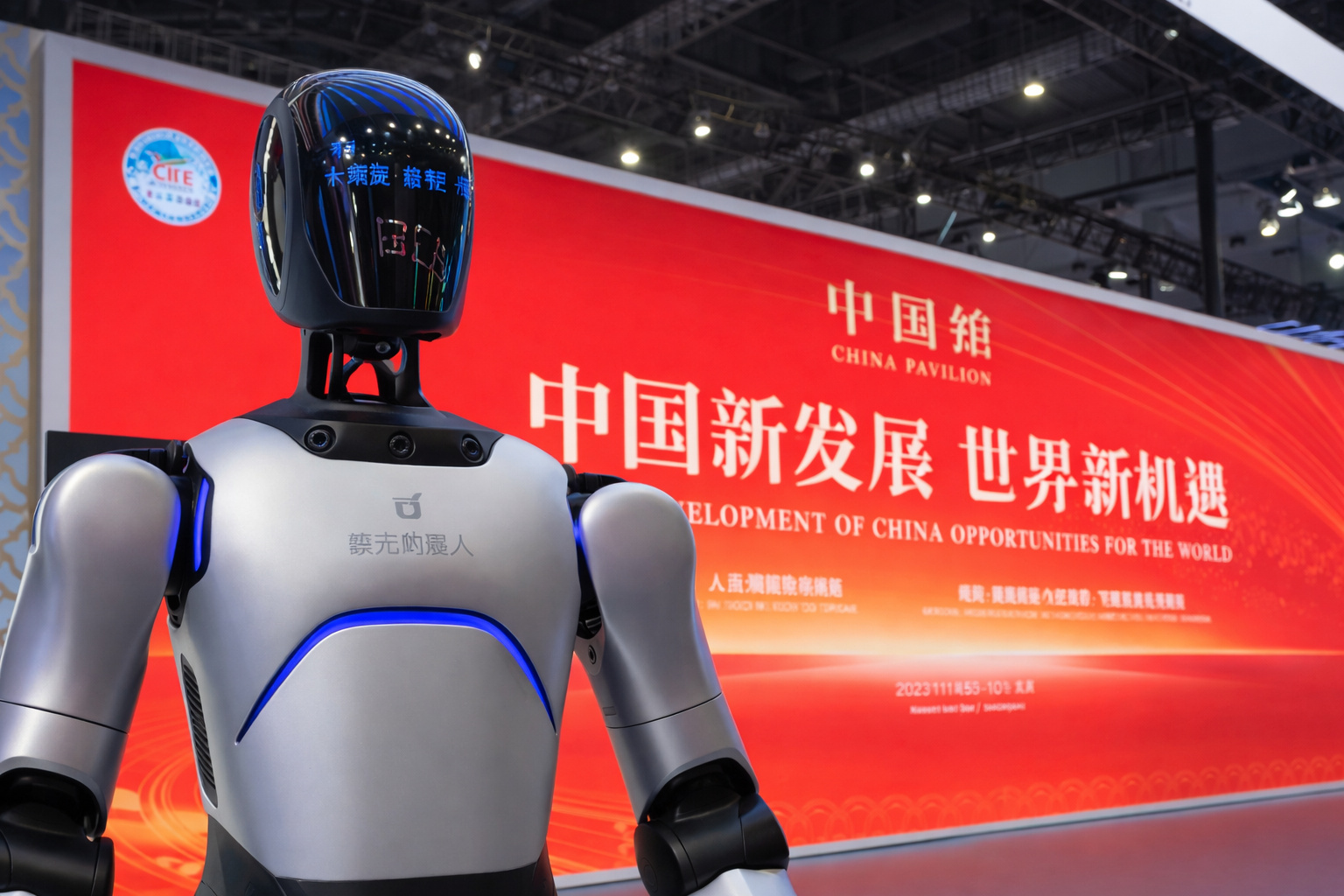
With 13 Thousand Units Sold in 2025 and Prices Starting at US$ 13,500, Chinese Manufacturers Accelerate Development Cycles Thanks to Supply Chains That Deliver Parts in Days, Not Weeks
China already dominates about 90% of the global humanoid robot market. However, contrary to what many believe, this leadership cannot be explained solely by state subsidies or technological copying. In practice, the Chinese differential lies in something more tangible and less ideological: an ultra-dense industrial infrastructure, capable of transforming weeks of waiting into just a few days of execution.
The information was released by the portal “Xataka,” which analyzed the latest numbers in the sector and highlighted the strategic role of logistics in the global robotics race.
During the Chinese New Year, for example, 16 humanoid robots from Unitree danced in front of nearly one billion viewers. The video went viral. Consequently, it reignited the debate: is China winning solely due to state support? Or is there something deeper behind this advancement?
-
Casio Unveils Moflin, Robotic Pet With Artificial Intelligence Designed To Provide Emotional Comfort And Simulate A Permanent Affectionate Bond

-
Google Maps Revolutionizes GPS Navigation With Gemini Artificial Intelligence, Ask Maps Feature, and Advanced 3D Visualization for Route and Travel Planning

-
China Warns the U.S. of a “Terminator” Style Apocalypse: Military AI Rivalry, Sanctions Against American Startup, and Fear of Algorithms Deciding Who Lives or Dies Place the World on the Brink of a Nightmare That Seemed Like Fiction

-
Many Use It Every Day, but Few Know That ChatGPT Has Limitations in Brazil: Users Under 14 Need Authorization, Sensitive Data Should Not Be Entered, and Content May Be Monitored in Specific Cases

90% of the Global Market and Prices That Accelerate Innovation


The numbers are impressive. In 2025, China sent approximately 13 thousand humanoid robots to the market, according to data from the consulting firm Omdia, released by Bloomberg. With this, it solidified its position as the leading global supplier.
Companies like Unitree, UBTech, and AgiBot lead in volume. Meanwhile, Tesla, with its Optimus project, deployed around 800 units internally in the same period. The difference in scale is significant.
In addition to production, the price also draws attention. The Unitree G1 model costs around US$ 13,500. In contrast, the Tesla Optimus is expected to exceed US$ 20 thousand. This difference is not just commercial. On the contrary, it directly influences the pace of development.
With a fixed budget, a Chinese company can test more units, make more mistakes, and fix flaws more frequently. Therefore, each dollar invested generates more learning cycles. And in humanoid robotics, learning quickly means evolving faster.
The Real Ace: Ultra-Dense Industrial Hubs

Although the Chinese government has set clear goals for the robotics sector, the structural advantage goes beyond industrial policy. The center of this transformation lies in the manufacturing hubs of the Pearl River Delta and the Yangtze River Delta.
These regions are among the most densely populated on the planet in terms of manufacturing. Motors, actuators, sensors, custom circuit boards, and tailored components are literally just a few blocks away.
According to engineers who have worked both in China and Silicon Valley, the difference is practical. If a Chinese company needs to test a new robot joint, it can cross the street and get the part almost immediately. In contrast, a startup in California might wait weeks to receive the same component from Asia.
This time difference profoundly alters hardware engineering. After all, developing humanoid robots requires constant trial and error. Prototyping, breaking, analyzing failures, replacing parts, and testing again are all part of the process.
If each cycle takes weeks, progress slows down. If it takes days, progress multiplies. Therefore, the Chinese advantage lies not only in talent; American and Chinese engineers are equally qualified, but in the speed of execution provided by local infrastructure.
In hardware, time is accumulated advantage.
The Role of the State and the West’s Challenge
It is true that the Chinese government has heavily invested in robotics. However, reducing success to industrial policy overlooks structural factors. The United States remains the largest venture capital hub in the world, with decades of experience funding high-risk startups.
If the competition were solely about who has more money, the scenario could be different. However, physical infrastructure cannot be built with financial capital alone. It requires integrated supply chains, logistical coordination, and years of consistent investment.
Moreover, Chinese state capital is not entirely free from pressure. It is often classified as public assets, imposing additional responsibilities on founders in the event of failure. Consequently, part of the resources may be directed to projects considered politically safe rather than necessarily the most disruptive.
Still, the decisive factor remains: the ability to “break and remake” quickly.
In the coming years, the world will see more viral videos of Chinese robots performing tasks with increasing fluidity. However, this is not just marketing. It is about an environment where prototyping, failing, and improving happens at an accelerated pace.
In hardware engineering, this capability explains almost everything. And, for now, China has built the most efficient environment in the world to do exactly this.
Do you believe that logistics can be more decisive than state investment in the global robotics race?










-

-

-

3 pessoas reagiram a isso.