





 Portuguese
  English
  Spanish
  4 min of reading
  0 comments


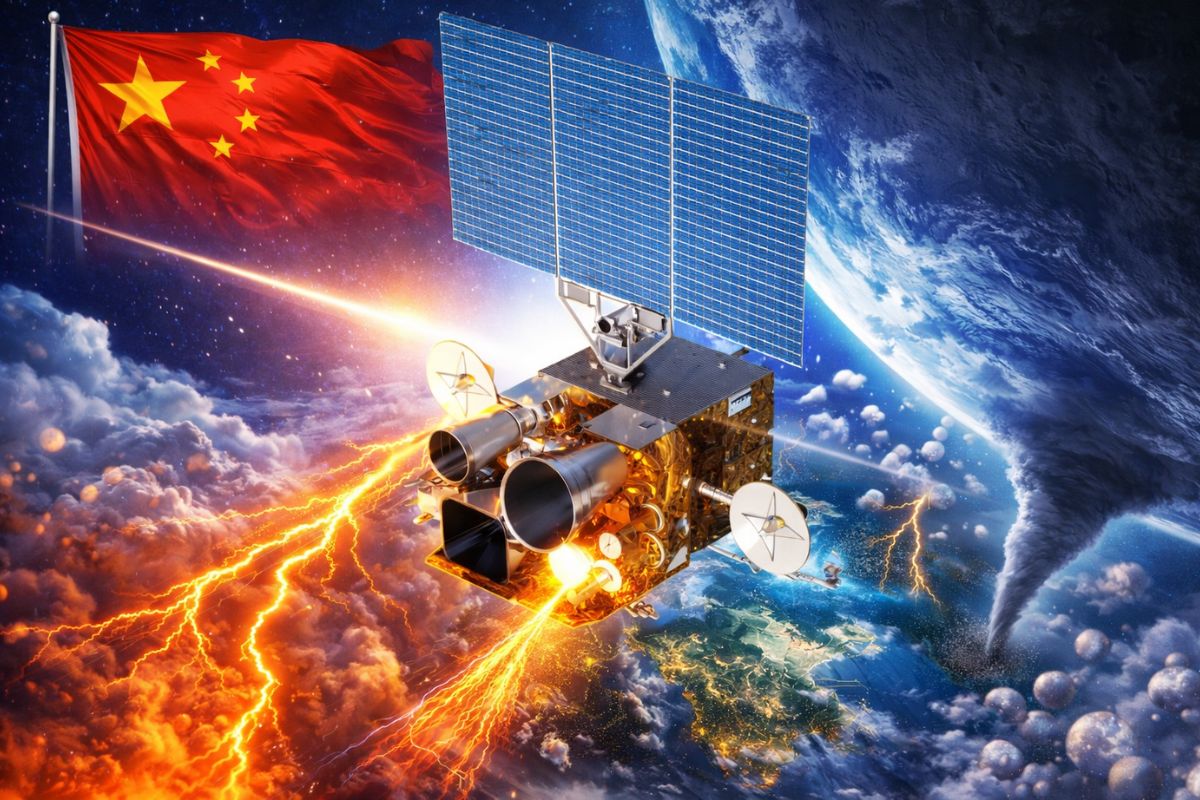
China has released the first images of the Fengyun-4C meteorological satellite, considered the most advanced in the world in observation capacity. With six scientific instruments, a lightning detector, and integration with artificial intelligence, the equipment enhances the accuracy of storm and severe weather predictions.
China has placed the world’s most advanced meteorological satellite, Fengyun-4C, into orbit, equipped with six internationally standardized scientific instruments, a lightning detection system, and integration with artificial intelligence for predicting severe weather phenomena. Launched on December 27 from the Xichang Satellite Launch Center in Sichuan Province, the equipment began its orbital tests in early January and has already transmitted the first images.
The Fengyun-4C meteorological satellite quickly detects phenomena such as storms, tornadoes, hail, and strong winds, issues alerts, and shares data with the international community. The Chinese early warning system MAZU, based on artificial intelligence, analyzes the information captured by the meteorological satellite and generates predictions with accuracy superior to any previous model.
What makes the Fengyun-4C meteorological satellite the most advanced in the world

The Fengyun-4C meteorological satellite stands out for its combination of six scientific instruments mounted on a single geostationary platform. Among them, an imaging sensor produces detailed records of atmospheric conditions, allowing meteorologists to clearly identify different types of clouds, from light rain formations to severe storm cells.
-
In 2028, Earth will cross debris that the Swift-Tuttle comet left in space in 1479, and the world’s most famous meteor shower could turn into a storm of hundreds of shooting stars per hour, a phenomenon that hasn’t occurred since before Columbus arrived in America.

-
Amazon bought a child-sized robot that detects your micro-expressions and knows when you are sad, in a hurry, or ignoring it: the brilliant and frightening strategy to enter your home without you resisting.

-
The digital brain of Brazil’s most advanced fighter jet is from Rio Grande do Sul: a company from the state developed the panoramic display, the helmet visor, and the encrypted communication system that equip the F-39E Gripen produced in the country.

-
Scientists have excavated a giant cave beneath the snow of Antarctica to create a natural refrigerator at minus 50 degrees that operates without electricity and can preserve the Earth’s climate memory for centuries.

Another instrument of the meteorological satellite functions as an atmospheric scanner, measuring temperature across various layers of air and at different altitudes with greater accuracy than previous models.
The ability to map the atmosphere at multiple levels allows for anticipating weather changes hours in advance, a significant advancement for protecting populations in areas vulnerable to extreme weather events.
The lightning detector of the meteorological satellite and storm prediction

One of the most innovative components of the Fengyun-4C meteorological satellite is the lightning detector, capable of recording lightning strikes and tracking storm formation in real-time. This instrument has already mapped atmospheric activity in South Asia, indicating the likelihood of events such as heavy rainfall, storms, strong winds, hail, and tornadoes.
Lightning detection is considered one of the most reliable indicators of severe storm development.
When a meteorological satellite records an increase in the frequency of electrical discharges in a specific region, meteorologists know that the likelihood of violent phenomena in the following hours is high. This information is crucial for issuing early warnings that can save lives.
The artificial intelligence that transforms data from the meteorological satellite into forecasts
The data captured by the Fengyun-4C meteorological satellite is processed by the MAZU system, a Chinese early warning platform based on artificial intelligence.
MAZU analyzes the massive volume of information transmitted by the meteorological satellite and generates forecasts with levels of accuracy that conventional models cannot achieve.
The artificial intelligence identifies complex atmospheric patterns by combining data from multiple instruments simultaneously: cloud images, temperature profiles, electrical activity, and solar radiation.
This integration allows the system to anticipate the formation of tornadoes, hail, and storms with more lead time and more precise location than traditional forecasting methods, representing a technological leap in global meteorology.
The solar radiation sensors of the Fengyun-4C meteorological satellite
In addition to instruments aimed at terrestrial weather, the meteorological satellite has ultraviolet and X-ray sensors that monitor solar activity. These sensors identify solar flares and phenomena in the upper layers of the atmosphere that can affect communication, navigation, and positioning systems on a global scale.
The data collected by the meteorological satellite helps scientists to more accurately predict the impacts of solar activity on Earth’s technological infrastructure.
Intense solar storms can cause failures in communication satellites, electrical grids, and GPS systems, and the ability to monitor these events in real-time is crucial for reducing damage.
China’s climate monitoring system in space
The Fengyun-4C is part of a network of 10 meteorological satellites from the Fengyun series currently in operation, distributed across different types of orbits close to Earth. According to Chen Zhenlin, director of the China Meteorological Administration, the country has built the largest climate monitoring system in the world, with observation on land, at sea, in the air, and in space.
The network of meteorological satellites in China covers everything from geostationary observation, which continuously monitors a fixed region of the planet, to polar orbits that sweep the entire globe with each cycle.
This combination allows the country to monitor climate phenomena at any point on the planet with unprecedented coverage and resolution, consolidating China as a global powerhouse in space meteorology.
The Fengyun-4C meteorological satellite positions China at the forefront of global atmospheric observation with six scientific instruments, a lightning detector, and integrated artificial intelligence.
The ability to predict storms, tornadoes, and hail with greater accuracy than any previous model represents an advancement that can benefit global meteorology.
With information from the portal TV Brics.
What do you think of this advancement by China in space meteorology? Do you believe that artificial intelligence will revolutionize weather forecasting in the coming decades? Leave your opinion in the comments and share with those interested in technology, climate, and space exploration.








Seja o primeiro a reagir!