





 Português
  Inglês
  Espanhol
  4 min de leitura
  0 comentários


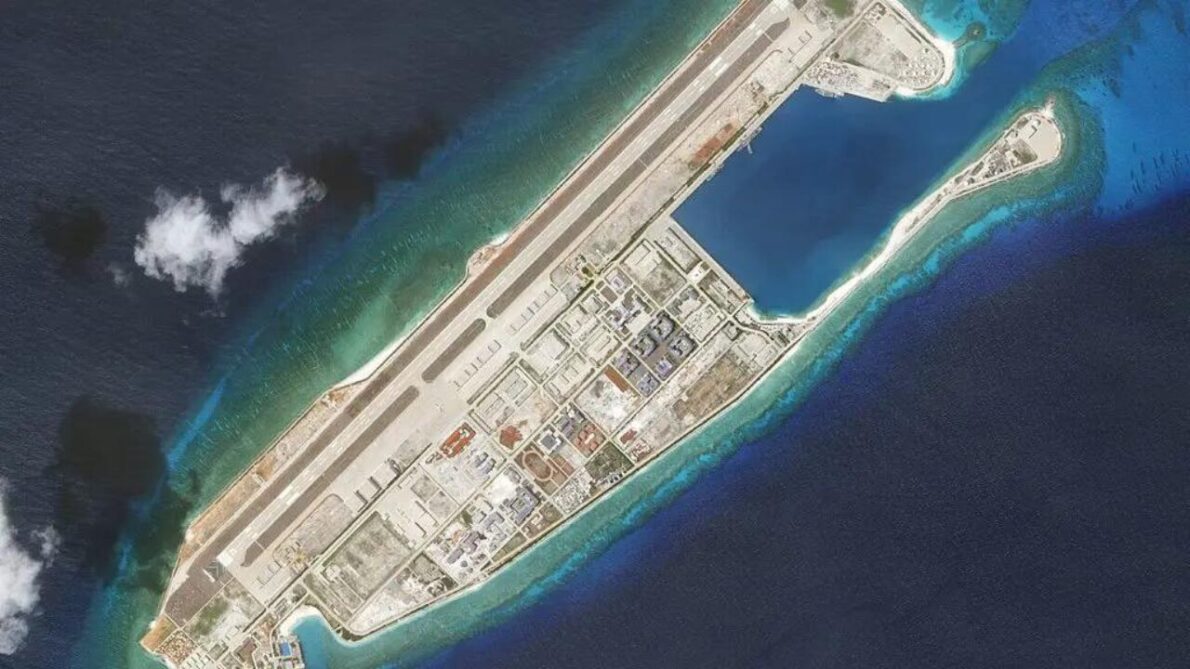
China Wants to Dominate the South China Sea with Floating Nuclear Power Plants to Supply Energy to Military Artificial Islands. Explore How This Strategy Impacts Territorial Disputes and the Response of the United States and Allies.
Authorities fear that nuclear power plants could supply energy to military bases on artificial islands built by China in the region.
China is advancing its plans to develop floating nuclear power plants to supply energy to the military facilities it has built in disputed areas of the South China Sea. The information comes from Newsweek magazine.
Western Pacific Control Strategy
The measure is an important part of Beijing’s strategy to gain control in the Western Pacific, concerning countries such as Indonesia, Malaysia, the Philippines, Taiwan, and Vietnam, with which it competes for a region that is the target of geopolitical disputes and has trade routes with an annual flow of US$ 3.4 trillion.
-
Found in one of the most radioactive places on Earth, this Chernobyl fungus may be doing something with radiation that no one has been able to explain to this day.

-
A bright yellow mushroom imported from Asia escaped from a cultivation farm in the United States in 2010 and is now aggressively spreading across 25 states, destroying entire communities of native fungi in American forests.

-
Buried under China, a colossal machine weighing 20,000 tons began operating as the largest neutrino detector on the planet and, in just 59 days, surpassed results that science took half a century to achieve.

-
Iran enters the center of a climate alert after the war emitted 5.6 million tons of CO2 in two weeks, surpassing the annual pollution of entire countries.


China began building floating nuclear power plants in 2016, with plans to deploy up to 20 of them in the South China Sea. In the same year, an international court deemed China’s constructions in the region illegal. The project was suspended in May 2023 due to safety concerns.
Mobile Nuclear Power Banks
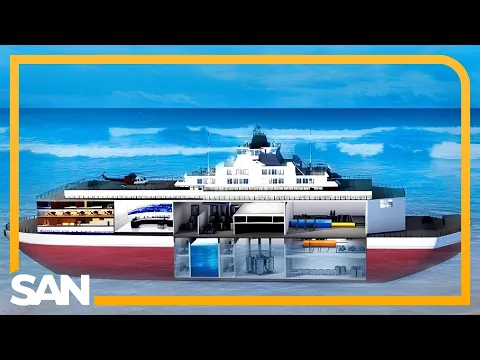
These reactors, known as mobile “power banks”, are small power plants designed to be installed on ships, providing energy to Chinese artificial islands with military infrastructure, such as airports. It is estimated that these reactors operate at about 25% of the capacity of a standard land-based nuclear power plant, and Beijing currently has 37 of these plants.
Amid rising tensions in the South China Sea, researchers from a Chinese think tank supported by the Chinese state highlighted in a 2020 article that these reactors could “ensure the smooth conduct of military exercises.”

International Reactions
The plans have heightened tensions in the region, especially among other nations that also claim parts of the South China Sea, such as the Philippines. Jonathan Malaya, assistant director-general of the Philippine National Security Council, told local media: “Any move that supports military presence on these islands is a threat to our national security and interests.”
Malaya also highlighted that it is expected that the United States and other Western nations, including Australia, will intensify their joint patrols in the South China Sea to counterbalance China’s growing influence.
Safety Guidelines
Amid this situation, the International Atomic Energy Agency (IAEA) advocates for the implementation of strict international guidelines to ensure the safe operation of nuclear reactors in maritime environments.
Liu Pengyu, spokesperson for the Chinese Embassy in Washington, stated to reporters that China is collaborating with ASEAN (Association of Southeast Asian Nations) countries to “promote peace and stability in the South China Sea,” aiming to turn it into “a region of peace, cooperation, and prosperity.” He also pointed out that some countries often use China as “an excuse to reinforce their military activities in the region, seeking to maintain their maritime supremacy.”
Heavily Armed
For nearly a decade, Beijing has been working on building artificial islands on remote atolls and coral reefs in the South China Sea. These islands include ports, runways, barracks, and hangars. Despite a promise made by President Xi Jinping in 2015 that the islands would not be militarized, China has installed anti-ship and anti-aircraft batteries on the largest islands, Subi, Mischief, and Fiery Cross Reefs. Furthermore, China has used these islands to land aircraft and dock warships, which has raised concerns among the U.S. and regional allies.
Russian Floating Nuclear Power Plant
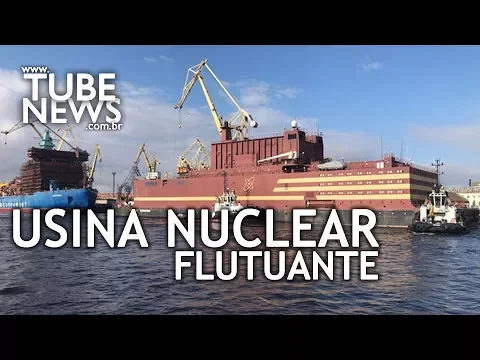
According to The Washington Post, Russia is the only country that has a floating nuclear power plant, called Akademik Lomonosov, which was put into operation in December 2019. Photos of the facility reveal a multi-story plant on an unmanned barge. According to IEEE Spectrum, this facility consists of two KLT-40S pressurized water reactors, similar to those used in Russian nuclear icebreakers, and two steam turbine plants.
Strategic Importance
In the past decade, the South China Sea has been the stage for numerous territorial disputes between China and other Southeast Asian claimants, as well as a geopolitical dispute with the United States over freedom of navigation in contested waters.
The Chinese have expanded their claims over almost the entire South China Sea and have built island bases on coral atolls over the past ten years. Washington responded by sending warships to the region, in what it classifies as “freedom of operation missions.”
Although the U.S. does not have territorial claims in the area, for decades the U.S. government has sent Navy ships and aircraft to patrol, aiming to promote free navigation in international waterways and airspace.







Seja o primeiro a reagir!