





 Portuguese
  English
  Spanish
  5 min of reading
  0 comments


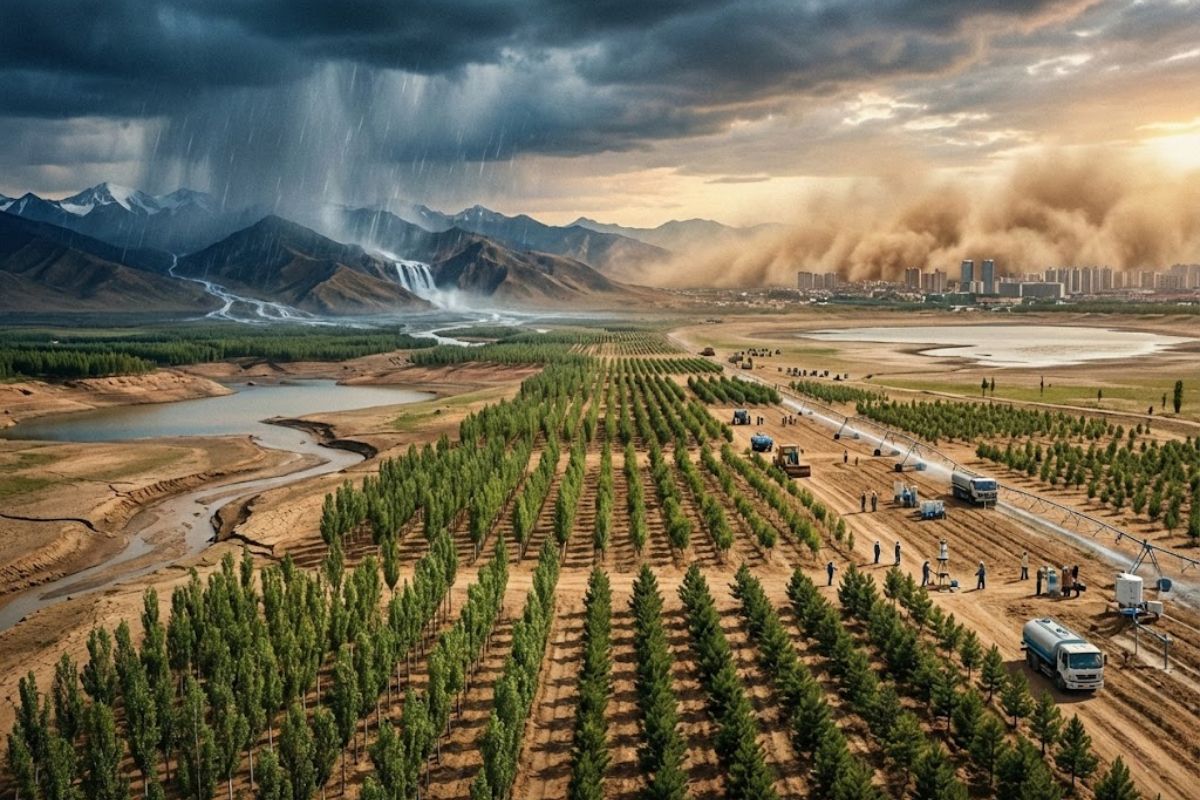
While China Celebrates Greening Between 2001 and 2020, Scientists Reveal That Reforestation Altered the Water Cycle, Dried Regions That Sum 74 Percent of the Territory, Brought Extra Rain to the Tibetan Plateau, and Created a Possible Silent Water Disaster for Millions of Residents in the North and Northwest.
For decades, China has bet on massive reforestation programs to combat desertification, restore degraded areas, and face global warming. A study published in the scientific journal Earth’s Future, with data collected between 2001 and 2020, now shows that this greening changed the way water circulates throughout the country.
The researchers concluded that the new forests intensified evapotranspiration, altered rainfall patterns, and reduced water availability across large parts of Chinese territory. Dry regions in the east and northwest lost water while the Tibetan Plateau began to receive more precipitation, creating a scenario of silent water disaster for millions of people and for agriculture in China.
Greening on an Unprecedented Scale

Image: An et al. (2025) Earth’s Future, Creative Commons CC BY-NC 4.0 SOURCE: UOL
The work led by researcher Arie Staal from Utrecht University analyzed how changes in land cover between 2001 and 2020 altered China’s hydrological cycle.
-
China accelerates global science and may surpass the United States in 2 years with increased public investment, continuous growth, and direct impact on the global technological competition.

-
Scientific studies indicate that drought may be strengthening a much greater silent threat: more resistant superbugs.
-
Man builds functional 5-meter submarine in his garage using gas cylinders, PVC pipes, and a refrigerator motor, and navigates with the vessel on a lake in Colombia.

-
Millions of people have been eating yam for centuries without knowing that this humble tuber contains a compound called diosgenin, which scientists have now discovered can improve memory and help control blood sugar levels.


According to him, the country promoted greening on a massive scale, particularly in areas like the Loess Plateau, where tree planting and the recovery of natural vegetation reactivated the water cycle in regions that were previously extremely degraded.
This process is part of a global movement towards increasing green areas since the early 2000s.
According to the study, China accounts for about 25 percent of the global increase in green area recorded between 2000 and 2017, resulting from aggressive reforestation and pasture recovery policies. Instead of merely stabilizing the soil, these changes began to directly interfere with where and when it rains.
The authors point out that the recycling of atmospheric moisture has become more intense.
In other words, more water evaporates from the surface, travels through the atmosphere, and returns as rain, often in regions different from where it was originally removed from the soil.
It is this silent redistribution that is reshaping the map of water within China.
Evapotranspiration: When the Forest Drinks More Water
The key to understanding the phenomenon lies in evapotranspiration, the process by which plants draw water from the soil and release it in vapor form into the atmosphere.
Both pastures and forests increase evapotranspiration, but trees consume much more water, especially during growth phases, thanks to deep roots that reach underground reserves even during dry periods.
The study shows that, between 2001 and 2020, the average evapotranspiration in China increased by 1.71 millimeters per year.
During the same period, precipitation also increased, but at a slower pace, insufficient to compensate for the extra water consumption by the new forests and restored vegetation areas. The result is a net reduction in water availability on a national scale.
Arie Staal summarizes the paradox: greening intensifies the water cycle, but in many places, more water leaves the land system than returns as rain in the same location. In other words, the surface becomes greener, but the soil drier, especially in regions that were already struggling with water scarcity in China.
74 Percent of China With Less Available Water
The maps presented in the study reveal that the impact of reforestation was not homogeneous. Regions in the east and northwest of China, many of them densely populated or with a strong agricultural presence, saw a consistent decline in water availability. Together, these areas represent approximately 74 percent of Chinese territory, representing a massive shift in the country’s water geography.
The most critical situation was observed in the so-called Northwest Arid Region. According to the authors, this area recorded the greatest decline in water availability, with an average reduction of 1.14 millimeters per year, precisely in one of the zones most vulnerable to drought.
Meanwhile, forests planted in the eastern monsoon region and the recovery of pastures in the northwest significantly increased local water consumption.
Part of the moisture generated in these new ecosystems was carried by winds and ended up precipitating over the Tibetan Plateau, an area known as the “water tower” of Asia for housing the sources of major rivers.
Thus, China is transferring water from already pressured regions to an elevated area, altering the internal water balance without any visible engineering works.
Extra Pressure on Agriculture and Large Water Projects
The alert is even more serious because the natural distribution of water in China is already historically unequal. The northern part of the country concentrates about 46 percent of the population, 60 percent of agricultural land, and only 20 percent of the national water resources.
It is precisely this region that has been affected by water losses associated with greening and changes in land cover.
To reduce this imbalance, the Chinese government has invested in megaprojects for water transfer, such as channels and systems that move water resources from the wet south to the drier north.
The authors of the study warn that these initiatives may fail or become insufficient if they do not take into account the effect of the new forests on the hydrological cycle, since part of the water that would have previously been captured by local rivers is now diverted by the evapotranspiration of trees.
Arie Staal argues that, from the perspective of water resources, each change in land cover needs to be analyzed on a case-by-case basis, considering how much water returns to the surface as rain and in what region this precipitation occurs.
Without this fine-tuning, well-intentioned reforestation programs have the potential to exacerbate water scarcity in strategic agricultural areas of China.
Green China, Planet on Alert
The case of China shows that large reforestation programs cannot be evaluated solely by the expansion of green area or carbon capture.
There are significant climate benefits, but there is a water cost that may fall precisely on rural communities, medium-sized cities, and already vulnerable agricultural belts.
The “green” seen from space hides drier soils in vast portions of the territory.
For scientists, the Chinese experience is a warning for other countries planning large-scale reforestation projects.
Climate, land use, and water management policies need to be integrated, taking into account everything from tree root behavior to the path of clouds that transport moisture.
Given this scenario, do you think China should rethink where it plants its forests to avoid turning an environmental project into a new type of silent water crisis?







-

-

-

-

10 pessoas reagiram a isso.