





 Português
  Inglês
  Espanhol
  7 min de leitura
  2 comentários


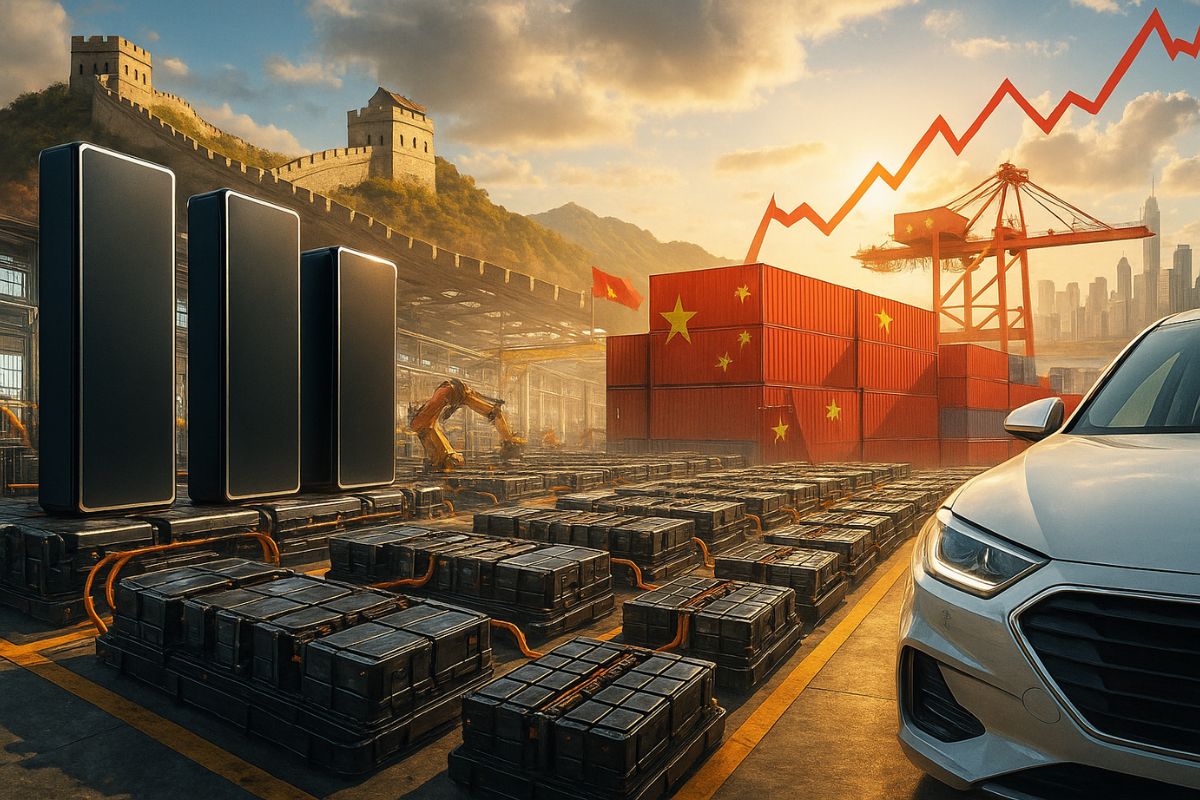


China Consolidated Leadership In Lithium-Ion Batteries By Combining Long-Term Industrial Planning, Internal Market Protection, Massive State Support, Factory Floor Engineering, And A Scale That Rivals Find Hard To Replicate.
China currently dominates battery technology for electric vehicles after more than two decades of strategic investment in a sector that barely existed in the country in the early 2000s. Since 2001, China has used the Olympic Games, aggressive industrial policies, and a carefully protected domestic market to build an industry that produces more than 75% of the world’s lithium-ion batteries. Experts assess that, in the short term, no other country is likely to achieve this level of scale and integration.
According to G1, throughout this process, China won the battery race by dominating production, controlling costs, and shielding its internal market to give time and space to local companies, while creating public policy instruments that required domestic and foreign automakers to use batteries produced in the country. At the center of this strategy are groups like CATL and BYD, which grew from emerging suppliers to global players with strong technological capability and mastery of mass manufacturing.
From Olympic Buses To China’s World Leadership
China’s leap in the lithium-ion battery industry for electric vehicles gained a symbol in 2008, with the Beijing Olympic Games.
-
Brazilian city gains industrial hub for 85 companies that is equivalent to 55 football fields.

-
Peugeot and Citroën factory in Argentina cuts production by half and opens a layoff program for more than 2,000 employees after Brazil drastically reduced purchases of Argentine vehicles.

-
A Brazilian city gains a factory worth R$ 300 million with the capacity to process 200 thousand tons of wheat per year, a mill of 660 tons/day, silos for 42 thousand tons, and an industrial area of 276 thousand m².

-
Havan will leave the shopping mall in Blumenau to inaugurate something that the chain has never done before: a megastore in half-timbered style in the Historic Center of the city, which is expected to be completed in May and change the landscape of local retail.


The fleet of around 50 electric buses powered by lithium-ion batteries was much more than a showcase of a “green Olympics.” It was the first large-scale test of China’s bet on a domestic battery industry for transportation.
The preparation began long before the official opening. In 2001, as soon as Beijing was chosen as the host for the Olympics, government-linked research bodies began mapping the state of the national battery industry.
The diagnosis was clear: China had a “very small” industry, with only two producers of batteries for electric vehicles and a sector still far from the standard of Japan and South Korea.
At that moment, Japan dominated the lithium battery market and South Korea was advancing rapidly. The leadership was in the hands of companies like Sony, Sanyo, Panasonic, and later, Samsung SDI. Meanwhile, China quietly observed and constructed its own long-term plan.
Aggressive Industrial Planning: China Has Been Organizing Since 2006
The institutional turning point came in 2006 when the Chinese cabinet launched a science and technology program for the next 15 years. Among 62 priority areas, China explicitly placed “new energy vehicles” and “rechargeable batteries” at the center of its industrial strategy.
The goal was broader than just selling electric cars. The aim was to elevate the Chinese industry to another level by 2020, replacing the logic of cheap labor with technological competitiveness.
In 2009, after the symbolic success of the Olympic buses, the Chinese government decided to “adjust and revitalize” its automotive industry.
The assessment was that, in the era of combustion engines, China had failed to become a relevant global competitor. However, in electrification, there was still a “blank space,” where everyone was starting practically from scratch.
From that point on, China guided regional governments to assemble supply chains and charging networks for electric vehicles, while supporting domestic companies in research, development, and industrialization.
The “10 Cities and One Thousand Vehicles” program, launched in 2009, brought new energy buses to major urban centers, creating real demand for domestically produced batteries.
Protected Internal Market: China’s Giant Laboratory
The period between 2012 and 2020 was crucial for turning plans into industrial scale. China designed industrial roadmaps with explicit production targets for new energy vehicles, established technical requirements for battery and vehicle manufacturers, and conditioned access to subsidies on compliance with standards set by the state itself.
In 2013, incentives reached the final consumer. China began to directly subsidize the purchase of electric vehicles by individuals, not just by public fleets. In 2014, central and regional governments disbursed around 10 billion yuan in subsidies, and in the following eight years, the country granted tax exemptions totaling 200 billion yuan for new energy vehicles.
The result was immediate: the share of these vehicles jumped from 1.3% in 2015 to 41% in 2024.
The most decisive step, however, was political and regulatory. In 2015, China created a rule that “isolated” its gigantic domestic market in favor of domestic battery manufacturers.
For an electric vehicle to qualify for a subsidy, the automaker needed to use batteries from suppliers included on an official list. All 57 companies were Chinese.
In practice, this meant that Chinese, Korean, Japanese, American, and European automakers that wanted to sell electric vehicles with incentives in China were forced to use batteries from local companies like CATL and BYD.
Foreign manufacturers that had built factories in the country found that the market had closed to them just as demand began to explode.
This move, combined with the “dual credit” system launched in 2017, completed the encirclement. Under the rule, manufacturers were required to produce a minimum number of electric vehicles to compensate for the production of conventional models, under the penalty of facing financial penalties.
China turned its own internal demand into a regulatory lever to push all actors toward national batteries.
Scale, Vertical Integration, And Factory Floor Engineers
With a protected domestic market, billion-dollar subsidies, and mandatory targets, companies like CATL and BYD gained something that their competitors desire today: predictable scale over many years.
CATL, which started as a branch of ATL and became an independent company in 2011, took the world lead in 2017. By 2024, it held about 40% of the global electric vehicle battery market, more than double that of the second-place holder, BYD itself.
China, as a whole, concentrates about 85% of global battery production capacity, compared to only 5% in North America and 7% in Europe.
This leadership is not just a matter of volume. Major Chinese manufacturers have adopted vertical integration models that have allowed them to control mines, process raw materials, produce cells, modules, and packs. By mastering the entire supply chain, they reduced costs, ensured stable supply, and gained room to innovate.
In production engineering, China invested heavily in highly automated factories, with strict process control and real-time testing.
In an automotive battery, hundreds of cells need to be practically identical to ensure range and safety. This consistency requires not only advanced equipment but also a specific profile of professional.
This is where one of the less visible trumps of the Chinese ecosystem comes in: the “practicing engineers,” trained in a system that integrates universities, vocational education, and training within companies.
They are not just lab doctors nor simple line operators. They are technicians and engineers with strong knowledge of the production process and sensitivity to market demands, capable of quickly adjusting designs to reduce costs and improve performance.
BYD illustrates this combination of scale, innovation, and pragmatism with its LFP blade battery launched in 2020.
China used this type of solution to lower technology costs, reduce dependence on inputs like cobalt, and at the same time, improve safety and energy density.
Why The United States, Europe, And Others Fell Behind
While China executed a long-term strategy, the United States and Europe followed a more fragmented path, with cycles of enthusiasm and retreat.
The United States had two significant waves of interest in electric vehicles: in the 1970s, with the oil crisis, and in the 1990s, with air pollution control policies, like California’s ZEV program.
These initiatives encouraged research and development but were not accompanied by consistent market protection and an industrial policy as coordinated as China’s.
In the 2000s, American startups in vehicles and batteries managed to advance, propelled by federal programs. The 2008 financial crisis, however, shut the window on clean energy investments. Many companies went bankrupt or were sold to Chinese groups, as in the case of A123, which was later acquired by Wanxiang.
Europe and Japan maintained strong technology companies but operated within more conservative industrial models, with large consortiums and slower decision-making processes.
In this interval, China capitalized on the combination of a strong state, a giant domestic market, and fierce competition among dozens of companies to accelerate from the prototype phase to mass production.
The Future: Can China Be Overtaken In The Next Generations Of Batteries?
Today, China dominates every stage of the lithium-ion battery chain, from mining to the final pack, and experts believe it to be very difficult for any country to replicate its industrial clusters, vertical integration, and production scale in a short time.
Chinese batteries are cheaper, perform well, and are widely available. This creates a powerful trade barrier, even when the basic technology is within reach of other research centers.
Still, there is a strategic crack where other countries may try to act. Analysts point out that China’s strength lies in making existing technologies better and cheaper, while its relative weakness is in cutting-edge research, especially in paradigm shifts like solid-state batteries.
This new generation, which uses solid electrolyte instead of liquid, could bypass part of the supply chain currently dominated by Chinese companies.
Chinese groups like CATL and BYD are already racing toward this frontier, as are players from South Korea, Japan, and the United States.
Even so, the transition from laboratory to large-scale production requires exactly the type of industrial competence that China has accumulated over the last 20 years.
In practice, this means that even in the next technological wave, countries that want to compete may end up relying on partnerships with Chinese companies to scale their own innovations.
The leadership built through aggressive state support, protected internal market, absurd scale, and applied engineering is likely to continue influencing the board.
In your opinion, at which part of the battery chain do other countries have the most realistic chance to challenge China first: in researching new chemistries, in mining raw materials, or in large-scale factory assembly?









Parem de idolatrar a China.!
Porque o brasileiro sempre acredita em tudo religiosamente?
Povo ignorante e fanático, acredita em qualquer coisa ou mentira e nao tem brilho próprio.
No Ceará avança a passos largos o Jeguim quântico, que rodam em patins elétricos. A China vai levar milênios para atingir os Apps que os Jeguim-Drones que entregam de alfinete a caminhões em poucos segundos os clientes têm experiências não apenas com as entregas, mas também com os relinchos no estilo de forró Afrofrutista de Juazeiro da Bahia, com a verticalização de todas as cadeias e presídios integradas antecipando à dobra do espaço-tempo em bilhões de anos luz.