





 Portuguese
  English
  Spanish
  4 min of reading
  0 comments


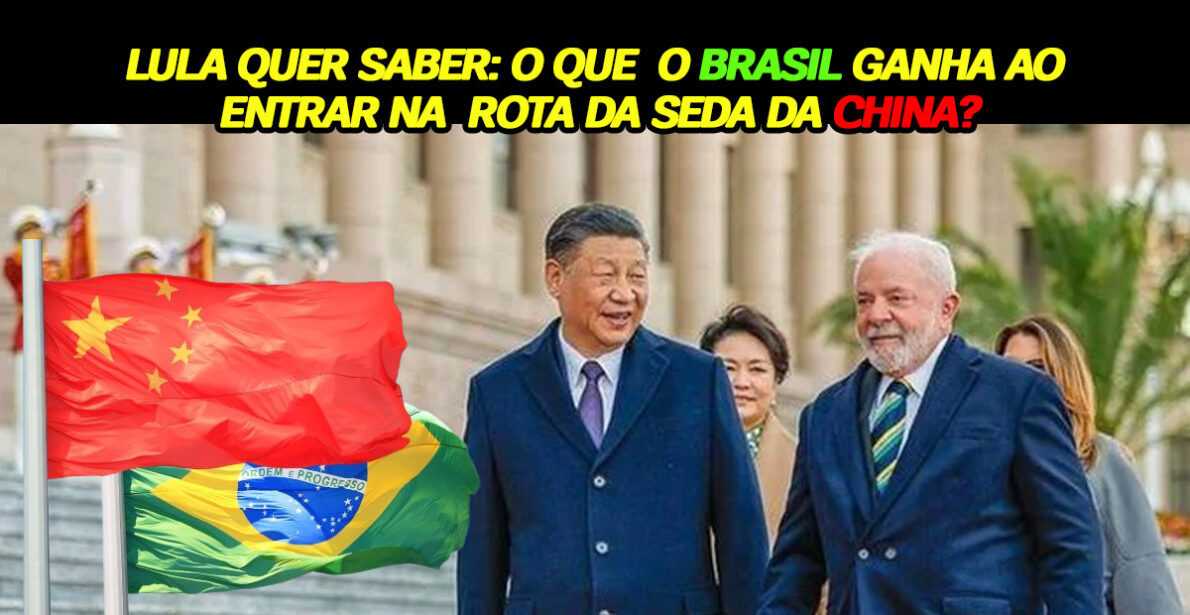
The New Silk Road, an Ambitious Project by China, Promises Trillions in Global Investments, but Brazil Has Yet to Respond. While President Lula Weighs the Benefits, the Asian Country Seeks to Expand Its Influence and Offer Strategic Partnerships. What Is Really at Stake for Brazil? A Decision That Could Define Its Economic Future.
International politics has a new stage, and the spotlight is on a trillion-dollar project that could redefine the course of the global economy. However, the big question hanging in the air is: what will Brazil’s role be in this new configuration?
Recently, China made a tempting invitation to the Brazilian government to join its New Silk Road, a megaproject aimed at connecting the world through trillions in investments.
But while the Asian giant plays its cards, President Lula still seems to be calculating the risks and benefits of this adherence.
-
With an investment of R$ 612 million, a capacity to process 1.2 million liters of milk per day, Piracanjuba inaugurates a mega cheese factory that increases national production, reduces dependence on imports, and repositions Brazil on the global dairy map.

-
Brazilian city gains industrial hub for 85 companies that is equivalent to 55 football fields.

-
Peugeot and Citroën factory in Argentina cuts production by half and opens a layoff program for more than 2,000 employees after Brazil drastically reduced purchases of Argentine vehicles.

-
A Brazilian city gains a factory worth R$ 300 million with the capacity to process 200 thousand tons of wheat per year, a mill of 660 tons/day, silos for 42 thousand tons, and an industrial area of 276 thousand m².

At the center of the negotiations, China exposed its expansion plans during a congress held in the city of Chengdu this September, where it announced its ambition to include Brazil as a strategic partner in the initiative.
The event, which gathered journalists and experts from around the world, served as a platform to strengthen China’s so-called soft power, according to columnist Kennedy Alencar from the UOL portal, who attended the congress at the invitation of the Chinese Communist Party. According to him, the Chinese government is focused on attracting more countries from Latin America, with Brazil being one of its main targets.
What Is the New Silk Road?
Launched in 2013 by President Xi Jinping, the New Silk Road aims to create a huge infrastructure and trade corridor that extends across Asia, Europe, Africa, and now, Latin America.
According to Kennedy Alencar, it is a “belt of mega investments,” capable of financing everything from infrastructure projects to partnerships in strategic sectors, such as energy and transportation.
In return, China seeks to export its knowledge in engineering and technology to participating countries, becoming a global power of influence.
As reported by Alencar, China is already involved in major works in countries like Hungary, building bridges and high-speed trains.
The next step would be to replicate this model in Brazil, offering the expertise of Chinese companies to develop large-scale projects such as hydropower plants and bullet train lines.
But for Lula, the main interest lies elsewhere: improving Brazil’s trade balance and diversifying the products we export to China.


Brazil in Search of Opportunities
China is currently Brazil’s largest trading partner, responsible for importing a vast amount of commodities, such as iron ore and soybeans.
However, President Lula wants more. He seeks to export products with higher added value, as highlighted by Kennedy Alencar.
According to the columnist, Brazil aims to strengthen its industry and diversify its export portfolio, moving away from being just a supplier of raw materials.
The central issue that still keeps the Brazilian government in a wait-and-see mode is understanding what the real benefits of this partnership will be.
Lula, as Alencar highlighted, wants to know what Brazil stands to gain in terms of market and economic growth.
“I want to know what’s in it for us, what we will gain from this,” the president reportedly said, according to Alencar. He is especially keen on partnerships that could open opportunities for the growth of industries like aerospace and beef, where Brazil has significant export potential.
China Wants More from Brazil
If on one hand Brazil sees the New Silk Road as an opportunity for growth, on the other hand, China also has its well-defined interests.
The Chinese want to export engineering services and establish strategic partnerships that include major infrastructure works, such as hydropower plants and railways.
“They want to build bridges, hydropower plants, and bullet trains around the world,” stated Kennedy Alencar. This ambition reflects China’s long-term vision to expand its global influence through investments in infrastructure that increase its presence in emerging economies.
Another aspect mentioned by Alencar is China’s interest in the aerospace sector. The Asian country is heavily investing in this area, and according to the columnist, China may surpass technology giants like Elon Musk in developing space technologies. “At the rate they’re going, they will reach Mars before Elon Musk,” he stated.
What Is at Stake for Brazil’s Future?
Although the Chinese offer seems tempting, it also raises suspicion. Lula wants to ensure that Brazil does not enter this game merely as an understudy, but as a significant player that can gain real advantages in terms of economic growth and industrial development. The partnership with China is seen as an opportunity for growth, but it also requires caution.
As pointed out by Kennedy Alencar, a critical perspective is needed to understand the long-term impacts of this alliance.
While China is undoubtedly one of the engines of global growth, Brazil must evaluate whether the New Silk Road will bring sustainable benefits to its economy or if it will merely be another piece in China’s global influence chessboard.
In any case, the decision to join or not join the New Silk Road is still under analysis by the Brazilian government, but China has already made clear what it desires from this partnership. Now, it is up to Brazil to determine if the benefits outweigh the risks involved.
Will this alliance be the path for the country to diversify its exports and strengthen its economy? Or just another diplomatic trap? Brazil’s economic future may hang in the balance, and Lula faces a crucial decision ahead.






Seja o primeiro a reagir!