





 Portuguese
  English
  Spanish
  6 min of reading
  0 comments


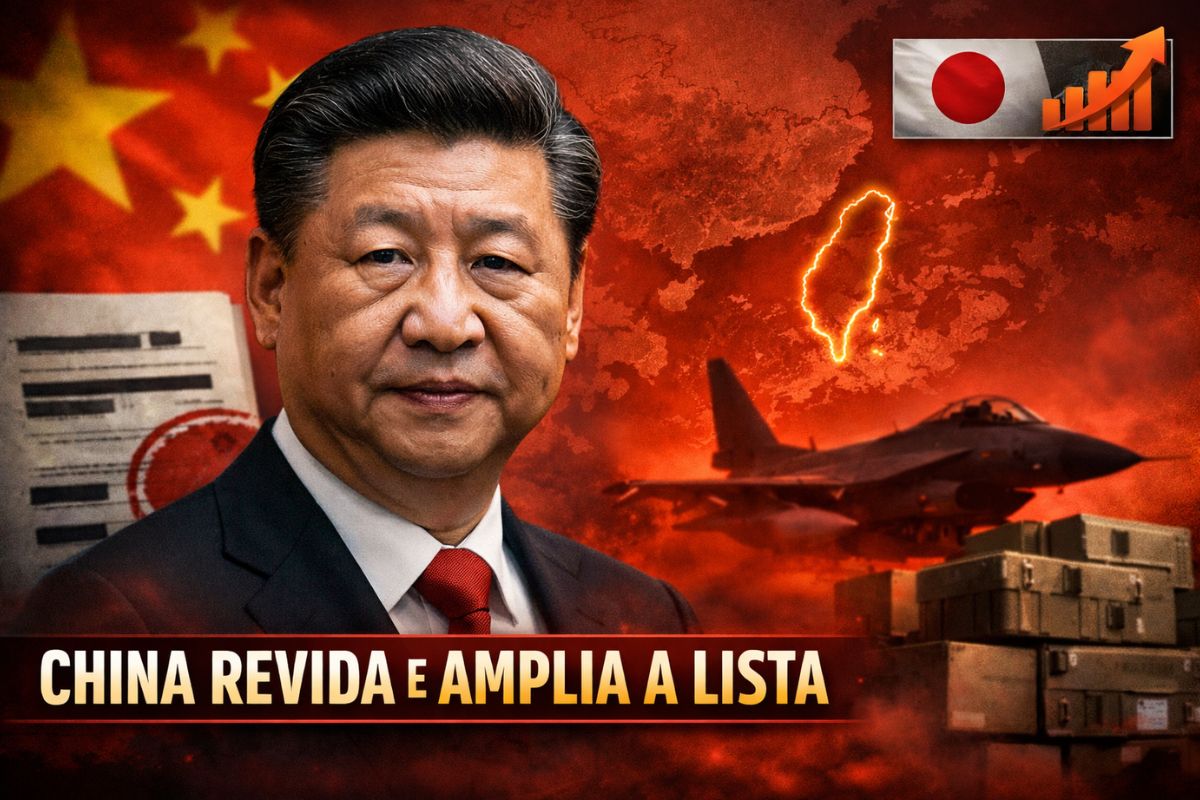
In The Week Following The Announcement Of The Sale, China Freezes Assets Of 20 Companies And 10 Executives Linked To The US Defense Sector, While Japan Announces A Military Budget Of 9 Trillion Yen For 2026, Above The Previous Record And Seen In Beijing As A Worrying Signal Today
On December 26, 2025, China announced sanctions against around 20 companies and 10 executives from the United States, in direct response to the package of about 11 billion dollars in arms approved by Washington for Taiwan the week before. Beijing accuses the US of crossing the “red line” by militarily reinforcing the island it considers part of its territory, despite the official US policy of recognizing only one China.
On the same day, Tokyo presented a record military budget for the fiscal year 2026, estimated at around 9 trillion yen, surpassing the 2024 defense plan and putting Japan on an accelerated trajectory to bolster its military capabilities. For analysts in the region, the simultaneous moves by China, the United States, and Japan deepen the tension in the Indo-Pacific and reopen debates on an arms race surrounding the Taiwan Strait.
China’s Sanctions Target Companies Linked To The US Military Complex

According to the details presented by the Ministry of Foreign Affairs in Beijing, China’s sanctions primarily target American companies linked to the defense sector, including subsidiaries of major industrial groups that also operate in commercial aviation and technology.
-
A new Brazilian shopping center worth R$ 400 million will be built in an area equivalent to more than 4 football fields, featuring 90 stores, 5 cinemas, a supermarket, a college, and parking for 1,700 cars, potentially generating 3,000 jobs.

-
Larger than entire cities in Brazil: BYD is building a 4.6 km² complex in Bahia with a capacity for 600,000 vehicles per year, but the discovery of 163 workers in conditions analogous to slavery has shaken the entire project.

-
With an investment of R$ 612 million, a capacity to process 1.2 million liters of milk per day, Piracanjuba inaugurates a mega cheese factory that increases national production, reduces dependence on imports, and repositions Brazil on the global dairy map.

-
Brazilian city gains industrial hub for 85 companies that is equivalent to 55 football fields.


The assets of these companies in Chinese territory are frozen, and new negotiations with Chinese entities are prohibited for the duration of the measure.
On an individual basis, the approximately 10 executives mentioned also enter a list of personal restrictions: in practice, everything they own in China, from real estate to investments, is blocked, and visas may be canceled.
Beijing seeks to signal that by supplying arms to Taiwan, officials and companies are not operating in a political vacuum, but are assuming direct risk in one of the largest markets in the world.
Dependence On Chinese Inputs And Potential Effect On The Defense Sector

China’s response is described as “non-military,” but has the potential to impact the industrial base that supports American military power.
The sanctioned companies depend on inputs ranging from electronic components to rare earth metals, areas in which the Asian country holds a dominant position in global supply.
By restricting access to this market, Beijing opens a pressure front on the supply chain of US arms manufacturers.
The Chinese government’s calculation is based on the internal strategic question: to what extent does it make sense to continue supplying material that, transformed into weapons, can be sold to Taiwan or used in future confrontation scenarios against China itself.
This end-of-year decision is seen as the first step toward a possible gradual hardening, should Washington maintain the pace of military sales authorizations to the island.
Arms Sales To Taiwan Revives Dispute Over “One China”

China’s reaction is directly linked to the package of about 11 billion dollars in arms announced by Washington for Taiwan.
The American justification relies on interpretations of the post-World War II arrangement, when the San Francisco Treaty redrew the Asian map without unequivocally defining the island’s status.
Since then, the United States claims to recognize only one China but maintains legal space to justify supplying arms to Taipei.
For Beijing, however, the reading is simple: any military reinforcement of Taiwan, especially amid talks of autonomy, is seen as direct interference in its internal affairs.
Therefore, the spokesperson for the Ministry of Foreign Affairs again accused Washington of “provocation” and of “crossing the red line,” a recurring expression in Chinese diplomacy regarding sovereignty and territorial integrity.
Japan Announces Record Military Spending In 2026
While China responds with economic sanctions, Japan moves another sensitive piece on the regional board.
On December 26, the Japanese government released a defense budget for 2026 that exceeds the 2024 record, surpassing 9 trillion yen, an amount estimated at just over 50 billion dollars.
This is the largest recent expansion of the Japanese Self-Defense Forces since the adoption of the post-war pacifist constitution.
The plan includes strengthening missile defense systems, modernization of naval assets, and acquisition of cutting-edge technology, in line with recent statements by Japanese politicians advocating a more assertive stance towards China and North Korea.
In parliamentary debates, government allies even floated the possibility of progressing towards nuclear capabilities, a hypothesis publicly rejected by China, South Korea, and Russia as “dangerous” and destabilizing.
Memory Of War And Regional Resistance To Japanese Remilitarization
China’s reaction to discussions of Japanese rearmament is not only present but also historical.
Beijing repeatedly reminds that during World War II, the Japanese occupation left over 25 million Chinese dead, including massacres like Nanjing, with hundreds of thousands of victims in a matter of weeks, and that the East Asian region still carries living memories of these aggressions.
In this context, Chinese authorities argue that any movement bringing Japan closer to a full military power profile reopens unhealed wounds.
The criticism is shared by parts of public opinion in South Korea and by political sectors in Russia, which view with suspicion the combination of increased Japanese military budget, nationalist discourse, and explicit support from the United States.
American Bases, Containment Rhetoric, And Chinese View Of The Indo-Pacific
The new arms package for Taiwan and the increase in Japanese spending occur in a scenario where the United States maintains tens of thousands of troops stationed in Japan and South Korea, in addition to a network of bases and ships in the Pacific.
From China’s perspective, this arrangement is presented as a containment strategy that surrounds the country with hostile military alliances.
Beijing, for its part, asserts in its official discourses that it does not seek to invade neighbors and favors conflict resolution through dialogue, citing the UN Charter as a reference.
At the same time, it makes it clear that it considers Taiwan an internal issue and affirms that it has military means to react if it deems its territorial integrity threatened, although it repeats that this path would be a “last resort” in extreme scenarios.
Slow Escalation Or Calculated Pressure
The combination of China’s economic sanctions, Japan’s military expansion, and billion-dollar arms sales from the US to Taiwan constitutes a picture of cross-pressure in the Indo-Pacific.
For the Chinese government, the use of financial and commercial measures is a way to signal strategic cost without immediately resorting to military responses.
For Washington and Tokyo, the official argument is that strengthening defense capabilities serves to “deter” Chinese actions regarding Taiwan.
In the midst of this narrative dispute, the risk of miscalculation increases: each new record budget, arms package, or round of sanctions heightens the possibility of incidents and misunderstandings in a region that concentrates vital maritime routes for the global economy.
The line between calibrated pressure and uncontrolled escalation remains thin and largely depends on the ability of China, the United States, and Japan to keep dialogue channels open.
In light of this scenario of China’s sanctions, arms for Taiwan, and Japan’s record military spending in 2026, do you believe the Indo-Pacific is heading towards a new arms race, or is there still real space to curb this diplomatic escalation?









-

-

-

-

-

10 pessoas reagiram a isso.