





 Portuguese
  English
  Spanish
  3 min of reading
  0 comments


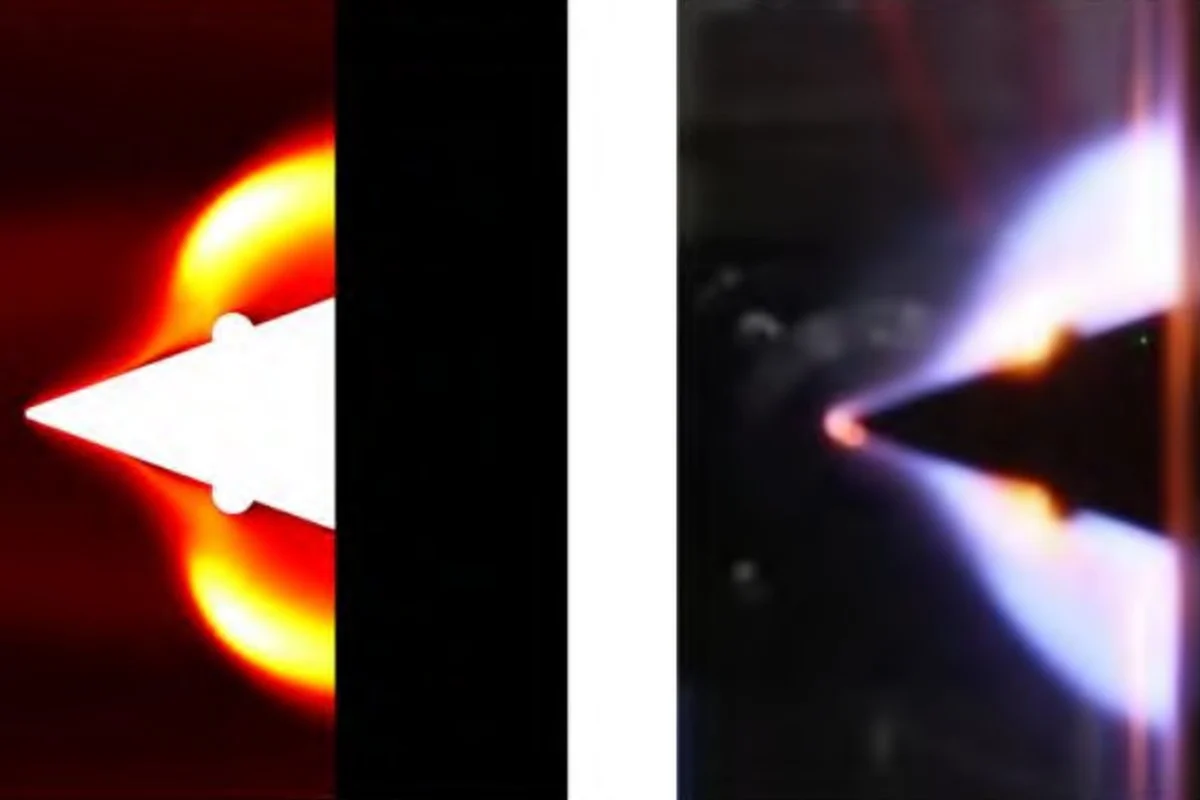
Chinese Researchers Successfully Test Hypersonic Engine Based on US Cold War Technology, Reigniting Race for Advancements in High-Speed Propulsion.
A team of Chinese scientists has completed an experiment considered a milestone in the development of hypersonic engines. This involves a hypersonic engine inspired by American technology.
Based on a concept set aside by the United States since the Cold War, the researchers were able to sustain a detonation for more than two seconds in an engine that could eventually propel jets at up to 16 times the speed of sound.
Sustained Detonation in New Test
The experiment was conducted by scientists from the Chinese Academy of Launch Vehicle Technology (CALT) and Northwestern Polytechnical University.
-
Motorola launched the Signature with a gold seal from DxOMark, tying with the iPhone 17 Pro in camera performance, Snapdragon 8 Gen 5 that surpassed 3 million in benchmarks, and a zoom that impresses even at night.

-
Satellites reveal beneath the Sahara a giant river buried for thousands of kilometers: study shows that the largest hot desert on the planet was once traversed by a river system comparable to the largest on Earth.

-
Scientists have captured something never seen in space: newly born stars are creating gigantic rings of light a thousand times larger than the distance between the Earth and the Sun, and this changes everything we knew about stellar birth.

-
Geologists find traces of a continent that disappeared 155 million years ago after separating from Australia and reveal that it did not sink, but broke into fragments scattered across Southeast Asia.

Both centers are recognized for their work in aerospace projects. The tested engine was based on the concept of oblique detonation, known by the acronym ODE.
The innovation is that this type of propulsion operates without moving parts and can achieve hypersonic speeds.
The test used RP-3 aviation kerosene, similar to the JP-8 fuel used by the US military. The scientists simulated a flight at Mach 8 at an altitude of 30 kilometers.
High-speed cameras recorded the continuous detonation for 2.2 seconds. The experiment was published on May 6 in the Journal of Aerospace Power and reported by the South China Morning Post.
Common Fuel and Measurable Thrust
During the test, a central injector fired RP-3 through four 0.3 mm wide nozzles in a supersonic airflow.
A wedge with a 20-degree angle and 2 mm protrusions helped initiate the detonation. The engine then produced white-blue flame fronts, followed by yellow zones, indicative of partial combustion. Sensors detected a pressure peak of 272 kilopascals after the detonation — more than 10 times the previous pressure.
Computer simulations with a ten-step chemical model yielded similar results to the real data, indicating significant thrust generation.
According to the lead researcher, Yang Yang, the combustion zone maintained stability throughout the test.
Reapproach to Old American Project
The ODE concept was proposed in 1958 by researchers at the University of Michigan, with support from the US Air Force.
In the 1970s, NASA studied the feasibility of the system, considering speeds between Mach 6 and Mach 16. However, technical difficulties led to the project being set aside.
The main limitation was maintaining stable detonation and controlling the air-fuel mixture under extreme conditions.
The recent Chinese research shows significant advancements, but challenges remain. Only 39% of the combustion chamber height effectively received fuel.
The external flow was weak, and pressure variation caused instability. The scientists suggest adjustments to the design, such as more efficient injectors and longer mixing channels.
Military and Civilian Interest
The involvement of CALT in the project shows that the Chinese government intends to transform the technology into something applicable. The agency is already responsible for the Long March rocket program and hypersonic vehicles used in military tests.
According to Chinese military publications, the oblique detonation engine may be used in the future for long-range guided munitions.
The idea would be to extend the range of artillery projectiles, currently limited by lack of propulsion.
Besides military uses, ODE propulsion is also seen as an alternative for hypersonic transport.
However, these applications are still expected to take years to reach the civilian sector. For now, the advancement represents a step forward in the global race for technology, initiated by the United States but now led by China.








Seja o primeiro a reagir!