





 Português
  Inglês
  Espanhol
  3 min de leitura
  0 comentários


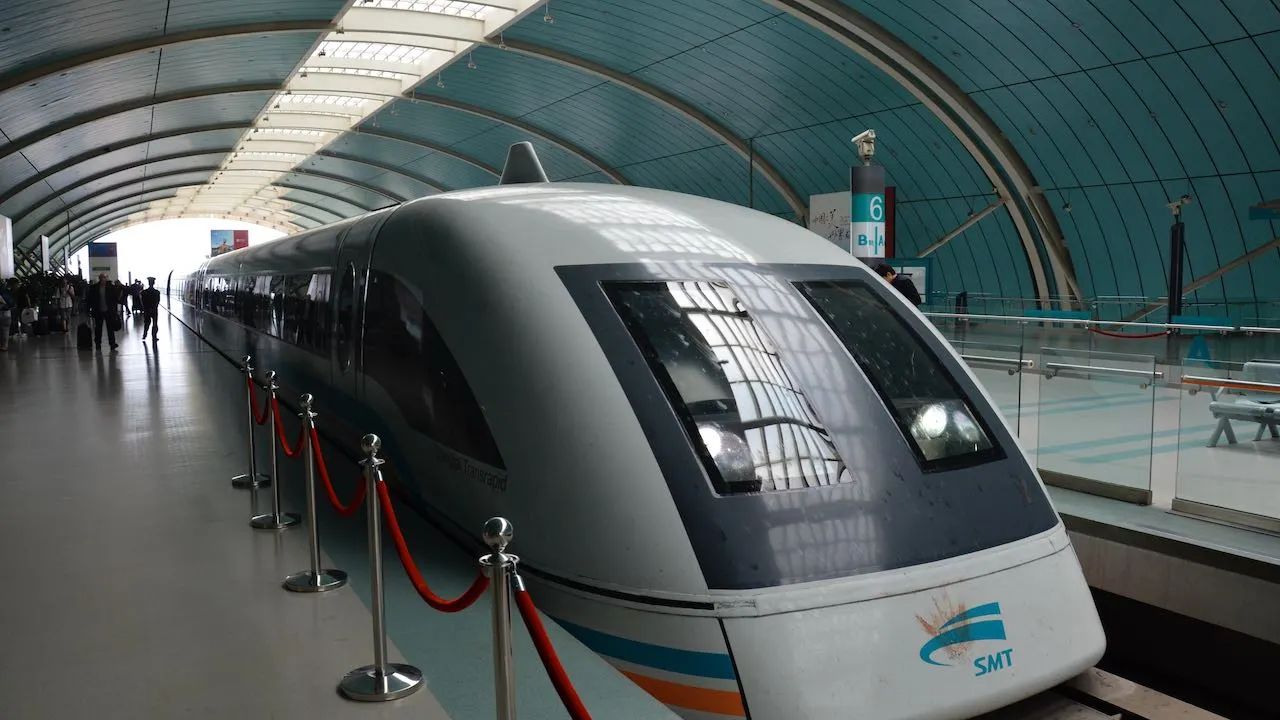
With Magnetic Levitation Technology and Vacuum Tunnels, China’s New Flying Train Has Already Surpassed 623 km/h in Tests and Promises to Reach 1,000 km/h, Outpacing Commercial Airplanes and Changing the Future of Travel!
Have you ever imagined taking a train and traveling faster than a commercial airplane? In China, this is already becoming a reality. The country is heavily investing in revolutionary technology: a flying train that uses magnetic levitation (maglev) and travels within almost airless tunnels to achieve insane speeds of up to 1,000 km/h.
The idea is not just to break speed records, but to completely change the way we move. And if you think this is still far off, there are already tests happening, and the initial results are jaw-dropping!
What Is the Flying Train and How Does It Work?

Unlike conventional trains that run on tracks and suffer from friction, the flying train simply floats above the tracks using maglev technology. But how is this possible?
-
A bright yellow mushroom imported from Asia escaped from a cultivation farm in the United States in 2010 and is now aggressively spreading across 25 states, destroying entire communities of native fungi in American forests.

-
Buried under China, a colossal machine weighing 20,000 tons began operating as the largest neutrino detector on the planet and, in just 59 days, surpassed results that science took half a century to achieve.

-
Iran enters the center of a climate alert after the war emitted 5.6 million tons of CO2 in two weeks, surpassing the annual pollution of entire countries.

-
Lunar exploration may change after a Chinese probe finds a “cavity” of radiation that reduces the impact on astronauts by up to 20% at certain times on the Moon.


Well, it works with superconductors that generate a super powerful magnetic field, making the train levitate. And how does it move? Simple: magnetic propulsion. This means the train never touches the tracks, eliminating almost all friction and allowing it to reach absurd speeds.
And there’s more: it won’t run on regular tracks, but rather inside low-pressure tunnels, practically in a vacuum. This further reduces air resistance, allowing the train to glide almost effortlessly. The result? A rocket on tracks!
Tests and Advances in China
If you think all of this is still on paper, think again! China is already testing this technology. In August 2024, one of these superconducting trains was tested in Shanxi province and achieved stable levitation and complete navigation control.
The exact speed details of this test were not disclosed, but the CF600-0001 model, designed for 600 km/h, has already surpassed 623 km/h in initial experiments. And the best part: the test tunnel is two kilometers long and was built exclusively for this new generation of maglev trains.
If everything goes as planned, China aims to reach the mark of 1,000 km/h, making the flying train the fastest land transport in the world.
And it doesn’t stop there! China already has other super-fast train projects in operation, such as the CR450, designed for 450 km/h, and the famous maglev train in Shanghai, which reaches 431 km/h connecting Pudong Airport to the city center. But this new technology promises to be a giant leap from all of this!
The Future of Maglev Technology and Billion-Dollar Investments
Of course, such an ambitious project doesn’t come cheap. But apparently, money is not an issue for China. According to China Railway, the government is set to invest over R$ 492.88 billion in the development of the flying train in the coming years.
So what would the first route of this super train be? One of the possibilities raised is between Hangzhou and Shanghai, drastically reducing travel time between these strategic cities. Imagine leaving one city and arriving in another in under 20 minutes?
If technology continues to advance at its current pace, it wouldn’t be surprising to see these trains operating commercially in less than a decade.







-

-

-

-

8 pessoas reagiram a isso.