





 Portuguese
  English
  Spanish
  3 min of reading
  0 comments


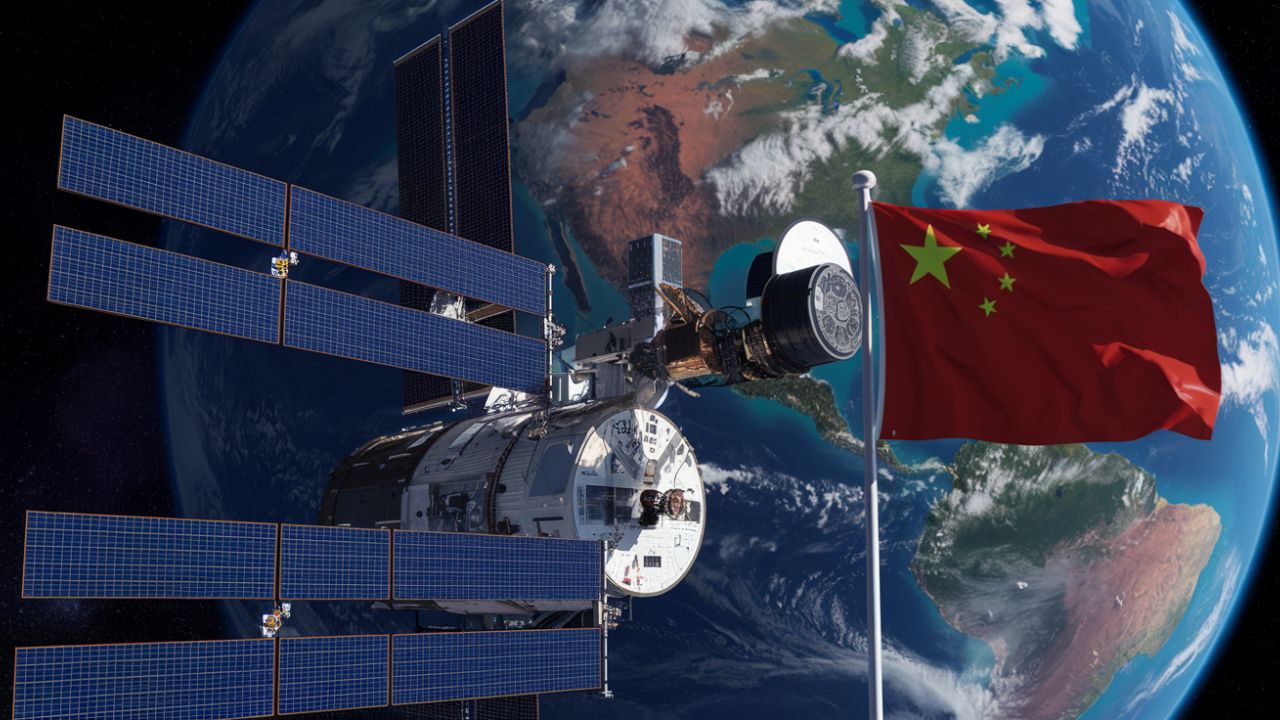
With A Projected Capacity Of 2 GW, China Aims To Revolutionize Renewable Energy Generation By Capturing Solar Light Directly From Space And Transmitting It To Earth Using Microwave And Laser Technology.
Have you ever imagined getting solar energy 24 hours a day, free from weather interruptions? That’s exactly what China is planning. The idea may sound like something out of a science fiction movie, but the Asian country has set a date to begin the largest space engineering project ever proposed: a solar space station 36,000 km from Earth.
The goal? To transform solar energy captured in space into usable electricity on Earth, revolutionizing the global energy sector. And all of this could be a reality within this decade. Let’s explore how China is leading this new space race.
What Is China’s Solar Space Station?
The solar space station is a giant power plant that will be in geostationary orbit. The difference? Up in space, solar panels can capture energy all the time, without relying on weather conditions or the day-night cycle. This energy would be sent to Earth via beams of microwaves or lasers.
-
Millions of people have been eating yam for centuries without knowing that this humble tuber contains a compound called diosgenin, which scientists have now discovered can improve memory and help control blood sugar levels.

-
Scientists from an international project drill 1,800 meters of ice in Antarctica using hot water and discover details about one of the most intriguing places on planet Earth.

-
Seen from space, a colossal volcano nearly 5,000 meters high in Russia has released 1,600 km of smoke over the Pacific, forming “devil’s horns” of lava and revealing the brutal force of the Ring of Fire.

-
Expedition 501: Scientists drill into the ocean floor and discover a giant reserve of fresh water hidden beneath the sea, extracting nearly 50,000 liters and revealing an invisible system that could reshape the map of water scarcity.


While it may seem like a mini version of the famous Dyson Sphere, a concept that would capture all the energy of a star, the Chinese idea is much more practical and feasible in the short term.
China’s Ambition
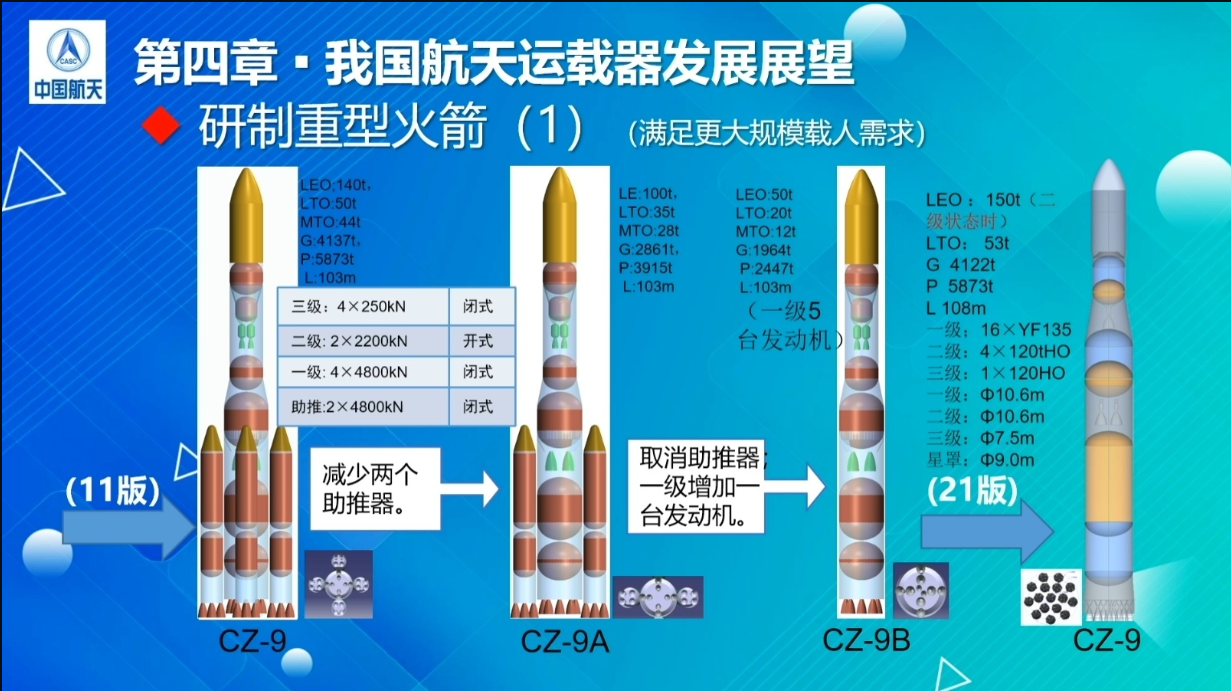
Ten years ago, when China announced this project, it seemed just another theoretical study. But the country proved it wasn’t kidding by setting clear goals and surprising other nations.
The timeline is ambitious:
- 2030: Launch of the first prototype with 500 kW of power.
- 2035: A larger version capable of generating 20 MW.
- 2050: A fully operational station with 2 GW of capacity.
This means dozens, perhaps hundreds, of launches and the assembly of thousands of solar panels in space. For this, China is betting on its CZ-9 rocket, fully reusable, which will be crucial for cost viability.
How Does The Solar Space Station Work?
Did you know that in geostationary orbit, solar panels can be up to 50% more efficient than on Earth? That’s what China intends to explore. The station will feature giant panels that will function like sunflowers, always facing the Sun.
The captured energy will be transmitted to Earth through microwaves or lasers. Imagine a magnifying glass focusing sunlight onto a single point: this is how the energy beam will be directed to receiving antennas on the ground. This technology has already been tested on a small scale by other countries, but never over such distances.
Challenges And Technology Involved
As promising as it is, the project faces enormous challenges. To begin with, building a station of this scale in space will require hundreds of launches, and each one must be extremely efficient. This is where the CZ-9 rocket comes in, designed to be reusable and reduce operational costs.
Another challenge is the safety of wireless transmission. Could the energy sent by microwaves or lasers affect airplanes or satellites? This is one of the questions scientists are trying to answer with prototypes and tests.
The Global Impact Of The Space Race For Solar Energy
If it works, China’s solar space station could mark the beginning of a new energy era. China is already a leader in photovoltaic energy on Earth, but now it wants to expand its dominance to space.
Other countries, such as Japan, the USA, and Europe, are also eyeing this market. In 2015, Japan managed to transmit 1.8 kW of energy using microwaves, but only 50 meters away. China, on the other hand, is planning to do this at 36,000 km.








-

Uma pessoa reagiu a isso.