





 Portuguese
  English
  Spanish
  5 min of reading
  1 comment


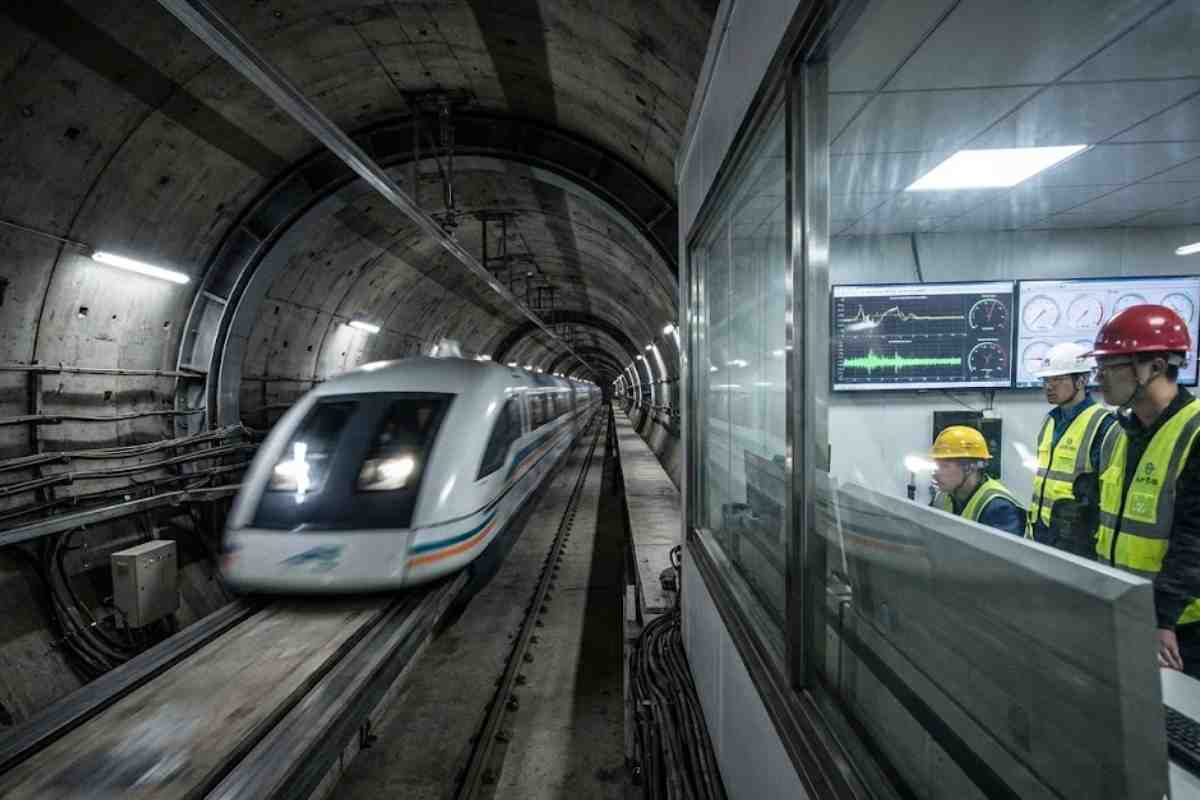


After Validated Record of 623 km/h in 2024, CASIC Took Its Magnetic Bullet Train to 650 km/h in Seven Seconds in a 1 km Low-Pressure Tube. The Goal Is 800 km/h in 2025, Before Expanding the Track to 60 km and Seeking 1,000 km/h in the First Phase.
In 2008, during the Beijing Olympics, China had only 120 kilometers of high-speed rail between Beijing and Tianjin, but seventeen years later, in 2025, it already operates more kilometers than any other country and is now accelerating a magnetic bullet train in a vacuum tube with a declared goal of 4,000 km/h.
The T-Flight project was announced in August 2017 by CASIC and, after a validated record of 623 km/h in 2024, the prototype reached 650 km/h in seven seconds in a controlled low-pressure environment on a track of just 1 km, exposing the main obstacle: keeping hundreds of kilometers of sealed tubes without decompression failures.
From Traditional High Speed to Technological Jump
The Chinese trajectory in rapid trains is described as a scale change. In 2008, there were 120 km of high-speed rail between Beijing and Tianjin.
-
New CCR concrete paving technology promises roads up to 3x more durable, less maintenance, and cost reduction in Brazil.

-
Made from recycled plastic, plastic wood is gaining space in the construction industry because it does not rot, resists moisture, and reduces maintenance costs over the years.

-
Florianópolis will receive a million-dollar BRT that will begin construction in 2026 with nearly 400 million in funding from the federal government and the Inter-American Development Bank, and the map already shows the routes for the exclusive bus corridors.
-
Without a blueprint, without an engineer, and using scrap from the dump, a father spends 15 years building an 18-room castle for his daughter, featuring tram tracks, 13 fireplaces, and over 700 m², which may now be demolished.


Seventeen years later, the network has grown to surpass any other in the world, and the strategy is no longer just to connect the territory but to test technologies that reduce the need for airplanes.
This objective appears in the investment in solutions that go beyond the high-speed standard.
While 250 km/h is cited as an established threshold, China wants to push the limit with the magnetic bullet train and systems that minimize two classic barriers: friction and air resistance.
What Is Maglev and Why It Changes the Game
Maglev is the magnetic levitation train: instead of resting on the tracks, it “floats” with powerful magnets and an electromagnetic field.
Without direct wheel-track contact, physical friction drops drastically, which opens up space for speeds far above the standard.
The basis points out that China already operates the fastest Maglev in the world, reaching 431 km/h and linking Beijing to Shanghai.
In parallel, Japan is testing a model that would exceed 600 km/h. Even so, these figures are treated as slow when compared to the ambition of T-Flight, a magnetic bullet train designed to enter supersonic territory.
Maglev + Vacuum Tube in Hyperloop Style


The difference of T-Flight is combining magnetic levitation with a vacuum tube, “in Hyperloop style.”
The logic is straightforward: putting the train inside a low-pressure environment to minimize aerodynamic drag, one of the factors that most “holds back” vehicles at extreme speeds.
The tube would have a system for removing air and maintaining a partial vacuum. At the same time, magnetic levitation eliminates contact friction.
This combination, according to the basis, is what would allow unprecedented speeds for a magnetic bullet train.
The Role of Superconductors and the Gain in Stability
Besides the tube, the plan includes reinforcing levitation with superconductors. The proposal is to lift the train up to 100 mm above the track, while conventional Maglevs elevate about 10 mm.
The justification is stability: the greater the gap, the greater the stability at extreme speeds, reducing the sensitivity of the system to micro-variations and irregularities that, at high speeds, become major issues.
Test Results and Why 1 km Already Says a Lot
CASIC would have achieved in 2024 a first validated test as a world record by reaching 623 km/h.
Then, in mid-2025, in a controlled low-pressure environment, the train reached 650 km/h in seven seconds.
The test was atypical for its length: the track was only 1 km, much less than usual in railway trials.
Still, the experiment is revealing because it shows the intensity of the dynamics: in just seven seconds and in only 1 km, the prototype accelerated to 650 km/h and managed to stop, suggesting extremely aggressive acceleration and braking.
The team states its goal is to reach 800 km/h still in 2025. From there, the plan enters phases.
The Phases of T-Flight: 1,000, 2,000, and 4,000 km/h
The project is described in three stages of increasing ambition.
In Phase 1, the goal is to reach 1,000 km/h. To validate this speed under conditions closer to reality, the team wants to extend the test track to 60 km, allowing longer sections of acceleration, stabilization, and braking.
Since the project’s inception, the following phases aim for 2,000 km/h and 4,000 km/h.
These would be supersonic speeds, competing with the fastest airplanes in the world, with a strong operational promise: connecting major Chinese urban centers in just a few minutes, reducing the logic of short domestic flights.
The basis also highlights a practical comparison argument: on short routes, the sum of airport waiting, boarding, and travel can undermine the sense of flying when compared to the convenience of train access, a scenario already observed in Europe.
The Nearly Impossible Challenge: Keeping the Tube Sealed for Hundreds of Kilometers
If magnetic levitation is presented as a proven technology, the central problem lies in the tube.
Maintaining a partial vacuum over hundreds of kilometers is described as a huge technical challenge because the joints need to be perfectly sealed.
Temperatures varying between cold and heat expand components and can cause leaks.
The cited estimate is critical: a 600 km tube would require a expansion joint every 100 meters. Each joint becomes a potential failure point.
On a large scale, this means thousands of opportunities for the system to lose pressure, and the consequence would be severe.
Why Decompression Would Be Catastrophic
The base text is straightforward: any decompression would be catastrophic. In a low-pressure tube, a failure that allows a sudden influx of air is not a “common leak,” but a rupture of operational conditions that support the performance and safety of the magnetic bullet train.
This technical risk adds to an institutional risk: according to the basis, there are no established certification standards or safety protocols for a vehicle of this type, which increases the complexity of turning tests into commercial operation.
What Is at Stake for China
Despite the barriers, the project is described as advancing at a good pace. At the same time, the final assessment is cautious: it seems difficult to see this train operating in the short term, precisely due to the problem of keeping tubes sealed over continental distances and the absence of standards and certifications.
Still, the basis concludes with a bet: if there is a country capable of achieving it, that country would be China, which has already transformed a 120 km network in 2008 into the largest high-speed network in the world by 2025 and is now trying to take the magnetic bullet train to a level that rivals aviation.
Quick Question: Do you think China can make a train at 4,000 km/h safe without established certification standards, or is the vacuum tube a too ambitious goal to become real transportation?









Eu não verei. Mas quem viver verá.
A ciência e tecnologia sempre consegue pela dedicação e perseverança dos cientistas.