





 Portuguese
  English
  Spanish
  6 min of reading
  0 comments


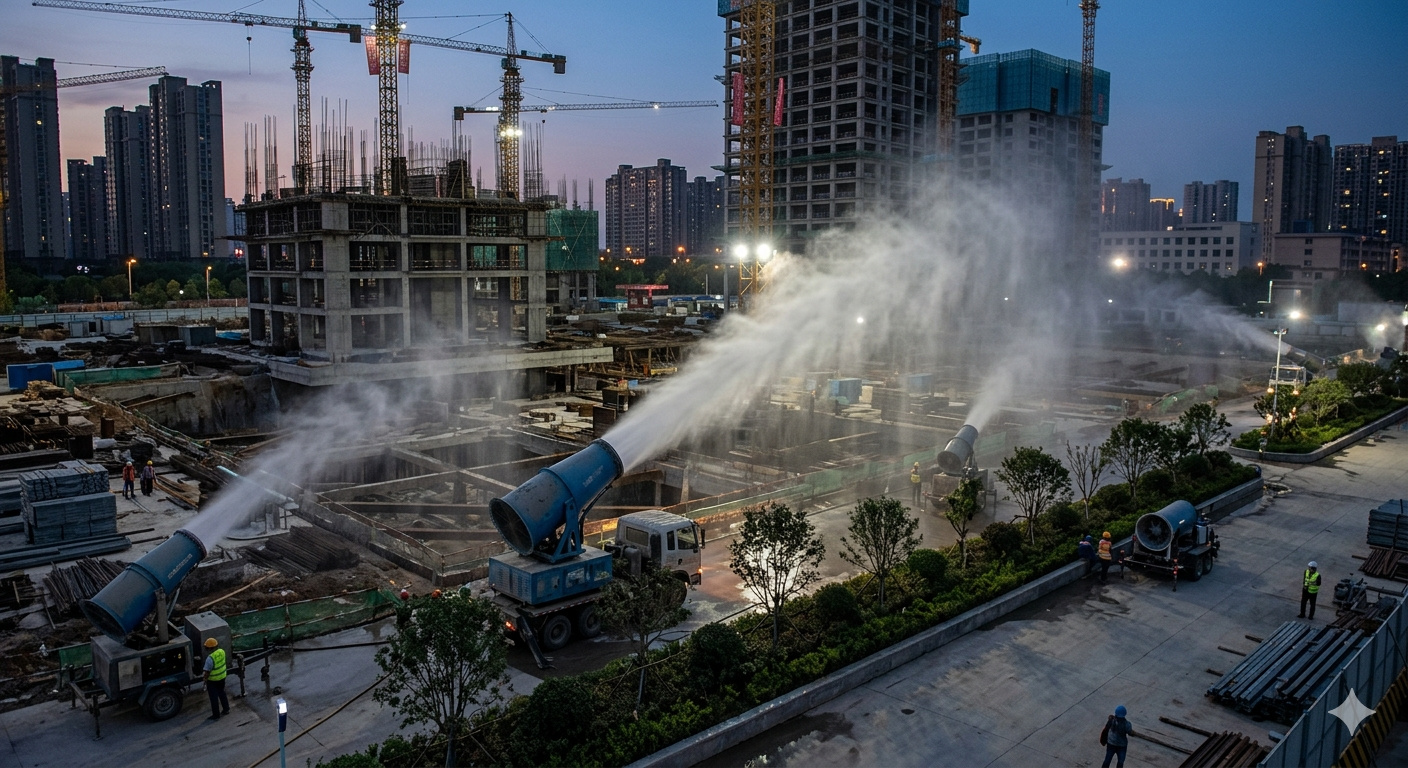
Dust networks and fog cannons reduced pollution at construction sites in China and prevented 26,000 deaths, according to a study with satellite data.
In 2017, the central government of China made it mandatory to cover construction waste with dust nets at urban construction sites across the country. The measure seemed simple — stretching a green mesh over debris and exposed soil. But a study published in 2025 in The Innovation, which crossed high-resolution satellite images with air quality models and machine learning, showed what no one had quantified before: between 2017 and 2021, these nets prevented 26,836 premature deaths in China.
The area covered by the nets skyrocketed. In 2019, the national total was 9.78 times greater than in 2016 — before the mandate. The increase was especially pronounced in the North China Plain, the most industrialized and polluted region of the country. This was just the beginning of a transformation that is reshaping how China builds in cities.
Construction pollution in China: dust, PM10, and PM2.5 as public health risks
Construction pollutes. This is an inconvenient truth that most countries accept as inevitable. Excavation, pile driving, earth transportation, cutting materials, stacking debris — each of these activities releases particles into the air.
-
New CCR concrete paving technology promises roads up to 3x more durable, less maintenance, and cost reduction in Brazil.

-
Made from recycled plastic, plastic wood is gaining space in the construction industry because it does not rot, resists moisture, and reduces maintenance costs over the years.

-
Florianópolis will receive a million-dollar BRT that will begin construction in 2026 with nearly 400 million in funding from the federal government and the Inter-American Development Bank, and the map already shows the routes for the exclusive bus corridors.

-
Without a blueprint, without an engineer, and using scrap from the dump, a father spends 15 years building an 18-room castle for his daughter, featuring tram tracks, 13 fireplaces, and over 700 m², which may now be demolished.

In Beijing, dust from construction sites accounted for about 10% of the monthly PM10 concentration in the city, according to government data. In some areas of Shanghai, the contribution reached 12.4%. In Guiyang, a city in southwestern China, the rate was nearly 25%.

PM10 are particles with up to 10 micrometers in diameter — small enough to enter the respiratory system. PM2.5 are even smaller, with up to 2.5 micrometers, and reach the pulmonary alveoli. Both cause respiratory diseases, cardiovascular issues, and cancers. The WHO does not establish a safe level of exposure; any concentration above zero already poses a risk.
China has urbanized at an unprecedented historical speed. In 2000, 36% of the population lived in cities. By 2024, that number is expected to reach 65%. This jump of 30 percentage points in less than 25 years has been accompanied by decades of uninterrupted construction and dust.
Dust nets seen by satellite: the simple solution that prevented 26,000 deaths
The simplest and most impactful innovation was also the cheapest: the dust net. Made from high-density polyethylene, the net is stretched over piles of earth, debris, and demolition waste exposed to the wind.
Its function is to prevent the wind from lifting and transporting particles away from the construction site. The cost per square meter is low, installation does not require specialized labor, and the result, as the 2025 study demonstrated via satellite, is measurable in lives.
The researchers used images from Sentinel-2 and Landsat-8 to map the evolution of net coverage at Chinese construction sites between 2015 and 2021. They trained machine learning algorithms to identify the green meshes in satellite photographs and crossed the data with PM2.5 and PM10 concentration models.
The result showed that in the years following the mandate, air quality near construction sites improved statistically significantly and that 26,836 deaths that would have occurred did not occur. Scientific studies rarely manage to quantify lives saved by such a simple measure.
Fog cannons: technology that reduces airborne dust by up to 90%
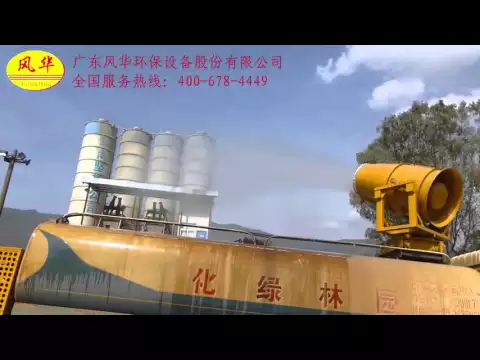
While the nets control what does not fly, the fog cannons attack what is already in the air. The equipment operates on a straightforward physical principle: an industrial fan projects a jet of air at high speed while nozzles inject pressurized water into the flow. The combination atomizes the water into droplets with diameters between 50 and 200 micrometers.

These droplets, when colliding with suspended dust particles in the air, increase the weight of those particles, which then fall due to gravity instead of remaining suspended.
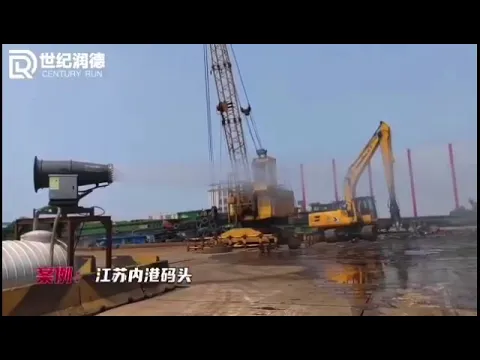
The range varies by model: smaller equipment reaches up to 30 meters, while larger ones can reach up to 120 meters. The cannon can rotate 360° and adjust the elevation angle, covering different areas of the site without blind spots. Mobile versions mounted on trucks allow movement between construction fronts, while fixed versions operate automatically with particle sensors.
The reduction of airborne dust can reach up to 90% within the equipment’s operational radius, according to Chinese manufacturers and field studies. A study published in PMC confirmed statistically significant reductions, especially in PM2.5.
Another critical factor is water consumption, which is 70% to 80% lower than traditional spraying systems, as the fog covers larger areas with a smaller volume.
Accelerated expansion: 61 municipalities adopted the system in a single year
The adoption was rapid and coordinated. According to a report from Dialogue Earth, during the period when fog cannons began to be used outside of mining and applied in urban environments, 61 Chinese municipalities opened public tenders for the acquisition of the system in a single year. Hebei province led the movement with 11 bids.
This advancement was driven by national policies initiated in 2013 when the State Council launched a pollution control plan with strict targets for reducing fine particles in the country’s main industrial regions.
The cannons migrated from mining, where they were already used for dust control in coal and crushing, to urban sites, with adaptations for mobility and water efficiency.
The complete dust control system in urban construction in China
The fog cannons and dust nets are part of a broader environmental control system imposed on construction sites.
The legislation revised in 2015 established the obligation of “dust-free construction,” delegating to local governments the creation of specific rules. This resulted in a standardized set of measures adopted in dozens of cities.
Among them are the physical enclosure of sites, the prohibition of concrete and mortar production on-site, mandatory washing of vehicles upon exiting construction sites, covering exposed materials, and using dust suppression systems.
The physical enclosure, in particular, acts as a double barrier, reducing both particle dispersion and noise. In some cases, complete structures are used to fully isolate the construction environment, such as the inflatable project in Jinan that gained global attention.
Chengdu as a model: 18% reduction in PM2.5 and national reference
In 2024, Chengdu reduced its PM2.5 concentration by 18% compared to the previous year, reaching the national air quality standard for the first time.
One of the pillars of this reduction was the construction sector. The city implemented more than 1,300 construction sites classified as “reference green,” with strict dust control requirements.
These sites must meet criteria such as total sealing, covering of materials, washing of vehicles, and continuous use of fog systems. The model has been used as a reference by the central government for replication in other regions.
Why construction dust is one of the main invisible sources of urban pollution
Construction dust is underestimated because it does not have a single emission point. Unlike industries or power plants, it is diffuse.
An excavation generates particles that spread over blocks. Trucks transporting debris without covering distribute material over kilometers. Exposed piles of sand become continuous sources of emission.
Scientific studies have confirmed that regions near construction sites show measurable increases in PM10, with a direct impact on health, especially among children and the elderly.
Limitations of fog cannons and unresolved challenges
Despite their effectiveness, the technology has significant limitations. The cannons are more efficient against larger particles, such as PM10. For PM2.5, efficiency depends on factors such as wind and humidity. In adverse conditions, the fog disperses before reaching the particles.
The dust nets also present challenges, mainly in enforcement. Satellite images show significant regional variations in compliance, even after the mandate.
The national air quality plan set PM2.5 reduction targets of 10% by 2025. By 2024, the national average had already dropped by 11.2% compared to 2020. Still, about 40% of large cities remain above the established standards.
What other countries can learn from the Chinese model
The Chinese experience shows that the most effective solution was not the most expensive. Dust nets are cheap, easy to install, and do not require complex technology. Fog cannons, although more expensive, remain affordable within the budget of large construction projects.
The difference lies in the combination of measures and enforcement. The system does not rely on cutting-edge technological innovation but on consistent management.
The inflatable bubble in Jinan attracts global attention, but the most relevant data remains another: 26,836 deaths avoided in four years by a simple solution applied on a national scale.









Seja o primeiro a reagir!