





 English
  Francês
  Alemão
  Italiano
  Japonês
  Norueguês
  Portuguese
  Spanish
 4 min of reading


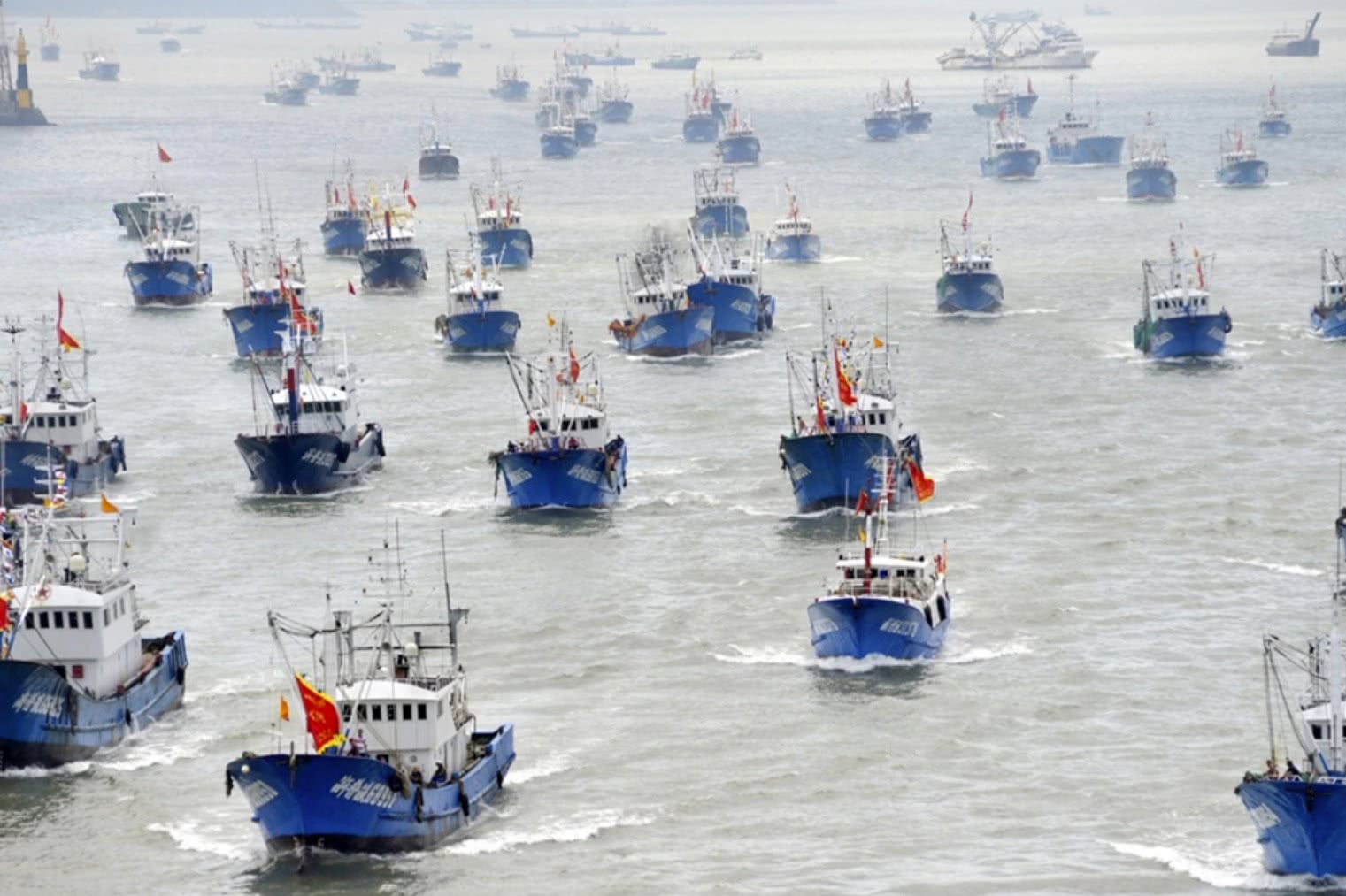
Geopolitics Professor and Fishing Institutions Report that Fishing Vessels from China Have Invaded South America’s Maritime Territory for Years
All coastal countries have the right to explore their Exclusive Economic Zones. These are the maritime areas extending up to 200 nautical miles (370 km) beyond each country’s territorial waters. Over these zones, each nation has priority to utilize the natural resources of the sea, both living and non-living, maintaining environmental management responsibility. However, over time, there have been several reports that fishing vessels from China have invaded these areas around the world, with the threat to South American territory increasing recently.
In a video posted on his YouTube channel, Geopolitics Professor Heni Ozi Cukier claims that the biodiversity of marine life in South America, especially fish, is under serious threat from invading Chinese vessels. Cukier, who is also known as Professor HOC, recalled the incident that occurred in 2020 when more than 300 vessels from China crossed the Strait of Magellan, at the southern tip of Chile, and reached the South Atlantic.
“When these fishing vessels get closer to the coast, they are actually invading the exclusive zone of a country. This illegal fishing in South American waters poses a challenge to the maintenance of sovereignty for the coastal countries of the Southern Cone (Brazil, Argentina, Chile, Paraguay, and Uruguay)”, said HOC. Furthermore, according to the scholar, Chinese fleets represent 70% of the countries practicing illegal fishing in the world.
-
New shoe factory in Ceará is expected to create 400 jobs and strengthen the local economy.

-
No one imagined it, but a mixture of sawdust with a mineral that fights fires surprises scientists with a result that changes the course of fire-resistant construction.

-
From empty land to a high-end house, wooden construction uses a lightweight system, metal structure for the foundation, ventilated ceramic cladding, and special windows to create an efficient and comfortable living space throughout the year.

-
From vacant land to a high-end house, wooden construction uses a lightweight system, a metal structure for support, ventilated ceramic cladding, and special windows to create an efficient and comfortable living space throughout the year.


China leads the global ranking of fish production countries, accounting for 15% of the average total production. The Chinese fish 15.2 million tons annually. No other country or continent comes close to these numbers. Indonesia (6.11 million), United States (4.9 million), Russia (4.47 million), Peru (3.77 million), India (3.60 million), and Japan (3.17 million) follow.


Union Says Illegal Fishing by Chinese Has Become Routine
According to the Port Operators Union of the State of São Paulo (Sopesp), Chinese fishing vessels seek less monitored coastlines. This was happening on the African continent; however, the situation became widely known, and the Chinese began to face pressure.
Also according to Sopesp, in an article published on its website, China shifted its destination in recent years. Illegal predatory fishing fleets began to be sighted more frequently in the South Atlantic and South Pacific.
The Union recalls the incident that occurred in 2019 in which around 7 tons of fish from illegal fishing were seized in a joint operation between the Brazilian Navy and the French Navy between the mouth of the Oiapoque River (Amapá) and the territorial waters of French Guiana. “It is known that most of the boats are Chinese, a country that invests heavily in the region. In other words, with one hand they are allies, with the other…”, says the organization.
Fishing in international waters is not illegal, but it is also not regulated. What worries Brazil is that, given the context, there is a tendency for the Chinese to increasingly approach the Brazilian coast, negatively impacting marine nature. Brazil and China are trade partners.
Conflict Cases Involving Chinese and South American Vessels Throughout History
In 2018, a tuna fishing vessel from Rio Grande do Norte (RN), with only 10 crew members and 22 meters long, was attacked by a Chinese vessel twice its size. The attack occurred 420 miles off the Brazilian coast (676 kilometers), with no injuries.
In Argentina, in 2016, the local coast guard opened fire, causing the sinking of a fishing boat from China that was within Argentine maritime territory. The intention of the Chinese was to catch squid.
In November 2020, Ecuador, Chile, Peru, and Colombia issued a joint statement regarding the Chinese fishing fleet operating in the Pacific, especially off the coast of Chile.
Controversial Proposals
Some massive Chinese fleets spend years at sea, being refueled by tanker ships, and transfer their catch to factory ships to continue fishing. In 2013, China presented a project to the government of Uruguay to build a fishing terminal as a repair and supply base for all ships from China and Taiwan. However, environmentalists and neighboring countries reacted against it.
It is also said that the Chinese are interested in building a maritime hub in the city of Rio Grande (RS). The Integrated Fishing Project was estimated at US$ 30 million for the construction of 400 trawler fishing vessels, a freezing plant with a capacity of 500 tons per day, in addition to a port of up to 100 hectares.










Seja o primeiro a reagir!