





 Portuguese
  English
  Spanish
 4 min of reading
  0 comments


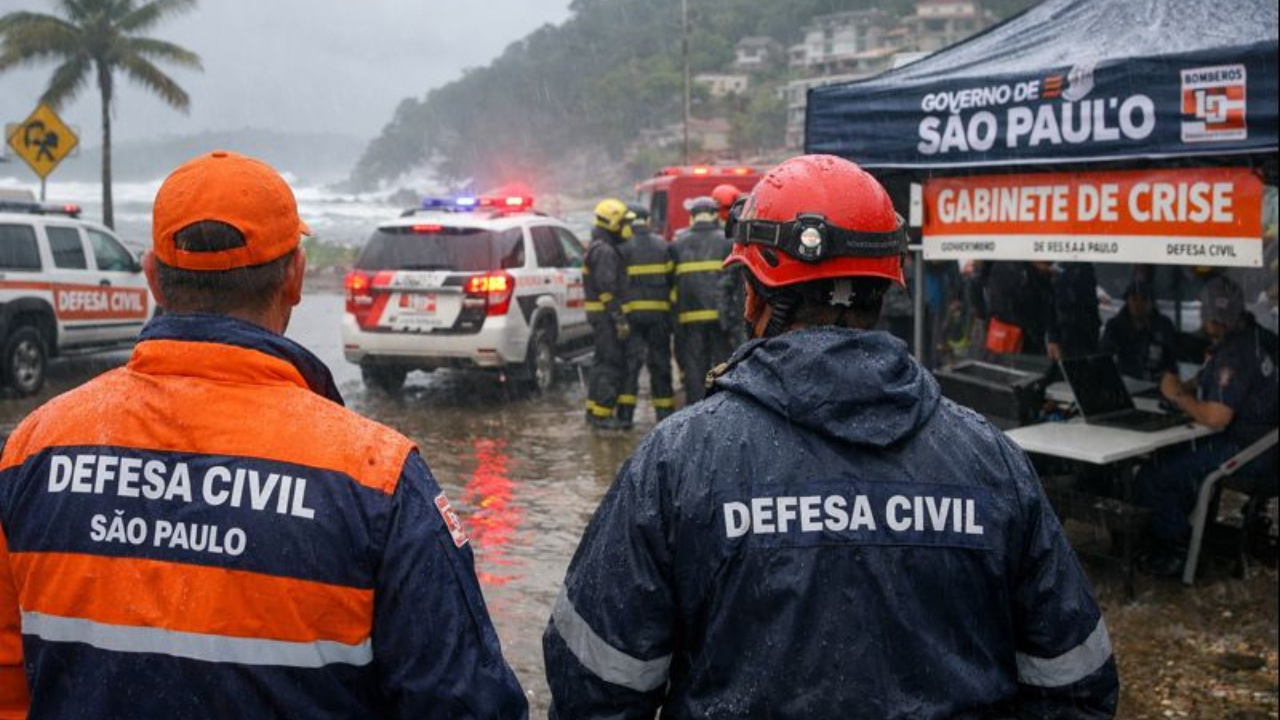
Crisis Cabinet Coordinates Preventive Actions of Civil Defense of São Paulo in Response to Heavy Rains Forecasted for the Coastal Region.
In light of the forecast for heavy rains during the New Year holiday, the Government of São Paulo has activated a crisis cabinet to coordinate preventive actions.
And for rapid response across the state, with special attention to the coastal region.
The measure was announced this Friday (26) by Governor Tarcísio de Freitas, after a meeting at the Palácio dos Bandeirantes with mayors.
-
What Changed at Florianópolis Beaches? New Rule Surprises Pet Owners and Restricts Dogs on the Sand at Specific Times
-
Economic Diversification Accelerates in Itatiaiuçu to Reduce Mining Dependence
-
Extreme Rains: Cold Front, Supercell, and Atmospheric Trough Cause Tragedy in MG
-
Minas Gerais Municipalities Press Congress Against Bombshell Bills and Warn of Risks to Public Finances


Representatives of state agencies and public service concessionaires.
The coordination occurs through the Civil Defense of São Paulo.
Which monitors climate conditions and executes the Integrated Summer Operation to reduce risks to the population.
Integrated Action to Face Heavy Rains
The crisis cabinet was structured to ensure joint action between the state and municipalities, especially in areas more vulnerable to storms.
According to the Civil Defense, the hot and humid climate typical of summer, combined with atmospheric instabilities
Should provoke intense rains, strong winds, and thunder, requiring a coordinated response.
During the meeting, the governor emphasized the importance of institutional alignment to preserve lives and minimize damage.
“We are preparing and will not leave the population unsupported. This requires readiness, prevention, and being on the same page.
Our goal is to protect lives and prepare our infrastructure to reduce damage to the population,” stated Tarcísio de Freitas, in a citation kept intact.
Guidelines from Civil Defense to Municipalities
As part of the strategy in response to heavy rains, Civil Defense of São Paulo advised municipalities to implement their contingency plans.
The actions include issuing risk alerts in the State System, preventive communication through social media and press, and direct alerts to the population.
Additionally, local teams must remain on standby to execute emergency measures
Conduct preventive inspections and respond to occurrences related to flooding, landslides, and fallen trees.
Meanwhile, the Emergency Management Center (CGE) maintains uninterrupted operation, with continuous weather monitoring and coordination among different public bodies.
Integrated Summer Operation Reinforces Presence on the Coast of São Paulo
The mobilization of the crisis cabinet occurs in a broader context of reinforcing the actions of Civil Defense during the most critical period of summer.
In total, about 5,400 agents are mobilized in the Integrated Summer Operation, which concentrates efforts especially on the coastal region.
As part of the preparation, simulated exercises were conducted with residents of risk areas in cities such as Santos, Ilhabela, São Sebastião, Guarujá, and Cubatão.
In these activities, the population received practical instructions on how to act in situations of storms, flash floods, flooding, and landslides, strengthening community prevention.
Weather Forecast Indicates Critical Days on New Year’s Eve
According to the state Civil Defense, the days December 27 and 28 are expected to register rains within normal levels.
However, between December 29 and 30, the scenario changes, with the risk of more intense storms, accumulations between 20 and 50 millimeters per day, strong winds, thunder, and possible hail.
On January 31, the forecast points to intense heat and humid weather, with typical summer showers.
On January 1, a new cold front is expected to move through the eastern part of the state
Affecting regions such as the Vale do Ribeira and, subsequently, the Baixada Santista, with volumes that can reach 60 millimeters.
The highest alert is expected for January 2 and 3 in the North Coast, where accumulations can reach up to 100 millimeters, accompanied by gusts of wind.
Thus, upon returning from the holiday on January 4, the forecast indicates widespread rains between 50 and 100 millimeters in the interior, the Metropolitan Region of São Paulo, and on the coast.
Santos Reinforces Preventive Plan in Response to Heavy Rains
The mayor of Santos, Rogério Santos, also participated in the meeting with the state government and highlighted the municipality’s preparation to face the most critical days.
“In Santos, we are ready to act in an integrated manner, with particular alert for the days 1 and 2, when we will be attentive to meteorological radars and elements that may anticipate risks,” he stated.
Since the beginning of December, municipal Civil Defense teams have been monitoring and advising residents of vulnerable areas.
Additionally, the actions are part of the Civil Defense Preventive Plan (PPDC), valid until April 30, 2026, which monitors over 4,800 homes in high and very high-risk areas, as well as other sectors monitored in the 17 hills of the city.
Prevention as the Central Focus of the Crisis Cabinet
With the intensification of heavy rains, the Government of São Paulo prioritizes prevention as a main strategy.
Thus, the integrated action of the crisis cabinet, combined with the work of the Civil Defense of São Paulo and the Integrated Summer Operation, seeks to reduce impacts, enhance rapid response, and ensure greater safety for the population during the period of greatest climatic instability.








Seja o primeiro a reagir!