





 Portuguese
  English
  Spanish
 5 min of reading
  27 comments


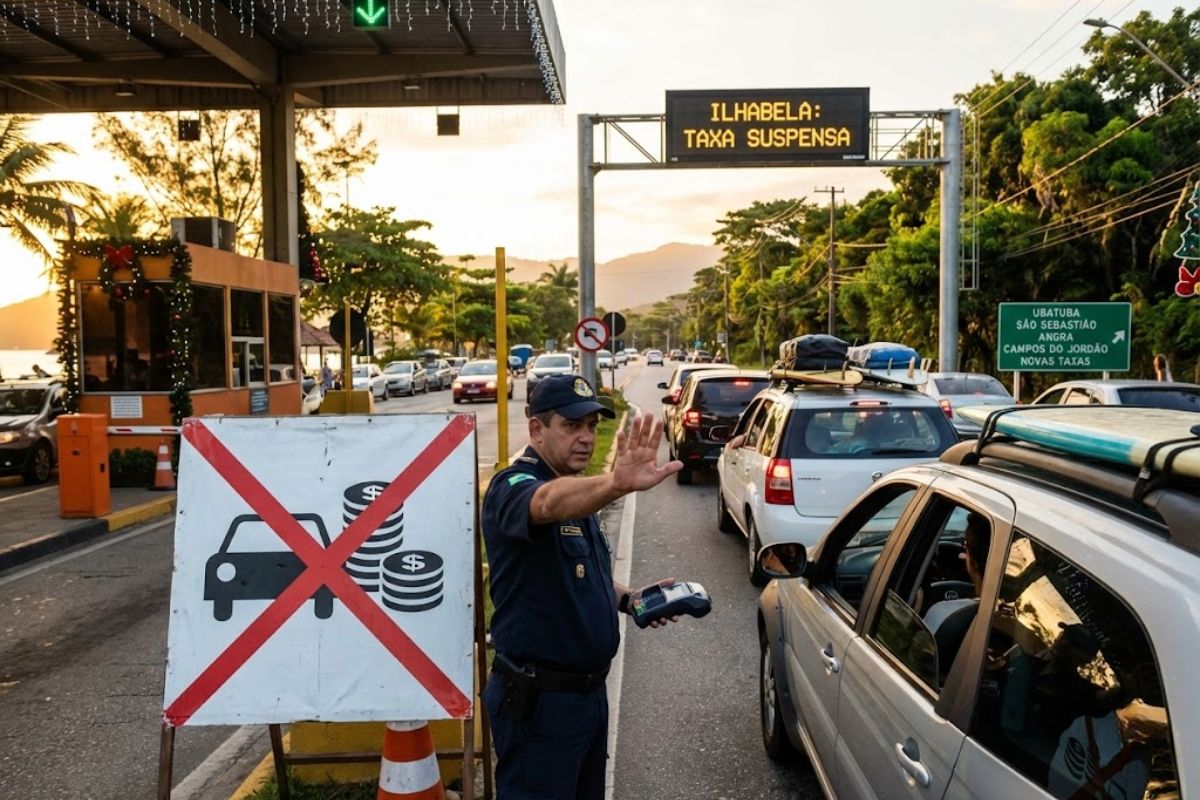


TCE Decision Causes Brazilian City of Ilhabela to Suspend Environmental Preservation Fee of 48 Reais per Car on the Eve of Christmas, While São Sebastião, Ubatuba, Angra dos Reis, and Campos do Jordão Advance on Their Own Tourist Charge Projects with Differentiated Values and Staggered Start Dates for the Fees.
The Brazilian city of Ilhabela, located on the northern coast of São Paulo, suspended the start of the new environmental preservation fee of 48 reais per car after the State Court of Accounts blocked the bidding to hire the company responsible for electronic charging just days before Christmas 2025. The fee was set to start on Thursday, December 18, coinciding with the first major influx of tourists for the high season, but now has no date set to come into effect following the municipality’s formal retreat.
The municipal administration announced that it revoked the bidding deemed problematic by the TCE and intends to relaunch the notice already on December 18, with adjustments. The declared goal is to keep the new preservation fee in place for summer 2025-2026, but without repeating legal failures that could compromise the charge and open space for new challenges.
TCE Blocks Bidding and Exposes Dispute Over Environmental Fee

The impasse began with the analysis of two representations presented to the State Court of Accounts, which pointed out irregularities in the bidding for the implementation, maintenance, and operation of the automatic charging system.
-
50 viaducts, 4 tunnels, 28 bridges, and 40 kilometers of bike paths: BR-262 in Espírito Santo will receive 8.6 billion reais for the largest engineering project in the state’s history, inspired by the Immigrant Highway in São Paulo.

-
Brazil produces too much clean energy and doesn’t know what to do with it: over 20% of solar and wind capacity was wasted in 2025 while investors flee and 509 renewable generation projects were abandoned in the last year.

-
Piauí will produce a new fuel that replaces diesel without needing to change anything in the truck’s engine and reduces pollutant gas emissions by half: truck drivers from all over the Northeast are already celebrating the news that will arrive later this decade.

-
A new Brazilian shopping center worth R$ 400 million will be built in an area equivalent to more than 4 football fields, featuring 90 stores, 5 cinemas, a supermarket, a college, and parking for 1,700 cars, potentially generating 3,000 jobs.


Following these manifestations, the TCE ordered the process to be suspended and halted the debut of the fee in Ilhabela.
In response, the municipality announced the revocation of the bidding and the intention to launch a new dispute with adjustments, maintaining the idea of financing part of the urban and environmental costs related to tourism through the preservation fee.
In practice, the Brazilian city postpones the charge but preserves the strategy of charging visitors for the impact generated on the archipelago.
According to the text approved at the City Council in September, the fee would replace the old model of physical booths, now deactivated, with a free-flow system that uses plate reading or tags and payment by card or Pix.
This change aimed to reduce queues at the ferry and give a more technological character to the collection.
How the 48 Reais Fee Would Work in Ilhabela
The approved design states that the standard value for tourist cars would be 48 reais per crossing, regardless of the number of days spent on the island.
For motorcycles, the fee would be 10 reais, and for larger vehicles, the table progressively increases, reaching 140 reais for buses.
The charge would apply exclusively to visitors, as vehicles registered in Ilhabela and neighboring São Sebastião would be exempt, as well as ambulances and official vehicles.
The official narrative is one of environmental preservation and compensation for the intense use of local infrastructure, but the financial impact on mass tourism is inevitable.
The model maintains the existing ferry fare, currently between 19 reais on weekdays and 28.50 reais on weekends, and adds the new environmental preservation fee upon leaving the archipelago.
In practice, a family entering by car through the ferry and leaving the island would pay two different charges on the same trip.
Northern Coast of São Paulo Transforms Fees into Regional Policy
While the Brazilian city of Ilhabela tries to legally restructure its preservation fee, the northern coast of São Paulo consolidates a kind of belt of environmental charges aimed at tourists.
Ubatuba has been charging a fee since 2023, Caraguatatuba is the only exception without a formal project, and São Sebastião replicated the model shortly after the approval in Ilhabela.
The tax created by São Sebastião was sanctioned in October, and the municipality expects to start charging in the first quarter of next year, with values ranging from 5.25 to 143 reais, depending on the type of vehicle.
The regional message is clear: those who enter by car to the main beaches of São Paulo must help finance cleaning, mobility, and preservation.
At the same time, municipalities attempt not to break away from the welcoming discourse for tourists, insisting that the fees are instruments of ordering and environmental compensation, not economic barriers to visitation.
The debate on transparency in resource allocation and effectiveness in territorial protection, however, is likely to gain momentum.
Angra dos Reis and Campos do Jordão Expand the Charging Map
Outside the northern coast, other relevant tourist areas have already decided to follow a similar path.
In Angra dos Reis, on the southern coast of Rio de Janeiro, the so-called sustainable tourism fee will come into effect in January 2026, charging 95 reais per visitor who stays up to seven days on the local islands and 47.50 reais for those who stay up to seven days on the mainland.
The most famous of these islands is Ilha Grande, accessible only by boat, which facilitates control over the flow of tourists.
The municipality’s expectation is to use the revenue to reinforce cleaning services, environmental inspection, and basic infrastructure in the most pressured areas.
In Serra da Mantiqueira, Campos do Jordão approved its own fee in October, targeting winter and weekend tourism.
The charge is expected to begin only in the second half of next year, in a model that will still be detailed, but follows the same logic of tying visitation to financing urban and environmental services.
Between Preservation, Municipal Revenue, and the Right to Go and Come
The advancement of different models of environmental fees in tourist cities brings to the forefront the debate on the boundary between preservation, revenue collection, and the right to circulation.
Ilhabela illustrates this dilemma by trying to reconcile the pressure for revenue and the discourse of protection with the need to respect legal controls and decisions from oversight bodies such as the TCE.
For residents, business owners, and tourists, the immediate effect is a scenario of uncertainty regarding the cost of entering and leaving the main beaches and mountain destinations in the coming summers.
For public authorities, the challenge will be to demonstrate that the collected money is returned in visible services, avoiding the perception that the preservation fee is just another access barrier.
With each Brazilian city calibrating values, deadlines, and formats, the debate on tax justice in tourism is expected to intensify as the first seasons with full charges show their effects on visitor flow and on municipal finances.
What do you think, are these environmental fees in tourist destinations a fair instrument for preservation, or do they end up deterring visitors and making year-end trips too expensive?









Não.. isso é um absurdo. Fere completamente o direito de ir e vir. Isso é mas uma maneira de roubar dinheiro.
A política desse país virou um CIRCO
Precisamos de um governo pra acabar com todas essas taxas um presidente que presta onde manda de verdade pq o que temos e presidentente que so pensa em impostos e taxa e encher o bolso dele e da família dele .
Isso é um roubo legalizado onde nao podemos te mais nada pq e tudo cobrado até mesmos o ar que respiramos uma hora o povo nao consegue pagar mais nada e se revolta é eu não vejo a hora que chegar logo, pra acabar essa palhaçada