





 Portuguese
  English
  Spanish
 5 min of reading
  0 comments


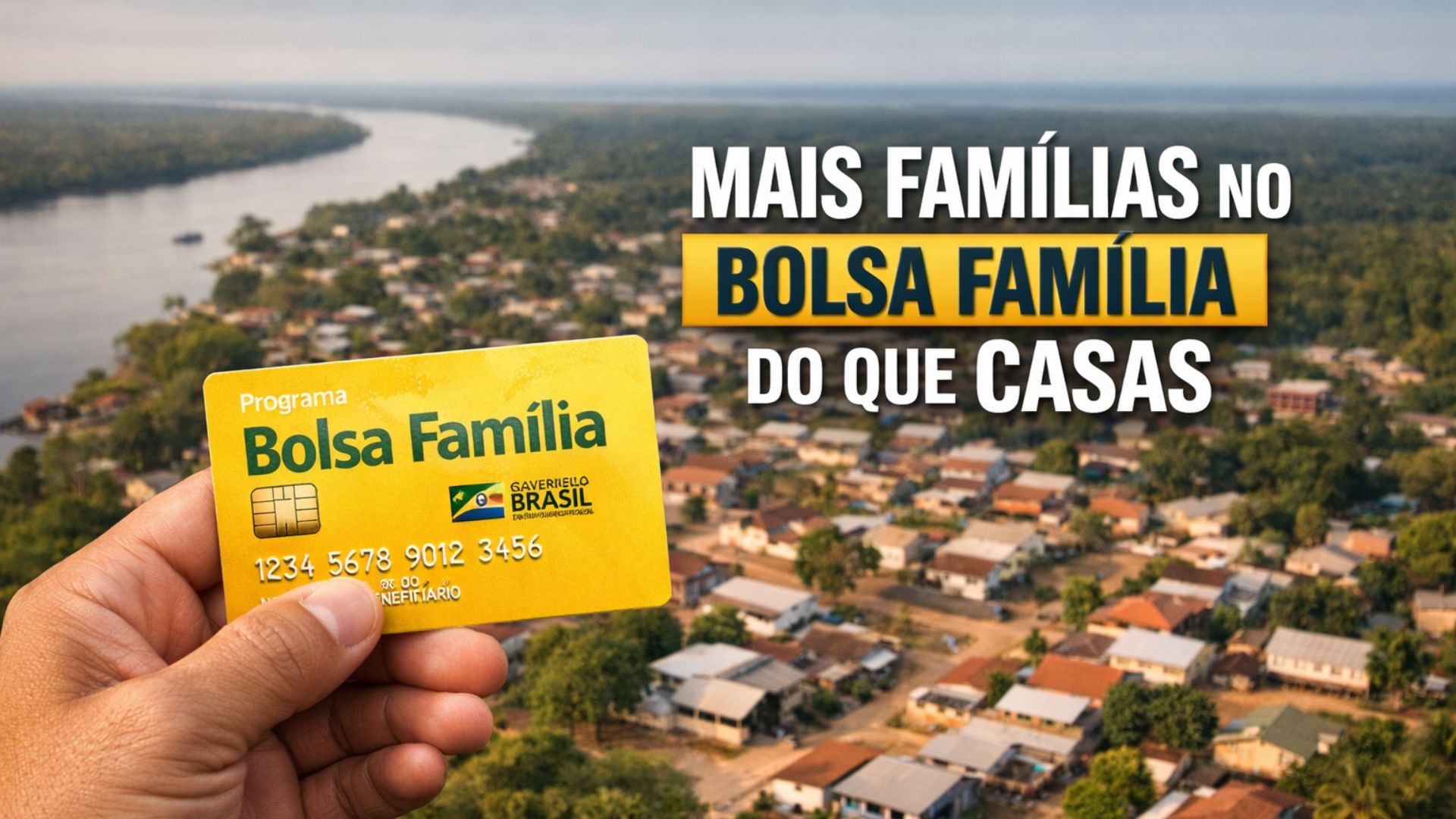
Crossing of the Single Registry and the Census Reveals Uncommon Proportion in a Municipality in Amazonas, Where the Number of Families in Bolsa Família Exceeds the Total Number of Registered Households. The Difference Exposes the Contrast Between Official Bases, Highlights Distinct Concepts of Counting, and Expands the Debate on the Interpretation of Public Data.
A cross-check between data from the Ministry of Development and Social Assistance, Family and Fight Against Hunger and the Brazilian Institute of Geography and Statistics placed São Paulo de Olivença, in the interior of Amazonas, at the center of a statistical debate by pointing out 7,722 families in Bolsa Família against 6,845 registered households.
The ratio exceeds 100% when comparing the total number of active family registrations in the social program with the number of housing units identified by the Census, a scenario that caught attention for contradicting an intuitive expectation that there are fewer beneficiary families than registered houses.
According to IBGE, the municipality recorded 32,967 inhabitants in the 2022 Demographic Census, distributed over a territorial area of 19,658.536 square kilometers, resulting in a population density of 1.68 inhabitants per square kilometer, one of the lowest in the country.
-
Friends have been building a small “town” for 30 years to grow old together, with compact houses, a common area, nature surrounding it, and a collective life project designed for friendship, coexistence, and simplicity.

-
This small town in Germany created its own currency 24 years ago, today it circulates millions per year, is accepted in over 300 stores, and the German government allowed all of this to happen under one condition.

-
Curitiba is shrinking and is expected to lose 97,000 residents by 2050, while inland cities in Paraná such as Sarandi, Araucária, and Toledo are experiencing accelerated growth that is changing the entire state’s map.

-
Tourists were poisoned on Everest in a million-dollar fraud scheme involving helicopters that diverted over $19 million and shocked international authorities.


These indicators help to delineate the territorial profile of the city, marked by large internal distances and the population dispersion typical of Amazon regions, where riverside communities coexist with a relatively small urban center compared to the geographical extension.
Difference Between Household and Family in Official Bases
The numerical discrepancy, however, does not result from a simple miscalculation, but from the comparison between distinct statistical concepts that belong to bases with different purposes, although both are public and used to guide government policies.
In the Census, the term “household” designates the structural unit of housing visited by census takers, encompassing houses, apartments, or other forms of habitation, regardless of the number of family nuclei residing there.
The Single Registry, which underpins the granting of Bolsa Família and other social programs, organizes information based on the concept of “family,” understood as a nucleus of people who share income and expenses or who identify as an economic unit.
This conceptual difference opens the possibility for situations where two or more families coexist in the same household, registered separately in the administrative system, even if they occupy the same physical housing structure identified by the Census.
Cohabiting Families and Co-habitation in Vulnerable Areas
The federal government itself recognizes the existence of so-called “cohabiting families,” when distinct nuclei share the same address but do not fully share income and financial responsibilities, thus being able to be registered individually for eligibility purposes.
In contexts of greater social vulnerability, cohabitation is a recurring practice, whether due to extended family ties or economic necessity, which can increase the number of family registrations without a corresponding growth in the number of houses.
Moreover, the Single Registry undergoes continuous updates conducted by municipalities, while the Census represents a snapshot of a specific data collection period, producing portrayals that do not always coincide in time or demographic dynamics.
Interpretation of the Data and Impact on Public Policies
The comparison between bases, therefore, involves temporal cuts and distinct criteria, requiring caution in interpretation to avoid hasty readings that disregard each system’s proper methodologies for public information.
The survey that highlighted São Paulo de Olivença included other Brazilian cities with a similar proportion between beneficiary families and registered households, in addition to mentioning hundreds of municipalities where at least half of the houses have some member served by the program.
This scenario reinforces the strong presence of Bolsa Família in certain local realities, especially in municipalities with low average income and high dependence on federal transfers as a complement to household income.
In the case of Amazonas, the combination of an extensive territory, scattered population, and logistical challenges typical of the region may influence both the registration updates and the reach of public policies, even though the official figures do not indicate irregularity by themselves.
Historical records from IBGE indicate that the municipality has origins linked to religious missions along the banks of the Solimões River, an element that helps to understand the social formation and territorial occupation based on river routes and communities distributed along the waterways.
When the data is presented directly, with the phrase “more families than houses,” the immediate reaction is usually one of surprise, as everyday logic suggests that each residence would correspond to a single family nucleus.
However, the normative structure of the Single Registry allows for multiple registrations at the same address as long as the families are economically independent, a situation that does not contradict the formal rules of the social program.
Nonetheless, the visibility of the case fuels discussions about transparency, oversight, and the quality of administrative bases, especially since the benefit is granted per family and involves public resources of significant national reach.
The comparative reading between registered households and registered families demands, therefore, a technical understanding of the criteria from each source, as well as attention to the territorial and social specificities that shape the reality of isolated municipalities in the Amazon.
The episode highlights how official statistics can generate controversy when placed side by side without adequate methodological contextualization, especially in an environment of widespread information circulation on digital networks.
In São Paulo de Olivença, the numbers remain recorded in public databases and illustrate the need for careful interpretation so that the debate on social policies is based on clear definitions, consistent parameters, and ongoing monitoring of government registrations.









-

Uma pessoa reagiu a isso.