





 Português
  Inglês
  Espanhol
 3 min de leitura
  0 comentários


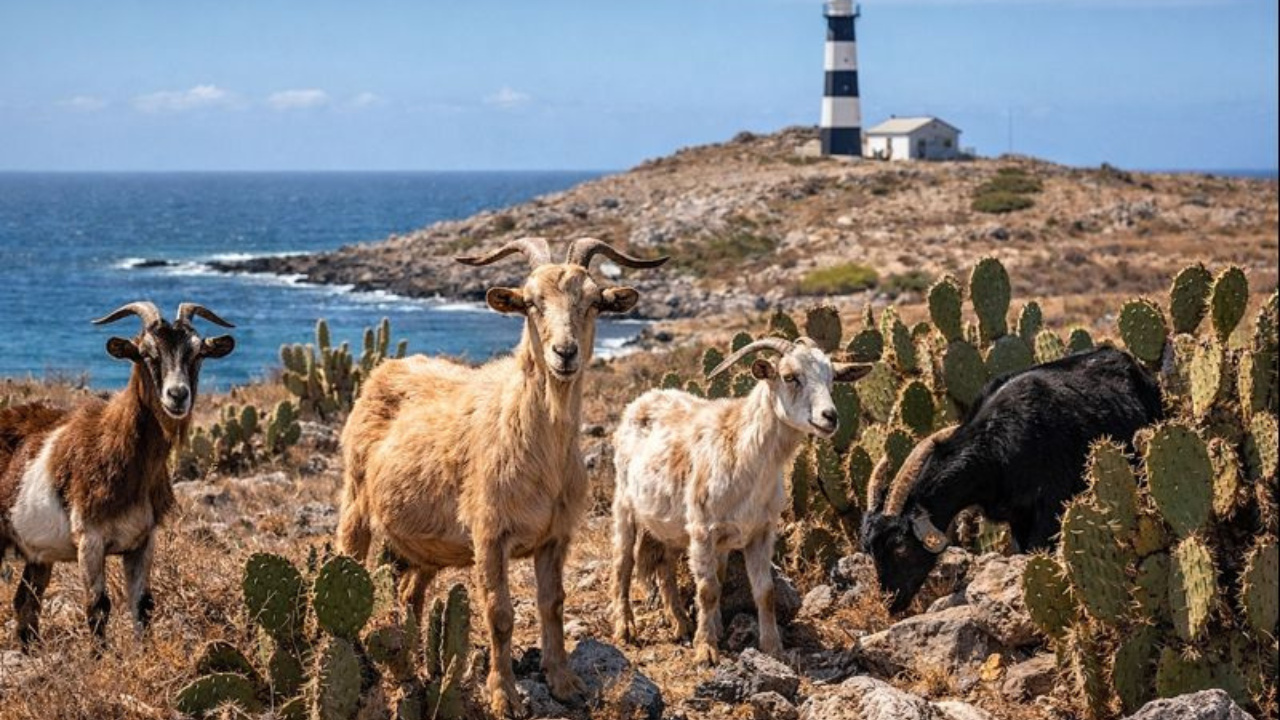
Feral Goats Lived Centuries Without Fresh Water. Case Reveals Genetic Adaptation and Reinforces Debates on Environmental Conservation.
For more than two centuries, feral goats survived in complete isolation on Santa Barbara Island, on the southern coast of Bahia, without access to any permanent source of fresh water.
The case, investigated by Brazilian scientists in early 2025, involves researchers, environmental agencies, and research institutions seeking to understand how, why, where, when, and by whom these animals managed to adapt to an environment marked by water scarcity.
Located in the Abrolhos Archipelago, about 65 kilometers from the municipality of Caravelas, Santa Barbara Island is only 1.5 kilometers long.
-
A bright yellow mushroom imported from Asia escaped from a cultivation farm in the United States in 2010 and is now aggressively spreading across 25 states, destroying entire communities of native fungi in American forests.

-
Buried under China, a colossal machine weighing 20,000 tons began operating as the largest neutrino detector on the planet and, in just 59 days, surpassed results that science took half a century to achieve.

-
Iran enters the center of a climate alert after the war emitted 5.6 million tons of CO2 in two weeks, surpassing the annual pollution of entire countries.

-
Lunar exploration may change after a Chinese probe finds a “cavity” of radiation that reduces the impact on astronauts by up to 20% at certain times on the Moon.


Thus, despite its small size and total absence of rivers, lakes, or aquifers, the location has hosted a goat herd for entire generations, a rare phenomenon from a biological standpoint.
Feral Goats and Human Occupation in the Colonial Period
Feral goats are not native to the Santa Barbara Island.
According to the Government of Bahia, the animals were introduced during the colonial period when European navigators often left domestic species on remote islands.
Thus, the practice had a strategic objective.
The goats served as a living food reserve, allowing crews to stock up on meat during journeys along the Brazilian coast.
Over time, the animals became isolated and began to survive without direct human interference.
Santa Barbara Island and Extreme Water Scarcity
Santa Barbara Island is classified by researchers as an “insular cerrado.”
This means that its vegetation evolved to withstand water scarcity, with predominance of cacti, grasses, and succulent plants.
In this environment, the water available to the feral goats came almost exclusively from the food consumed and moisture captured from the environment.
Thus, surviving for more than 200 years under these conditions raised the hypothesis of a possible genetic adaptation to water stress.
Scientific Operation Removes Feral Goats from Santa Barbara Island
In early 2025, a coordinated operation led by the Chico Mendes Institute for Biodiversity Conservation marked a new chapter in this story.
With the support of the Brazilian Navy, Embrapa, the State University of Southwest Bahia, and the Bahia Agricultural Defense Agency, 21 animals were captured.
The objective was to understand how these animals adapted to life without perennial water sources.
Genetic Adaptation Could Benefit Semi-Arid Regions
According to researcher Ronaldo Vasconcelos from the Department of Animal Science at Uesb, the expectation is to find answers in the animals’ DNA.
The genetic adaptation observed in feral goats may reveal markers associated with water use efficiency, resistance to water stress, and reproductive capacity in extreme environments.
Environmental Conservation and Recovery of Insular Habitats
Thus, in addition to scientific research, the removal of feral goats from Santa Barbara Island also serves environmental conservation objectives.
According to ICMBio, the action follows a Management Plan established in 2023.
The plan seeks to reduce pressure on native vegetation, allowing for the natural recovery of insular habitats and strengthening the island’s ecological resilience.
Meanwhile, the participating institutions plan to expand the herd in a controlled environment and store genetic material in specialized banks.
Science, Sustainable Production, and Preservation Go Hand in Hand
The initiative connects science, agricultural production, and environmental conservation.
Thus, the story of the feral goats of Santa Barbara Island ceases to be merely a historical curiosity and transforms into a concrete opportunity for sustainable innovation in regions affected by water scarcity.







-

-

4 pessoas reagiram a isso.