





 Portuguese
  English
  Spanish
  4 min of reading
  0 comments


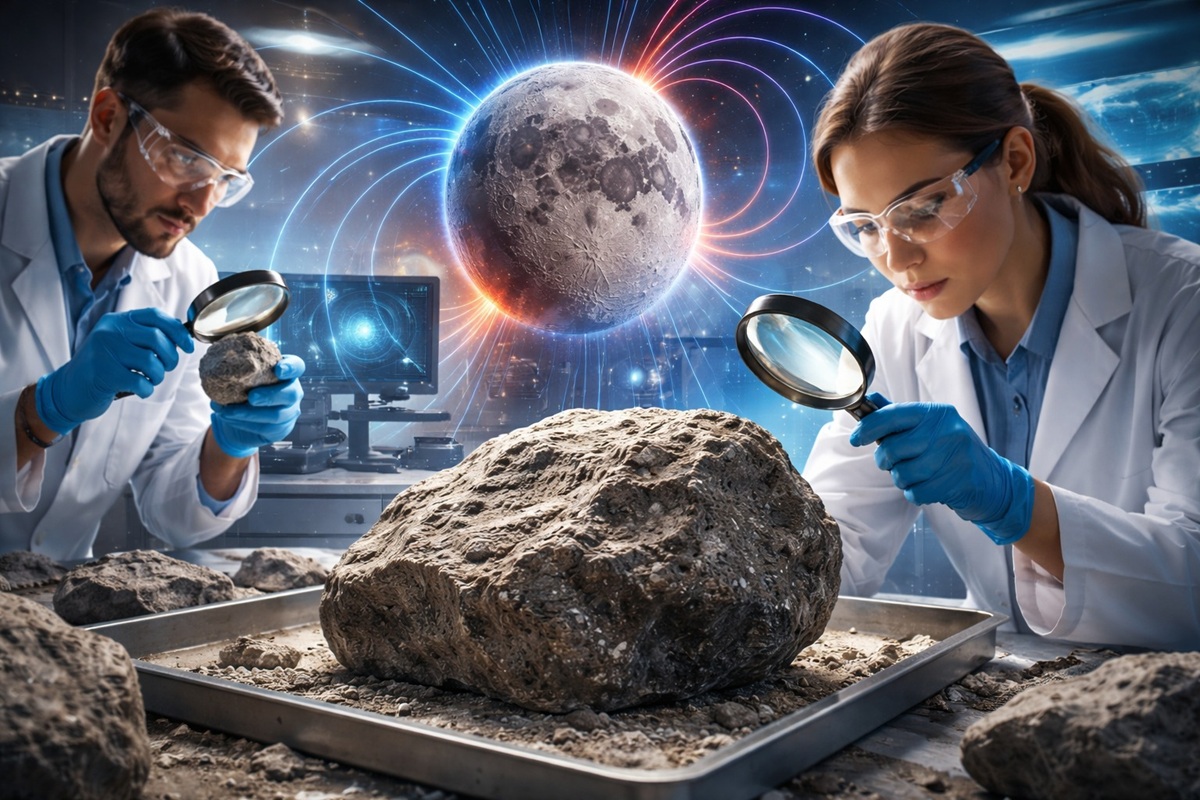
New Research Based on Detailed Analysis of Lunar Rocks Collected Between 1969 and 1972 by the Apollo Missions Indicates That the Moon’s Magnetic Field Remained Weak During Most of Its 4.5 Billion Years, Showing Only Brief Episodes of Intensification Associated with the Melting of Titanium-Rich Materials in the Lunar Interior
A new analysis of lunar rocks collected during the Apollo missions indicates that the Moon’s magnetic field was predominantly weak throughout its history, despite brief episodes of strong intensity recorded between 3.5 and 4 billion years ago.
Study with Lunar Rocks Suggests Solution to Historical Scientific Debate
The research on lunar rocks was published on Thursday, February 26, in the journal Nature Geoscience and addresses a scientific debate that has persisted for decades regarding the intensity of the lunar magnetic field over time.
According to the study, the Moon’s magnetic field exhibited short periods of intensification in its early history. These episodes occurred approximately between 3.5 and 4 billion years ago but did not persist during most of the Moon’s 4.5 billion-year existence.
-
Motorola launched the Signature with a gold seal from DxOMark, tying with the iPhone 17 Pro in camera performance, Snapdragon 8 Gen 5 that surpassed 3 million in benchmarks, and a zoom that impresses even at night.

-
Satellites reveal beneath the Sahara a giant river buried for thousands of kilometers: study shows that the largest hot desert on the planet was once traversed by a river system comparable to the largest on Earth.

-
Scientists have captured something never seen in space: newly born stars are creating gigantic rings of light a thousand times larger than the distance between the Earth and the Sun, and this changes everything we knew about stellar birth.

-
Geologists find traces of a continent that disappeared 155 million years ago after separating from Australia and reveal that it did not sink, but broke into fragments scattered across Southeast Asia.

According to lead author Claire Nichols, associate professor of planetary process geology at the University of Oxford, the strengthening of the magnetic field occurred over extremely short intervals, not exceeding 5,000 years and possibly lasting only a few decades.
The phenomenon is believed to have been caused by the melting of titanium-rich rocks located at the boundary between the lunar core and mantle, a process capable of temporarily generating a very strong magnetic field.
Limitations of the Apollo Missions Influenced Interpretation of Lunar Rocks
The scientific debate arose due to the limited amount of lunar rocks available for analysis. Between 1969 and 1972, six Apollo missions landed on the Moon in regions near the lunar equator.
These locations exhibited similar characteristics and were mainly composed of lunar maria, large basalt plains formed after meteorite impacts that melted original surface rocks.
The chosen areas facilitated the landing of spacecraft but also concentrated specific types of materials. These regions are known for having titanium-rich basalts, a central factor for previous conclusions regarding lunar magnetism.
The new analysis compared the amount of titanium present in the samples with the intensity of the magnetic field preserved in the studied lunar rocks.
Scientists identified that samples containing less than 6% titanium exhibited weak magnetic fields, while rocks with higher concentrations recorded more intense magnetism.
Relation Between Titanium and Temporary Generation of Magnetic Field
The results indicate a direct connection between the formation of titanium-rich rocks and episodes of strong lunar magnetic field.
According to researchers, both the creation of these rocks and the periods of elevated magnetism were caused by the melting of titanium-rich materials in the Moon’s interior.
This process would have produced intense magnetic fields only temporarily, explaining why some lunar rocks exhibit elevated magnetism while others indicate much weaker conditions.
The discovery helps reconcile divergent interpretations existing in the scientific community, which previously relied on limited sets of samples analyzed over the decades.
Available Samples Represent Limited Section of Lunar Collection
The lunar rocks brought back by the Apollo missions represent a significant portion of the lunar material existing on Earth. Estimates indicate that about 650 kg of lunar rocks present on the planet come from meteorites.
Within that total, approximately 382 kg belong to the Apollo collection, according to NASA data.
The predominance of analyses in titanium-rich rocks contributed to the perception that the Moon may have maintained a strong magnetic field for long periods.
However, some scientists questioned this hypothesis due to the small size of the lunar core, which is only one-seventh of the radius of the Moon, considered insufficient to sustain intense magnetism for extended intervals.
Modeling Confirms Sampling Bias in Analyzed Lunar Rocks
The researchers conducted computational models to assess the impact of the available set of samples. The results showed that a random selection of lunar rocks would contain only a few samples with strong magnetism.
This confirms the existence of a sampling bias associated with the regions where the Apollo missions landed.
According to Jon Wade, co-author of the study and associate professor of planetary materials at Oxford, the concentration of missions in the lunar maria occurred for operational, not scientific reasons.
He stated that if the landings had occurred in other regions, scientists would likely have concluded that the Moon has always had only a weak magnetic field, missing important episodes of early lunar history.
The expectations of the researchers is that future Artemis missions, led by NASA, will land in more diverse areas, allowing for the collection of new lunar rocks that can more completely represent the 4.5 billion years of the Moon’s evolution.








-

Uma pessoa reagiu a isso.