





 Portuguese
  English
  Spanish
  3 min of reading
  0 comments


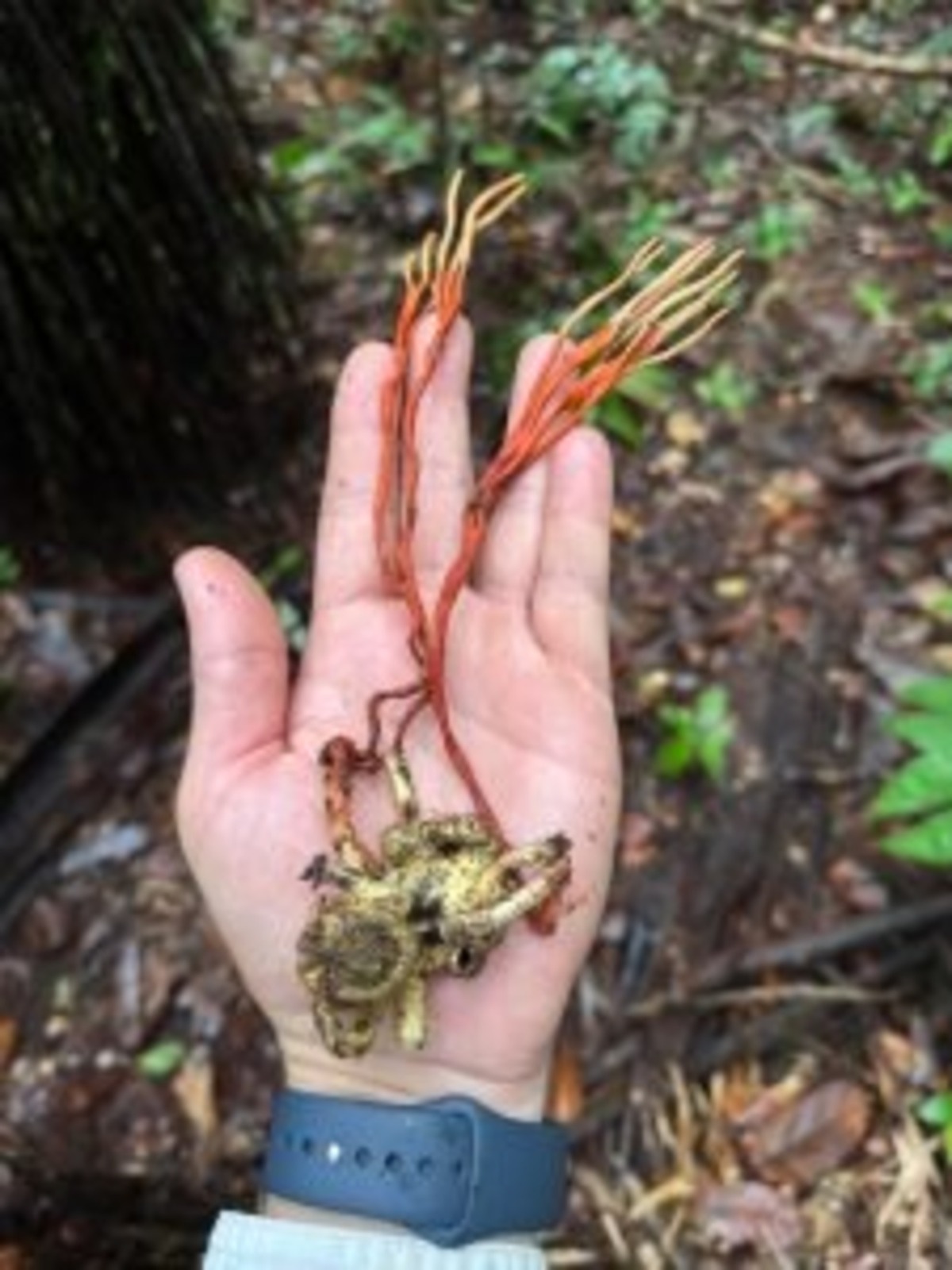
Rare Record Made by Brazilian and Danish Researchers Expands Knowledge About Relationships Between Fungi and Arachnids and Reinforces the Value of Scientific Research in the Amazon
Brazilian and Danish researchers took an important step towards understanding the relationship between fungi and arachnids by recording, for the first time, a fungus of the species Cordyceps caloceroides parasitizing a tarantula of the species Theraphosa blondii.
The work involves scientists from the Federal University of Santa Catarina (UFSC), the University of Copenhagen (UCPH), and the National Institute of Amazonian Research (Inpa), and draws attention for revealing a rare association in nature.
Fungi of the genus Cordyceps became known to the general public after the series The Last of Us, in which they are portrayed as capable of controlling humans and provoking a zombie apocalypse.
-
Motorola launched the Signature with a gold seal from DxOMark, tying with the iPhone 17 Pro in camera performance, Snapdragon 8 Gen 5 that surpassed 3 million in benchmarks, and a zoom that impresses even at night.

-
Satellites reveal beneath the Sahara a giant river buried for thousands of kilometers: study shows that the largest hot desert on the planet was once traversed by a river system comparable to the largest on Earth.

-
Scientists have captured something never seen in space: newly born stars are creating gigantic rings of light a thousand times larger than the distance between the Earth and the Sun, and this changes everything we knew about stellar birth.

-
Geologists find traces of a continent that disappeared 155 million years ago after separating from Australia and reveal that it did not sink, but broke into fragments scattered across Southeast Asia.

In reality, these organisms infect insects and arthropods, interfering with their nervous system and altering their behaviors.
Findings Occurred During Field Activity in the Amazon
The parasite and its host were found in January by Lara Fritzsche, a student of Environmental Sciences at UCPH, during activities of the Tropical Mycology Field Course.
The course, organized by biologist João Paulo Machado de Araújo, a professor at UCPH, brought together specialists from Denmark and Brazil in the Ducke Reserve, an area near Manaus.
The discovery was announced by Elisandro Ricardo Drechsler-Santos, a professor in the Graduate Program in Biology of Fungi, Algae, and Plants at UFSC and coordinator of the MIND.Funga research group, on his social media.
Rare and Highly Specialized Relationship
According to Elisandro, although similar fungi may exist in other Brazilian biomes, including Santa Catarina, the specimen identified in the Amazon has great scientific relevance.
In an interview with the portal A Crítica, he explains that fungi in this group have very high levels of specialization.
“The classic example is species X of the fungus that attacks species Y of the ant. These are relationships that often established around 50 million years ago. Studies confirm this in the case of ants. Meanwhile, with arachnids, it is very rare and very difficult to find,” he stated to the portal A Crítica.
Many Questions Still Unanswered About the Fungus
The professor also clarifies that Cordyceps propagates through spores that infect their hosts. However, there is still little information about how this process occurs specifically in spiders.
“Most likely, the spores fall onto the bodies of the spiders, or they pass over the ground where these spores have already germinated and end up becoming contaminated in some way,” he explained.
Curiosity Driven by Pop Culture
For Elisandro, the popularity of The Last of Us helped awaken public interest in mycology.
He commented that the series “did a great service to mycology around the world,” drawing attention to a group of organisms considered important but historically neglected by science and funding.
His first video about the discovery received over 2 million views. “Finding and documenting a rare species like this is indeed very exciting for scientists in our country,” he added.
The research reinforces the relevance of the Amazon as a fundamental space for new biological records and expands knowledge about poorly documented interactions between fungi and arachnids, paving the way for future studies.
With information from Notícias.ufsc.







-

Uma pessoa reagiu a isso.