





 Português
  Inglês
  Espanhol
  3 min de leitura
  0 comentários



Negative Light-Based Technology Allows for Hiding Data Within Natural Thermal Radiation Emitted by Objects, Creating Invisible Communications That Reach 100 Kilobits Per Second and Can Evolve to Megabits or Even Gigabits with New Electronic Components
Researchers have developed a communication technique based on negative light capable of transmitting invisible information by hiding it in background thermal radiation, achieving an initial speed of 100 kilobits per second without revealing that any data is being sent.
How Negative Light Allows for Hiding Messages in Heat
The technology utilizes a phenomenon called negative light to disguise data within the naturally emitted thermal radiation from heated objects. This radiation is in the infrared range of the electromagnetic spectrum, located just beyond the red end of visible light.
Although invisible to the human eye, infrared radiation can be detected by thermal cameras. All objects naturally emit a faint infrared glow, perceived as heat radiated into the surrounding environment.
-
A bright yellow mushroom imported from Asia escaped from a cultivation farm in the United States in 2010 and is now aggressively spreading across 25 states, destroying entire communities of native fungi in American forests.

-
Buried under China, a colossal machine weighing 20,000 tons began operating as the largest neutrino detector on the planet and, in just 59 days, surpassed results that science took half a century to achieve.

-
Iran enters the center of a climate alert after the war emitted 5.6 million tons of CO2 in two weeks, surpassing the annual pollution of entire countries.

-
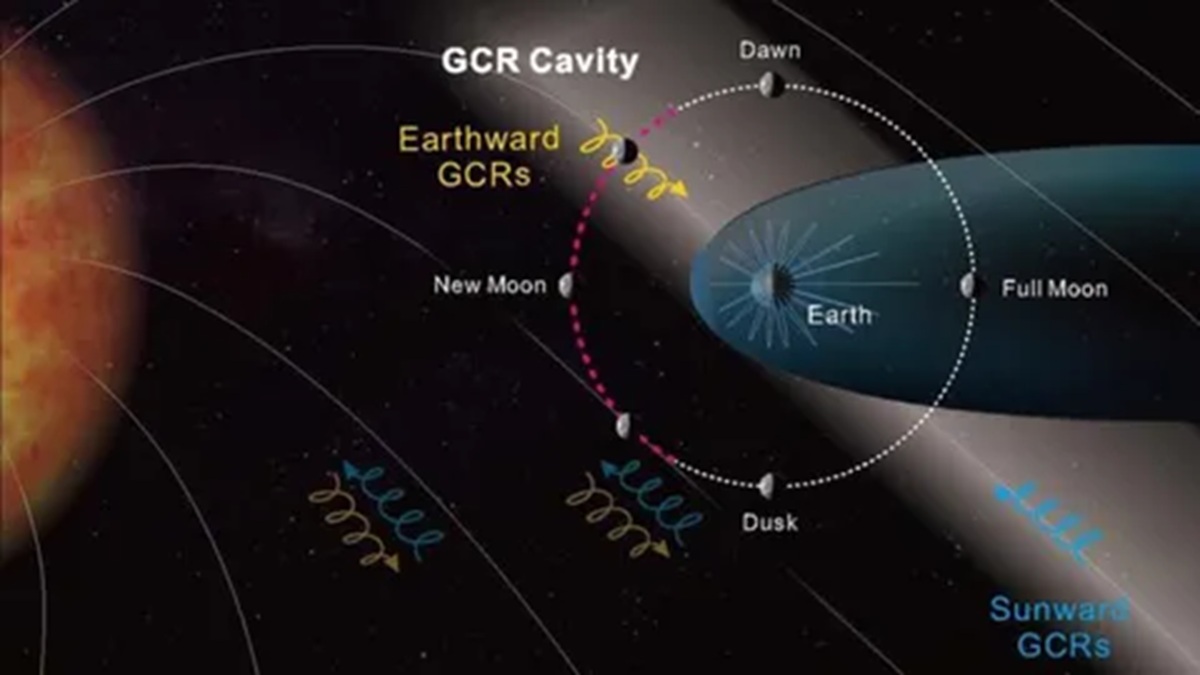
Lunar exploration may change after a Chinese probe finds a “cavity” of radiation that reduces the impact on astronauts by up to 20% at certain times on the Moon.

In the system developed by the researchers, negative light modifies this natural glow, making it slightly dimmer instead of brighter. The effect is compared to a flashlight capable of casting darkness relative to ambient light, according to researcher Michael Nielsen.
Negative Light Technology Mixes Data with Infrared Noise
To transmit the information, the team used devices known as thermoradiative diodes. These components create patterns that alternate slightly lighter or darker states within the natural infrared glow.
The patterns generated by the diodes blend with the typical background thermal noise of the environment. To external observers, the signal appears to be just part of normal thermal radiation and does not reveal that data is being transmitted.
However, specialized receivers can identify these variations and interpret them as digital information. This way, the data is transferred in a practically undetectable manner for those lacking the appropriate equipment.
Origin of the Technology Linked to Nighttime Energy Generation
The thermoradiative diodes used in the negative light-based communication initially emerged from another project conducted by the research team. This work investigated the possibility of generating solar energy even after sunset.
The technology explored the infrared radiation released by the Earth at night, when the planet begins to release the heat absorbed throughout the day. The diodes were capable of converting part of that thermal energy into electricity.
From this principle, the researchers adapted the devices to create controlled patterns in the infrared glow. These patterns then began to function as carriers of information within the ambient thermal radiation.
Current Transmission Speed and Expansion Potential
In the initial experiments, the negative light-based system achieved a transmission rate of 100 kilobits per second.
Although modest, the team claims that the speed can significantly increase with technological improvements.
According to Michael Nielsen, the main current obstacle lies in the availability of sophisticated electronic components needed for the system. In principle, the technology can reach speeds of tens of megabits per second with the existing devices.
With improvements in detector design and component performance, the rate could reach gigabits per second. The team believes that commercial equipment with megabits per second speeds may emerge in a few years.
Use of Graphene Can Elevate Transmission to Gigabits
Another possibility for advancement involves replacing the current semiconductor material of the diodes with graphene. This material consists of a sheet of carbon atoms just one atom thick arranged in a honeycomb-like pattern.
According to Ned Ekins-Daukes, co-lead of the research, the use of graphene could elevate transmission rates to the gigabit-per-second range. In ideal scenarios, performance could reach up to hundreds of gigabits.
The researchers emphasize that the main advantage of negative light-based communication lies in the fact that the very act of transmitting data remains concealed. Without access to the same detection technology, an external observer cannot perceive that any communication is occurring.
The team points out that this feature could enhance data security in sectors such as healthcare, defense, finance, and manufacturing. In applications requiring protection beyond traditional encryption, the technique could provide an additional layer of secrecy in digital transmissions.







-

3 pessoas reagiram a isso.