





 Portuguese
  English
  Spanish
  5 min of reading
  0 comments


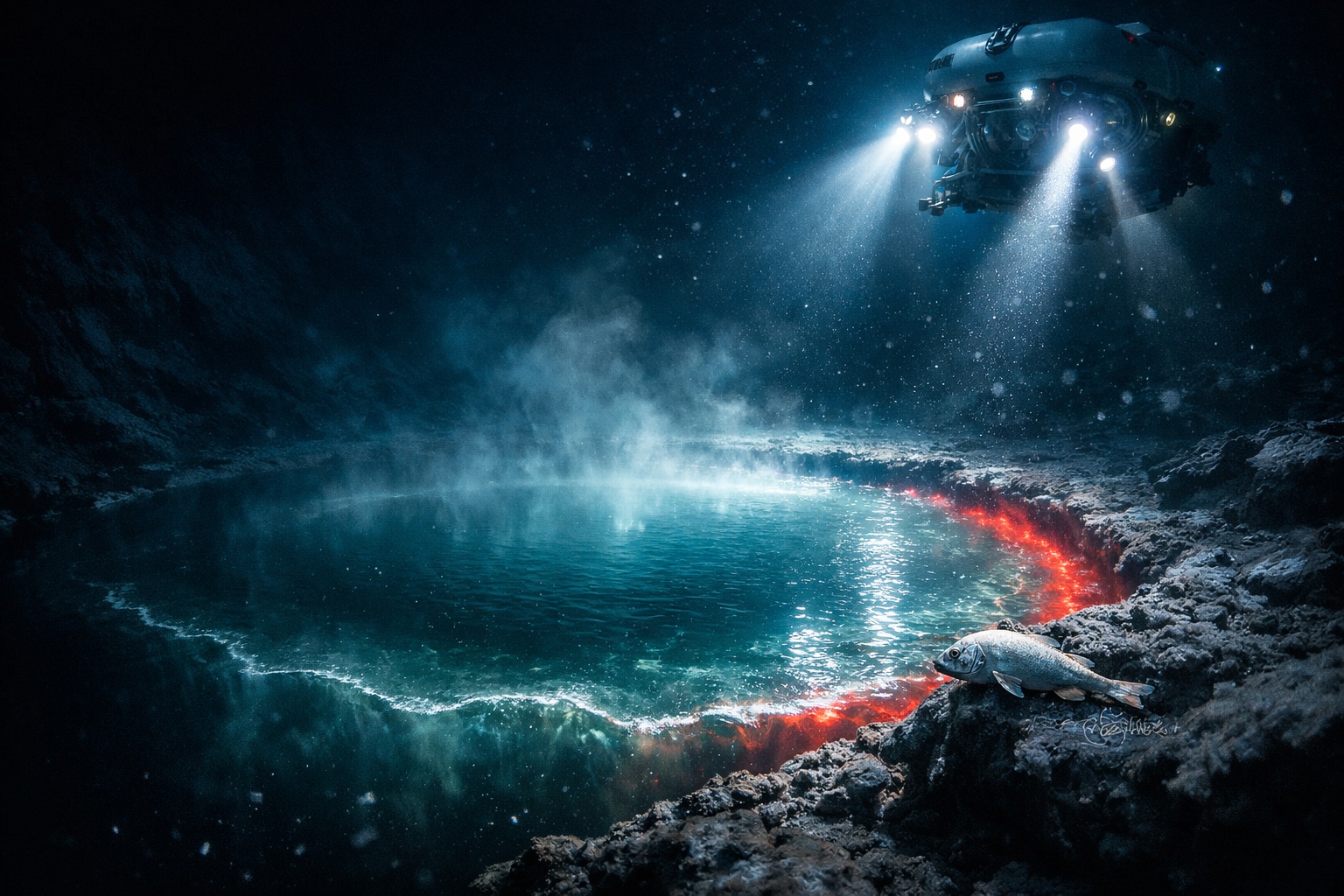
Scientists Discover Submarine Lakes in the Red Sea at 1,770 Meters Depth Preserving 1,200 Years of Tsunamis and Revealing Bacteria with Anticancer Potential
The ROV still had a few minutes of battery left when the ten-hour mission at the bottom of the Gulf of Aqaba seemed to be concluding. The abyssal plain in front of the cameras looked like so many others recorded at great depths: gray mud, absence of natural light, and subtle relief. Nothing indicated that this area of the Red Sea was hiding one of the most rare oceanographic discoveries of recent decades.
Then something different appeared on the monitor.
A reflective surface emerged at the bottom of the ocean. It was neither rock nor common mineralization. It was a liquid boundary. Two distinct fluids coexisting side by side, separated by a sharp line. Seawater encountered something denser, heavier, and chemically distinct — something that simply did not mix. They were lakes.
-
Motorola launched the Signature with a gold seal from DxOMark, tying with the iPhone 17 Pro in camera performance, Snapdragon 8 Gen 5 that surpassed 3 million in benchmarks, and a zoom that impresses even at night.

-
Satellites reveal beneath the Sahara a giant river buried for thousands of kilometers: study shows that the largest hot desert on the planet was once traversed by a river system comparable to the largest on Earth.

-
Scientists have captured something never seen in space: newly born stars are creating gigantic rings of light a thousand times larger than the distance between the Earth and the Sun, and this changes everything we knew about stellar birth.

-
Geologists find traces of a continent that disappeared 155 million years ago after separating from Australia and reveal that it did not sink, but broke into fragments scattered across Southeast Asia.
Submarine lakes within the ocean, with defined margins and their own dynamics, located at 1,770 meters depth in the Red Sea. The discovery occurred literally in the last minutes of the dive, according to researcher Sam Purkis from the University of Miami. What seemed to be just another exploratory dive revealed the so-called NEOM Brine Pools, hypersaline brine pools that function as geological time capsules.
What Are the Submarine Lakes of the Red Sea and How They Form
The submarine lakes of the Red Sea, technically known as brine pools, form from the dissolution of ancient salt deposits buried beneath the ocean floor. The Gulf of Aqaba is situated in an active tectonic zone associated with the Red Sea rift system, where tectonic plates are slowly moving apart.
This geological dynamic facilitates the circulation of subsurface fluids. Evaporitic deposits — layers of salt formed millions of years ago during periods of intense evaporation — dissolve under pressure and release solutions that are highly concentrated in salt.
When this brine emerges from the seafloor, its high density prevents it from mixing with regular ocean water. The result is the formation of a stable submarine lake, deposited in natural depressions of the relief.
The salinity measured in the NEOM Brine Pools reached 160 PSU (Practical Salinity Units). For comparison, open ocean has approximately 35 PSU. This means that the submarine lakes of the Red Sea have a salinity 4.5 times higher than the surrounding water.
In addition to the extreme hypersalinity, the environment is completely anoxic, with no dissolved oxygen in the brine.
Why the Brine Does Not Mix with the Ocean
The physical phenomenon that allows the existence of these submarine lakes is the difference in density. The highly concentrated brine has a significantly higher specific weight than regular seawater.
Without sufficient turbulence to promote homogenization, the two liquids remain separated by a visible interface. This boundary functions like a submerged shoreline, creating a lake within the ocean.

Internally, the brine can exhibit micro-currents and slow undulations but remains confined. This type of liquid stratification is rare in the global marine environment and requires a specific combination of geological, tectonic, and chemical factors.
Currently, similar environments have only been identified in three regions of the planet: the Gulf of Mexico, the Mediterranean Sea, and the Red Sea.
Intact Record of 1,200 Years of Tsunamis in the Gulf of Aqaba
The most impressive aspect of the submarine lakes of the Red Sea is not only chemical but sedimentological.
Since the environment is anoxic, there is no biological disturbance of the sediment. This means that the layers deposited over the centuries remain intact, without mixing or disturbance.
Researchers inserted sampling tubes that penetrated more than three meters into the compacted sediment of the pools. The result was a continuous record of at least 1,200 years of geological history of the Gulf of Aqaba.

Each layer corresponds to distinct events: coastal flooding, submarine landslides, seismic activity, and tsunamigenic episodes.
One of the analyzed layers, dated to approximately 500 years ago, showed chaotic sedimentary structure typical of abrupt high-energy events — consistent with a submarine landslide capable of generating significant coastal waves.
This event is not incorporated into modern seismic risk models for the region.
Impact of the Discovery on Coastal Megaprojects
The Gulf of Aqaba is undergoing one of the fastest urban expansions on the planet, with major infrastructure projects being developed along the Saudi coast.
The existence of a preserved geological archive beneath the seabed profoundly changes the risk assessment landscape.
Risk models generally rely on written historical records, which rarely extend beyond a few centuries. The submarine lakes of the Red Sea function as a physical archive that can be expanded with deeper drilling.
These records could redefine seismic and tsunamigenic risk parameters for the entire region.
Extremophile Bacteria and Anticancer Potential
At the interface between normal ocean water and brine, an extreme chemical gradient forms, with high concentrations of salt, hydrogen sulfide, and almost total absence of oxygen. Even under these conditions, specialized microbial communities manage to survive.

Previous studies in deep pools of the Red Sea showed that microorganisms isolated from these environments produce rare bioactive compounds.
Research published in the journal BMC Complementary Medicine and Therapies tested 60 bacterial extracts from brine pools against seven cancer cell lines.
Half of the samples showed significant inhibition of cell growth. Some extracts demonstrated selectivity against triple-negative breast cancer while maintaining low toxicity to normal cells.
The metabolic adaptation required to survive in hypersaline and anoxic environments leads to the production of unusual chemical molecules, which have pharmaceutical interest.
Submarine Lakes as an Analogue for Primitive Earth
Before the Great Oxidation Event, about 2.4 billion years ago, Earth did not have free oxygen in the atmosphere.
Environments similar to the submarine lakes of the Red Sea — anoxic, chemically extreme, and rich in dissolved minerals — may have been common in the primitive oceans.
Studying these systems helps to understand how life arose on the planet and what minimum conditions allow biological persistence.

Moreover, analogous environments may exist in subterranean oceans of moons like Europa (Jupiter) and Enceladus (Saturn), where there is evidence of liquid water beneath layers of ice.
Publication in Nature and Next Steps
The discovery of the NEOM Brine Pools was published in June 2022 in the journal Communications Earth & Environment, part of the Nature group. The article has accumulated tens of thousands of accesses, a high number for marine geosciences studies.
The team intends to return to the site with drilling equipment capable of reaching even deeper layers, expanding the record beyond the 1,200 years already documented.
Meanwhile, the submarine lakes of the Red Sea remain stable at 1,770 meters depth, accumulating new sediment layers with each geological event. The archive continues to be written in the absolute silence of anoxia.








-

-

-

3 pessoas reagiram a isso.