





 Português
  Inglês
  Espanhol
  5 min de leitura
  0 comentários



New Measurements From The James Webb Space Telescope Indicate That The Interstellar Comet 3I/ATLAS May Have Formed Between 10 And 12 Billion Years Ago, Potentially Becoming One Of The Oldest Objects Ever Observed Crossing The Solar System And Offering Clues About The First Chemical Environments Of The Milky Way
Recent observations from the James Webb Space Telescope indicate that the interstellar comet 3I/ATLAS may have formed about 10 to 12 billion years ago, potentially becoming one of the oldest objects ever detected crossing the solar system.
The object known as 3I/ATLAS garnered worldwide attention after being identified as an interstellar visitor crossing the solar system last year.
Initially, its passage generated speculation and debate, including online theories suggesting it might be a possible alien spacecraft.
-
A bright yellow mushroom imported from Asia escaped from a cultivation farm in the United States in 2010 and is now aggressively spreading across 25 states, destroying entire communities of native fungi in American forests.

-
Buried under China, a colossal machine weighing 20,000 tons began operating as the largest neutrino detector on the planet and, in just 59 days, surpassed results that science took half a century to achieve.

-
Iran enters the center of a climate alert after the war emitted 5.6 million tons of CO2 in two weeks, surpassing the annual pollution of entire countries.

-
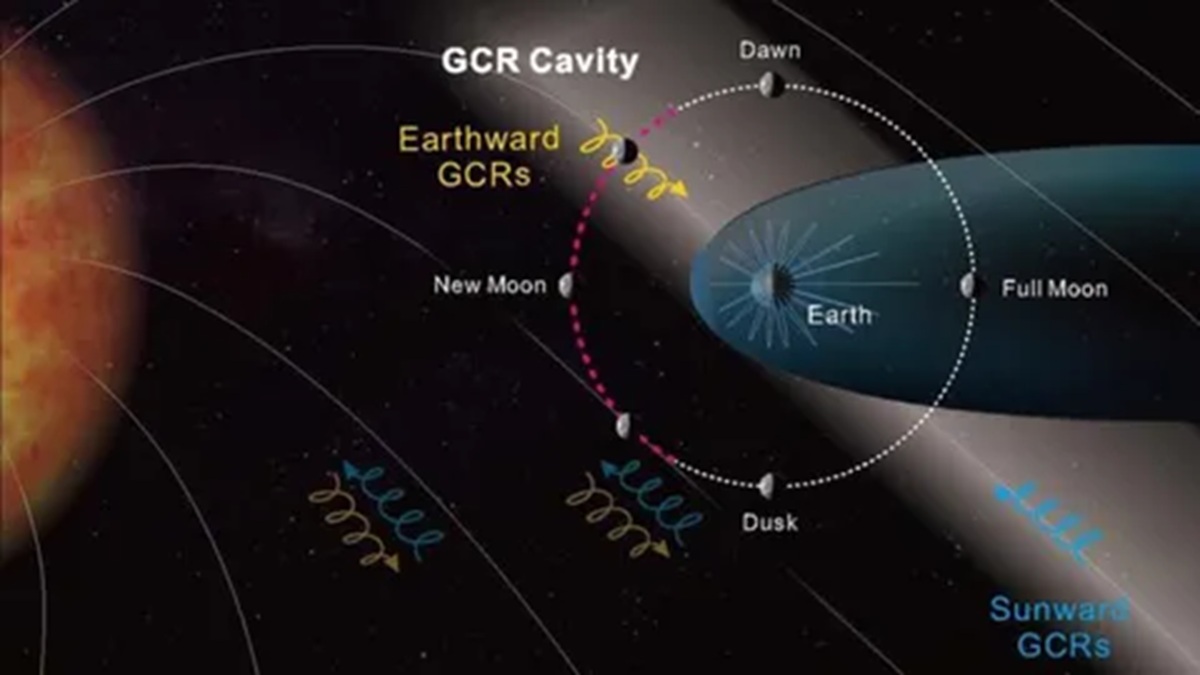
Lunar exploration may change after a Chinese probe finds a “cavity” of radiation that reduces the impact on astronauts by up to 20% at certain times on the Moon.
Despite these hypotheses, most astronomers have concluded that 3I/ATLAS is a comet originating from an unknown stellar system. Recent studies reinforce this interpretation by analyzing its composition and trajectory more precisely.
The new analyses have been preliminarily published on the Research Square preprint server and are still under peer review. Nevertheless, the data obtained provide detailed information about the possible age and origin of the comet.
Observations From The James Webb Indicate Extreme Age Of 3I/ATLAS
Scientists had already suspected that 3I/ATLAS could be extremely ancient due to its speed and trajectory while crossing the solar system. These characteristics indicated that the object likely formed long before the birth of our own planetary system.
Initial estimates suggested that the comet could be between 3 billion and 11 billion years old.
However, the new measurements taken by the James Webb Telescope narrowed this range and indicate an approximate age of between 10 billion and 12 billion years.
If these estimates are confirmed, 3I/ATLAS would be more than twice the age of Earth, estimated at about 4.5 billion years. The age would also exceed that of the solar system itself, formed about 4.6 billion years ago.
In the highest estimate, the comet could approach the age of the Milky Way, calculated at about 13.6 billion years. The value also approaches the estimated age of the universe, which is around 13.8 billion years.
3I/ATLAS Is Only The Third Registered Interstellar Visitor
3I/ATLAS is only the third interstellar object identified crossing the solar system. According to observations made by the Hubble Space Telescope, the body has an estimated diameter of between 440 meters and 5.6 kilometers.
The comet entered the solar system at an approximate speed of 221,000 kilometers per hour. After approaching the Sun, it followed a trajectory that allowed telescopes to observe its composition and behavior.
The closest point to the Sun, called perihelion, was recorded on October 29, 2025. Shortly thereafter, on December 19, the comet made its closest approach to Earth.
On that occasion, 3I/ATLAS passed about 270 million kilometers from the planet. Observations made by the James Webb Telescope occurred a few days later, on December 22.
Chemical Composition Of 3I/ATLAS Reveals Very Ancient Origin Environment
As comets approach a star, the increase in temperature causes the sublimation of ice present on their surface. This process transforms ice directly into gas and releases materials that can be analyzed by scientists.
Researchers used this characteristic to study the composition of the material released by 3I/ATLAS. The analysis focused mainly on the ratio of isotopes present in the gases emitted by the comet.
The results indicated that the water present in 3I/ATLAS has deuterium levels higher than those observed in any comet already studied within the solar system. Deuterium is a heavier isotope of hydrogen.
Additionally, the ratio of carbon isotopes found in the comet also exceeded the levels typically recorded in objects from our planetary system. These data reinforce the hypothesis that the comet formed in a different stellar environment.
According to researcher Romain Maggiolo from the Royal Belgian Institute for Space Aeronomy, the results indicate that 3I/ATLAS likely emerged about 10 to 12 billion years ago in another region of the Milky Way.
Extreme Formation Conditions May Have Occurred At The Beginning Of The Galaxy
The data obtained by researchers also suggest that the comet formed in an extremely cold environment. Estimates indicate temperatures around 30 kelvins, equivalent to about minus 243 degrees Celsius.
This scenario suggests that 3I/ATLAS may have emerged within a dense and protected protoplanetary disk. Environments of this type are regions where planets and other celestial bodies can begin to form.
The observed chemical characteristics in the comet also indicate a significant presence of volatile molecules. These compounds can provide clues about the chemical processes that occurred in the early planetary systems of the Milky Way.
Maggiolo highlighted that these molecules may indicate that a rich prebiotic chemistry was already occurring in star formation regions very early in the history of the galaxy.
Exact Origin Of 3I/ATLAS May Never Be Discovered
Even with the new measurements, scientists consider it unlikely to discover exactly in which stellar system 3I/ATLAS formed. The object has likely traveled great distances over billions of years as it traversed interstellar space.
The long exposure to cosmic radiation may also have significantly altered its chemical composition. This process makes it even more difficult to reconstruct the exact conditions of its place of origin.
Despite these limitations, researchers emphasize that the data collected by the James Webb Telescope represent an important piece for understanding this interstellar visitor. Each new measurement contributes to clarifying its history.
Comet 3I/ATLAS Is Already Leaving The Solar System
As studies continue, 3I/ATLAS is already rapidly moving away from the solar system. The object is currently heading toward the region of Jupiter, where it will make its closest approach to the planet on March 15.
During this passage, the comet is expected to come within about 54 million kilometers of the gas giant. This distance is significantly smaller than that recorded during its approach to Earth.
After that, the comet will continue its journey toward the outer regions of the solar system. Projections indicate that it will cross Saturn’s orbit in July, Uranus’s orbit in April 2027, and Neptune’s orbit in March 2028.
Even as it moves away rapidly, 3I/ATLAS will continue to be monitored by astronomers. Each new observation may reveal more details about this ancient interstellar messenger that crossed our solar system.







Seja o primeiro a reagir!