





 Portuguese
  English
  Spanish
  3 min of reading
  0 comments


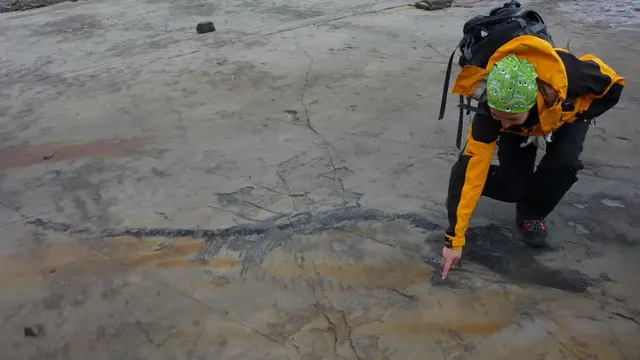
An Impressive Paleontological Discovery Revealed the Fossil of a Marine Reptile 131 Million Years Ago That Was Pregnant. Inside the Fossilized Creature, Researchers Found Two Well-Preserved Fetuses
A rare and well-preserved fossil revealed a secret hidden for millions of years. A marine reptile, known as an ichthyosaur, was found pregnant with twins. The fossil, excavated in Chile, offers a unique insight into the past and reproduction of these extinct animals.
Discovery Made Possible by Glacier Melting
The story began in 2009 when paleontologist Judith Pardo-Pérez found the remains of an ichthyosaur in Torres del Paine National Park, Chile. The discovery occurred after the melting of the Tyndall Glacier, which revealed the fossil embedded in rock.
The animal was nicknamed Fiona and belongs to the species Myobradypterygius hauthali, a type of ichthyosaur that lived about 131 million years ago. It measured about 3.5 meters in length and was incredibly well preserved.
-
Motorola launched the Signature with a gold seal from DxOMark, tying with the iPhone 17 Pro in camera performance, Snapdragon 8 Gen 5 that surpassed 3 million in benchmarks, and a zoom that impresses even at night.

-
Satellites reveal beneath the Sahara a giant river buried for thousands of kilometers: study shows that the largest hot desert on the planet was once traversed by a river system comparable to the largest on Earth.

-
Scientists have captured something never seen in space: newly born stars are creating gigantic rings of light a thousand times larger than the distance between the Earth and the Sun, and this changes everything we knew about stellar birth.

-
Geologists find traces of a continent that disappeared 155 million years ago after separating from Australia and reveal that it did not sink, but broke into fragments scattered across Southeast Asia.

Initially, in 2010, researchers thought they had found a single fetus inside the fossil. But a new analysis conducted in 2022 brought a surprise: Fiona was pregnant with twins.
First Complete Fossil in the Country
The skeleton of Fiona is the first completely excavated ichthyosaur specimen in Chile. The excavation took place in 2022 at the edge of the glacier under challenging conditions.
The study of the fossil showed that the fetuses’ vertebrae were larger than expected. According to the researchers, this indicates that the species gave birth to relatively large offspring. The babies’ vertebrae measured about 1.5 cm, which caught the team’s attention.
The discovery was described in a paper published in the Journal of Vertebrate Paleontology and gained international scientific press attention.
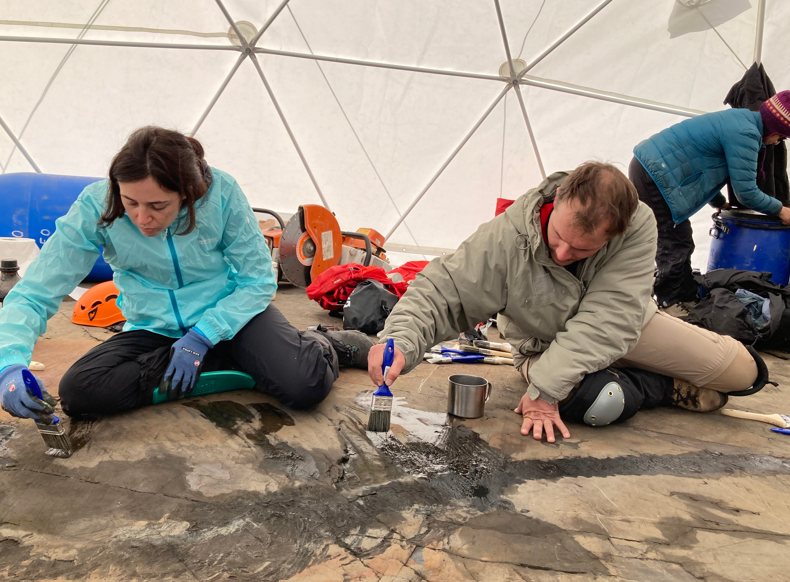
Fossil Shows Rare Signs
In addition to the fetuses, Fiona’s fossil revealed more surprising details. Scientists found remains of small fish inside the animal’s stomach. This provided important clues about the diet of ichthyosaurs during the Cretaceous period.
The preservation of the fossil was considered exceptional. According to the study, the carcass was rapidly buried by sediments.
This process prevented decomposition and stopped other animals from destroying the remains. The low-oxygen environment at the bottom of the sea also helped keep the fossil intact.
Birthing Tail First
Another important point was the position of the fetuses inside Fiona’s body. The analysis indicated that she would give birth with the tail of the offspring coming out first.
This type of birth is also common in modern marine mammals, such as dolphins and whales.
This similarity suggests a similar evolutionary adaptation, despite ichthyosaurs not being mammals.
It is an example of what scientists call convergent evolution, when different species develop similar solutions to the same challenges.
Third Case from the Cretaceous Period
So far, only three pregnant ichthyosaurs from the Cretaceous period have been found. The other records were linked to the Jurassic and Triassic periods.
This makes Fiona’s fossil even more valuable for scientific studies. It offers unprecedented information about how these animals lived, fed, and reproduced.
Paleontologist Judith Pardo-Pérez, responsible for the discovery, continues to analyze the fossil. She plans to release more information in a new scientific publication.








Seja o primeiro a reagir!