





 Portuguese
  English
  Spanish
  6 min of reading
  0 comments


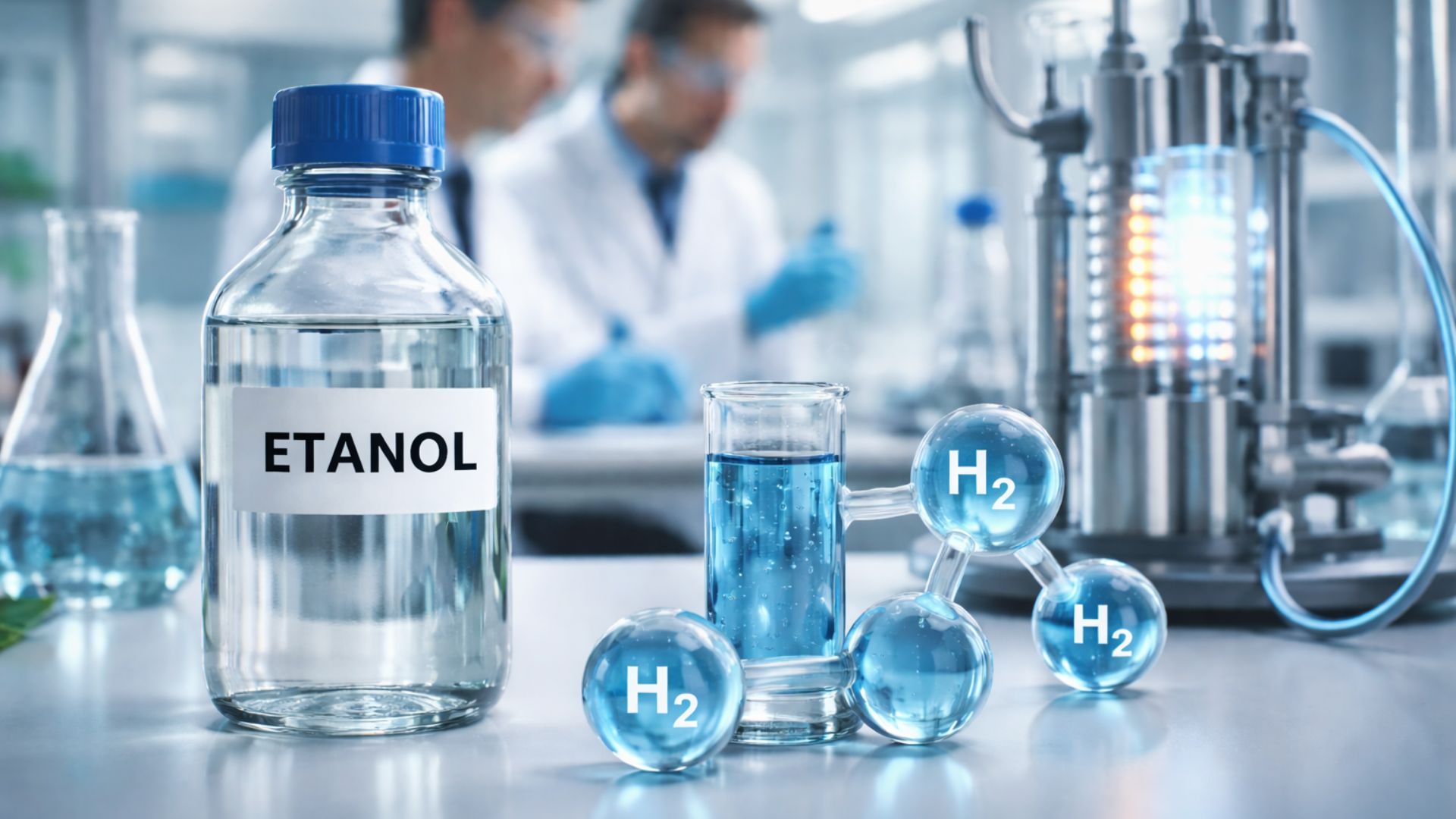
Research Conducted by Scientists from Ipen Reveals How a New Ceramic Catalyst Increases Efficiency in Hydrogen Production from Ethanol, Achieving 100% Conversion and Greater Operational Stability.
In the midst of the climate crisis and the urgent need to reduce greenhouse gas emissions, Brazilian researchers have made a significant advancement in the area of clean energy. According to an article published by FAPESP Agency on February 24, scientists from the Institute of Nuclear and Energy Research developed a ceramic catalyst capable of significantly improving the conversion of ethanol into hydrogen, expanding the possibilities of using renewable fuels in the country.
Scientists Advance the Conversion of Ethanol into Hydrogen Focusing on Efficiency and Stability
The study, coordinated by Fabio Coral Fonseca, was published in the International Journal of Hydrogen Energy and shows that precise control of the processing temperature of the material is crucial for achieving high catalytic performance. The results include 100% conversion of ethanol, a yield of 4.04 moles of hydrogen per mole of ethanol, and operational stability of up to 85 hours, with low formation of coke.
Hydrogen is considered one of the most promising energy vectors in the low-carbon economy. When produced from renewable sources, it can act as clean fuel, industrial input, and a form of energy storage.
-
Renewable energy advances over protected areas in Brazil, and a survey by the Energy Transition Observatory reveals silent impacts that challenge environmental conservation and pressure sensitive traditional territories.

-
Rio Grande do Sul accelerates energy transition: State invests in renewable technologies and consolidates decarbonization strategies and pathways to attract billions in new industrial investments.

-
With 160,000 m² of collectors, an area larger than 20 football fields, Silkeborg, in Denmark, hosts a solar thermal plant that heats 19,500 homes and could become the largest solar heating plant in the world.

-
A study reveals the expansion of renewable energy procurement in Brazil and shows how companies are taking advantage of opportunities to reduce expenses, ensure energy efficiency, and strengthen strategic environmental commitments.

Among the available technological routes, ethanol steam reforming — known by the acronym ESR — stands out in the Brazilian context. In this process, ethanol reacts with steam at high temperatures to generate hydrogen and carbon dioxide. The ideal global reaction is represented by:
C₂H₅OH + 3 H₂O → 2 CO₂ + 6 H₂
Although the equation appears simple, the process involves multiple intermediate stages. It is precisely at this point that the role of the catalyst becomes central. It directs the reaction to maximize hydrogen production and minimize unwanted byproducts, such as the formation of solid carbon, known as coke, which compromises the system’s lifespan. Scientists have demonstrated that small variations in the material manufacturing step can completely alter the catalyst’s final performance.
Perovskite-Type Ceramic Catalyst Improves Performance in Hydrogen Production
The material developed is a ceramic oxide with a perovskite-type structure, defined by the general formula ABO₃. In this crystal arrangement, different elements can occupy positions A and B, providing great structural flexibility and adjusting electrical, ionic, and catalytic properties.
Unlike conventional methods, where the active metal is impregnated onto the surface of the support, the new catalyst incorporates nickel directly into the crystal structure during synthesis. Subsequently, under controlled conditions, a phenomenon known as exsolution occurs.
In exsolution, nickel (Ni⁰) metallic nanoparticles emerge from the internal structure to the surface of the material. These particles become strongly anchored to the ceramic substrate, which reduces surface mobility and increases stability against sintering. This structural detail is crucial for maintaining catalytic activity over time and minimizing coke formation, a recurring issue in reforming processes.

Calcination Temperature Defines the Catalyst Efficiency in Ethanol Reforming
One of the main advancements of the study was to demonstrate that the calcination temperature of the precursor oxide, prior to the reduction stage, controls the catalyst’s performance.
The researchers synthesized the material using a chemical method and calcined it at three distinct temperatures: 650 °C, 800 °C, and 1,200 °C. This step directly influences the size of the ceramic particles and the available surface area.
The results showed that calcining at 650 °C preserves a larger surface area and favors efficient nickel exsolution. Under this condition, the system achieved 100% conversion of ethanol and a yield of 4.04 moles of hydrogen per mole of ethanol. Furthermore, the catalyst maintained stability for up to 85 hours of continuous operation, with low carbon formation.
At 800 °C and 1,200 °C, excessive growth of ceramic particles occurred. This increase in size reduced the surface area and hindered the emergence of nickel to the surface, impairing catalytic activity.
In these cases, lower ethanol conversion and a shift in reaction selectivity were observed, favoring simple dehydrogenation instead of complete reforming for hydrogen generation. The study highlights that selecting the right elements is not enough: material processing is crucial for the final performance.
Scientists Explore Abundant Metals to Make Renewable Fuels More Competitive
Traditionally, reforming processes use noble metals such as ruthenium, rhodium, or platinum, known for their high catalytic activity. However, these elements come at a high cost and limited availability.
By using nickel — a more abundant and economically accessible metal — the new catalyst reduces reliance on noble metals and expands the economic viability of hydrogen production from ethanol.
This strategy is especially relevant for countries seeking to strengthen renewable fuels without excessively increasing production costs. The use of cheaper metals, combined with the greater stability of the system, represents a significant advancement for future industrial applications.

Integration Between Ethanol and Hydrogen Reinforces Brazil’s Strategic Role
Brazil has one of the largest ethanol production chains in the world, with a consolidated infrastructure for the production, distribution, and use of the biofuel. This installed base creates favorable conditions for exploring technological routes that add value to ethanol.
The conversion of ethanol into hydrogen can allow for decentralized production, low-carbon industrial applications, and integration with electrical generation systems. However, the researcher responsible for the study emphasizes that simple conversion is not always the most efficient alternative from an energy standpoint, considering the entire agricultural, fermentation, and distillation process necessary to produce ethanol.
For this reason, the team is also investigating direct ethanol fuel cells, capable of converting liquid fuel directly into electricity, expanding the technological possibilities associated with the studied perovskites.
Scientists Expand Research with Support from FAPESP and International Collaborations
The study is part of a broader research program on metallic exsolution in perovskites. In a previous work, also coordinated by Fonseca and published in Catalysis Science & Technology, significant results were obtained with ruthenium exsolved in structures based on lanthanum chromite.
The research received support from the São Paulo Research Foundation through the Thematic Project “Advanced Electrochemical Devices for Molecule Conversion and Energy Production,” in addition to Research Grants 17/11937-4, 18/19251-7, and 24/00989-7, and a Doctoral Scholarship.
The group also collaborates with researchers from the United States with funding from the National Science Foundation. Part of the advanced characterizations is carried out at Sirius, the Brazilian synchrotron light accelerator that allows for structural analyses at the atomic level.
In addition to studies with polycrystalline powders, scientists are advancing to even more controlled systems, such as epitaxial thin films produced by pulsed laser deposition. In these materials, the ordered growth allows for investigating exsolution with greater precision and understanding the fundamental mechanisms involved.

What This Advance Means for the Future of Renewable Fuels
The results demonstrate that it is possible to achieve high catalytic performance with abundant metals, prolonged stability, and refined structural control. Achieving 100% conversion of ethanol, with a yield of 4.04 moles of hydrogen per mole of ethanol and stable operation for 85 hours, reinforces the technological potential of the route.
In a global scenario of energy transition, solutions that combine economic feasibility, technical performance, and the use of existing production chains are likely to stand out. The development of this catalyst represents a consistent step in that direction.
By integrating materials science, chemical engineering, and decarbonization strategies, Brazilian scientists demonstrate that technological innovation can strengthen the competitiveness of renewable fuels and expand the role of hydrogen in the energy matrix.









-

-

7 pessoas reagiram a isso.