





 Portuguese
  English
  Spanish
  5 min of reading
  0 comments


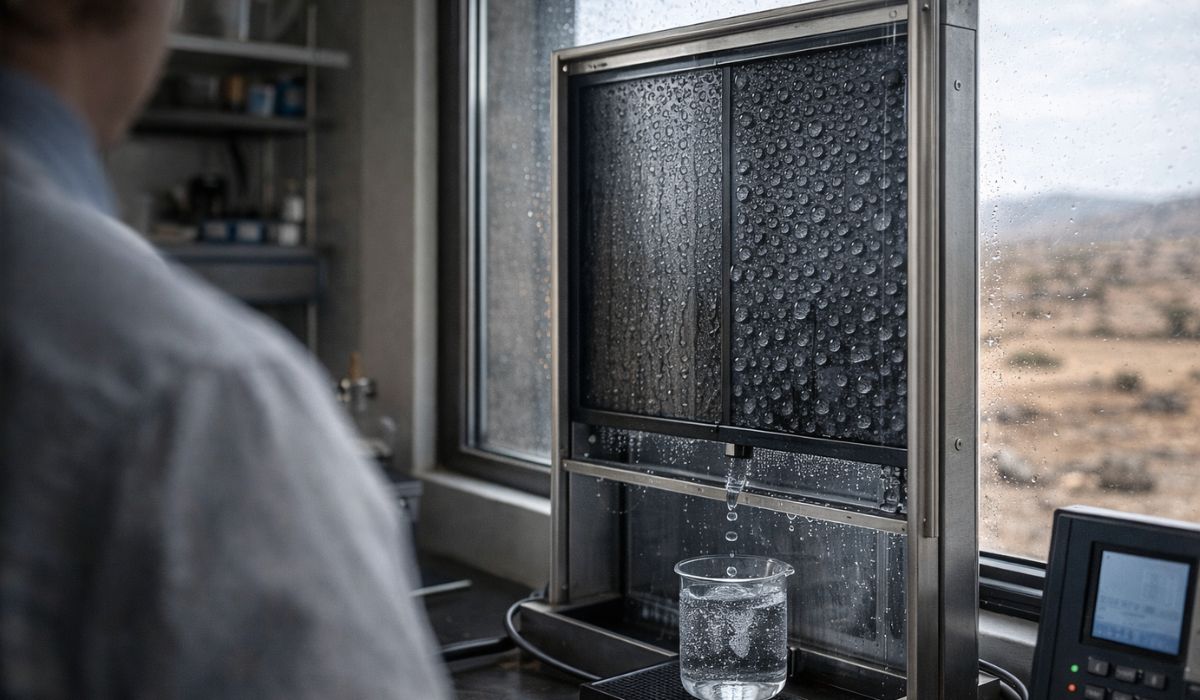
One Prototype From MIT Uses Hydrogel and Natural Temperature Variations to Capture Humidity From the Air and Generate Water for Consumption Without Electricity, With Tests in the Desert and Results That Place the Technology in the Access Debate.
Researchers from the Massachusetts Institute of Technology (MIT), in the United States, developed a passive water collector that extracts humidity from the air and converts it into drinking water without relying on electricity, batteries, or solar panels.
The prototype, approximately the size of a window, was tested in Death Valley, California, and produced water even in low humidity conditions, with a volume of up to 160 milliliters per day, according to the authors.
The study was published in the scientific journal Nature Water.
-
Motorola launched the Signature with a gold seal from DxOMark, tying with the iPhone 17 Pro in camera performance, Snapdragon 8 Gen 5 that surpassed 3 million in benchmarks, and a zoom that impresses even at night.

-
Satellites reveal beneath the Sahara a giant river buried for thousands of kilometers: study shows that the largest hot desert on the planet was once traversed by a river system comparable to the largest on Earth.

-
Scientists have captured something never seen in space: newly born stars are creating gigantic rings of light a thousand times larger than the distance between the Earth and the Sun, and this changes everything we knew about stellar birth.

-
Geologists find traces of a continent that disappeared 155 million years ago after separating from Australia and reveal that it did not sink, but broke into fragments scattered across Southeast Asia.

According to the team, the proposal aims to advance alternatives for regions with limited infrastructure, where solutions requiring power or continuous logistical supply may not be available.
The device is based on a vertical panel made of hydrogel, a porous material capable of absorbing water.
In the model described by the researchers, this hydrogel was shaped with small protrusions, resembling a dark “bubble wrap,” to increase the contact area with the air and facilitate vapor capture, as described in the technical details released by MIT.
Around the panel, there is a glass chamber.
The team reports that the glass received a treatment designed to facilitate cooling of the surface, thereby favoring the formation of droplets when the vapor comes into contact with the material.
How The Device Transforms Air Humidity Into Water
The operation relies on natural variations in temperature and humidity throughout a daily cycle.
In cooler periods, the hydrogel absorbs some of the water vapor present in the air and expands, according to the researchers.
As the temperature rises, the material begins to release the water it retains.
This vapor, upon meeting the glass, condenses, a process in which the gas returns to a liquid state.
After that, the formed droplets flow down by gravity.
The water is then channeled through a tube to a reservoir, a step described by the team as part of the design for collection without external energy consumption.

The main difference compared to other atmospheric capture devices, according to the authors, is that there is no need for electricity to heat, cool, or operate mechanical components.
In many existing devices, artificial cooling is what allows the vapor to condense into liquid water.
Testing in Death Valley and Registered Daily Production
To evaluate performance under challenging conditions, the prototype was installed in Death Valley, an area often cited in climatological records as one of the driest in North America.
The experiment lasted over a week, during which the device maintained daily production, according to the researchers’ reports.
In the best observed result, the system generated up to 160 milliliters per day, a volume equivalent to about two-thirds of a cup.
MIT claims that performance can vary depending on humidity and temperature, and that more humid locations tend to allow for greater capture.
Furthermore, the institution notes that one possibility being studied is the use of more than one panel in parallel, which would increase the total volume collected in the same location.
The research, however, does not provide a closed estimate of how many panels would be necessary to meet household consumption standards in the public statement consulted.

Crisis of Drinking Water and Water Security Around the World
MIT relates the project to challenges of access and water security in different regions.
In the statement about the study, the institution cites estimates according to which over 46 million people in the United States face water insecurity, either due to lack of piped water or difficulties in regularly accessing water considered safe to drink.
On a global scale, data consolidated by international organizations indicate that 2.2 billion people lacked access to safely managed drinking water services in 2022.
This indicator considers criteria such as availability when needed and absence of contamination at risk levels.
The World Health Organization (WHO) also reports that consumption of contaminated water can lead to the transmission of diseases and associates this problem with a high number of deaths from diarrhea each year.
For this reason, proposals seeking to expand access to safe sources are often discussed alongside sanitation and treatment measures.
Limitations of the Prototype and Challenges for Scale Use
Despite the results presented, the equipment described by MIT remains a prototype.
The institution’s own public statement frames the experiment as a demonstration of viability at a “meter scale” and indicates that larger versions could be evaluated.
Information on performance in prolonged use, production costs at scale, durability of the hydrogel in different environments, and maintenance requirements to ensure water quality over time are still lacking based on what has been disclosed.
There is also no timeline for commercialization or deployment in the public material consulted.
The authors emphasize, on the other hand, that the atmosphere contains water in vapor form and that the central technological question is how to capture and convert this moisture into useful volumes without relying on complex infrastructure.
In this line, the team describes the device as an attempt to take advantage of common environmental conditions, such as the alternation between cooler nights and warmer days.
With a test conducted in a low-humidity area and registered daily production, the next step pointed out by the researchers is to understand how the approach behaves in other scenarios and scales.
From there, the debate will include practical issues such as cost, maintenance, and potable water standards required in each country.







-

-

-

-

6 pessoas reagiram a isso.