





 Portuguese
  English
  Spanish
  3 min of reading
  8 comments


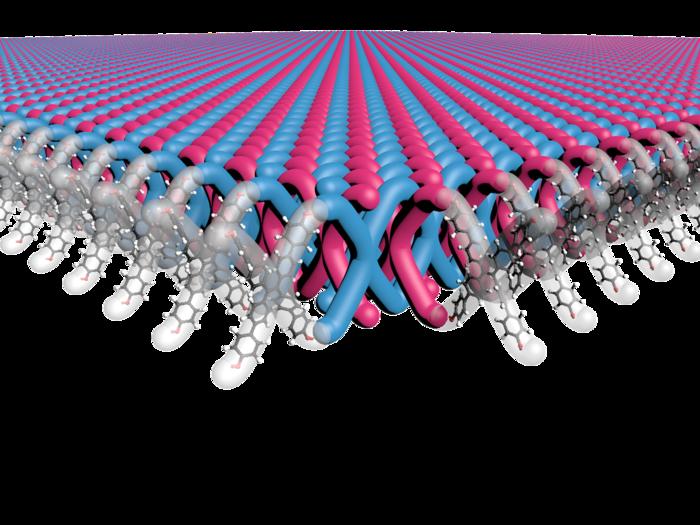


An Incredible Scientific Breakthrough! Researchers in the USA Created a Material with 100 Trillion Links, Making It the Most Resistant Shield Ever Recorded.
Researchers from Northwestern University in the United States announced the creation of a revolutionary material that promises to change the concept of resistance and flexibility in shielding.
It is the first mechanically interlinked two-dimensional (2D) material, with an impressive density of 100 trillion mechanical links per square centimeter.
ARTICLE CONTINUES BELOWSee also
Motorola launched the Signature with a gold seal from DxOMark, tying with the iPhone 17 Pro in camera performance, Snapdragon 8 Gen 5 that surpassed 3 million in benchmarks, and a zoom that impresses even at night.

Satellites reveal beneath the Sahara a giant river buried for thousands of kilometers: study shows that the largest hot desert on the planet was once traversed by a river system comparable to the largest on Earth.

Scientists have captured something never seen in space: newly born stars are creating gigantic rings of light a thousand times larger than the distance between the Earth and the Sun, and this changes everything we knew about stellar birth.

Geologists find traces of a continent that disappeared 155 million years ago after separating from Australia and reveal that it did not sink, but broke into fragments scattered across Southeast Asia.
This breakthrough could pave the way for lighter and highly resistant body armor, as well as other industrial shielding applications.
The idea behind the mechanical links dates back to the 1980s, when chemist Fraser Stoddart introduced the concept. His contribution to science did not stop there.
He expanded the use of these links in molecular machines, creating dynamic structures that enable functions like contraction, expansion, and rotation. These discoveries earned him the Nobel Prize in Chemistry in 2016.
However, developing mechanically interlinked polymers was not an easy task. Decades of failed attempts marked the search for a viable solution.
According to William Dichtel, a professor at Northwestern and leader of the research, the main challenge was creating rings large enough for other molecules to pass through. “In organic chemistry, it’s simple to form small rings with 5 to 8 atoms, but these don’t work for our purpose,” he explained.
The Innovative Process
The key to success was a creative approach led by Madison Bardot, a PhD student in Dichtel’s lab. She developed X-shaped monomers that organize into ordered crystalline structures.
From there, other molecules formed the mechanical links, resulting in interlinked 2D polymer sheets. This unique structure allowed for a link density never seen before.
A notable feature of the new material is its flexibility combined with strength. According to Dichtel, the polymer can bend under light forces but becomes rigid when subjected to greater stresses. This property, known as “strain hardening,” is crucial for applications that require high durability.
Another surprising detail is that the interlinked sheets can be separated by dissolving the polymer in solution. This facilitates handling and opens possibilities for specific applications, something previously unattainable in such resistant materials.
Testing and Future Applications of Shielding
The tests conducted by the team also demonstrated how the material can be integrated with other compounds. In collaboration with researchers from Duke University, the new polymer was mixed with Ultem, a fiber of the same family as Kevlar.
Only 2.5% of the material was enough to drastically improve the strength and toughness of Ultem, making it ideal for shielding and ballistic protection.
Additionally, the team managed to synthesize nearly half a kilogram of the material, proving that the method is scalable. This advancement is essential for the technology to be applied on a large scale.
Overcoming Challenges
The development of this polymer even challenged the most experienced scientists. “We needed a multidisciplinary team to prove that we really had the interconnected structure we envisioned,” Dichtel revealed. Chemists, polymer engineers, and electron microscopy specialists joined forces to understand and validate the properties of the material.
The ability to manipulate links at the molecular level opens a new chapter in materials science. In addition to its obvious application in armor, the architecture of the polymer has the potential to revolutionize industrial sectors, making equipment safer and more durable.
Although it is still in its early stages, this technology could redefine the concept of mechanical resistance.








Já no Brasil, temos incontáveis inventores de GOLPES!!! A SOLUÇÃO É ALUGAR O BRASIL!!!
O kevlar tem 10 Quadrilhoes de ligações por centimeto quadrado, conteúdo errado!
Eu gosteu,eu queria tranzar denovo.
Como é? Rsrsrsrsrs