





 Português
  Inglês
  Espanhol
  5 min de leitura
  0 comentários


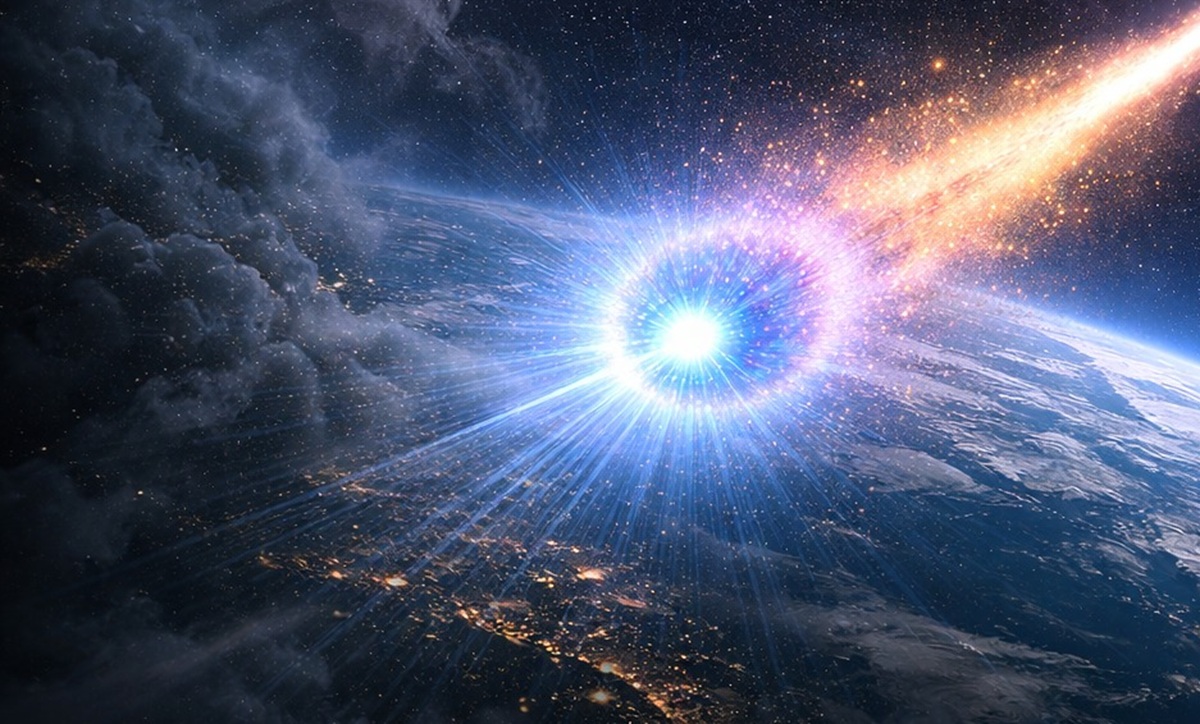
Detection of a Neutrino with About 220 PeV on the Bottom of the Mediterranean Sea on February 13, 2023, Led Scientists to Investigate Whether Jets Associated with Supermassive Black Holes in Blazars May Be Responsible for Launching Extreme Energy Particles Throughout the Universe
On February 13, 2023, a detector installed on the bottom of the Mediterranean Sea recorded a neutrino with about 220 PeV of energy, the most energetic ever observed, leading scientists to investigate whether jets associated with supermassive black holes could be the origin of the phenomenon.
The event attracted attention for far exceeding the previous energy record registered for this type of particle. The detection occurred in the KM3NeT/ARCA detector, a system anchored in the depths of the Mediterranean Sea that uses the ocean water itself as a medium to register the passage of these extremely rare particles.
Neutrinos are often called the ghost particles of the Universe because they almost have no mass, carry no electric charge, and interact very little with ordinary matter. Billions of them continuously pass through the planet and even the human body without leaving any detectable signal.
-
A bright yellow mushroom imported from Asia escaped from a cultivation farm in the United States in 2010 and is now aggressively spreading across 25 states, destroying entire communities of native fungi in American forests.

-
Buried under China, a colossal machine weighing 20,000 tons began operating as the largest neutrino detector on the planet and, in just 59 days, surpassed results that science took half a century to achieve.

-
Iran enters the center of a climate alert after the war emitted 5.6 million tons of CO2 in two weeks, surpassing the annual pollution of entire countries.

-
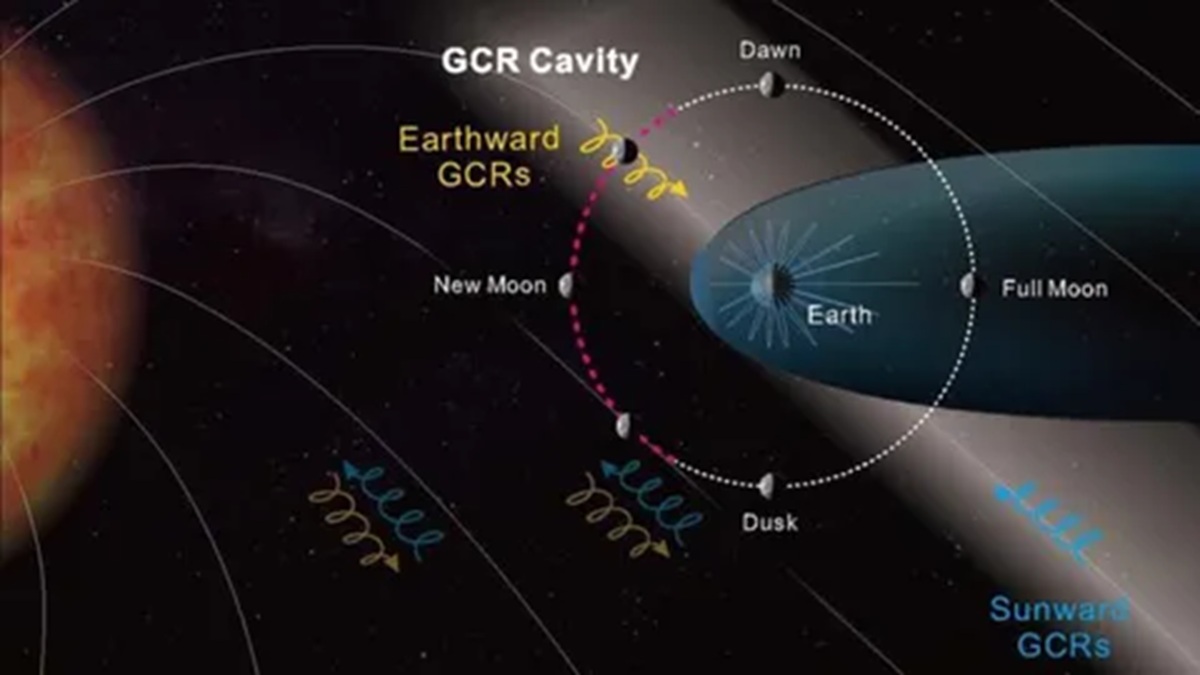
Lunar exploration may change after a Chinese probe finds a “cavity” of radiation that reduces the impact on astronauts by up to 20% at certain times on the Moon.

Detecting a neutrino of extreme energy is a significant technical challenge. For this reason, large experiments like KM3NeT/ARCA have been built to monitor immense volumes of water and identify the light signals produced when these particles rarely interact with their environment.
Detection in the Mediterranean Revealed Record Neutrino Associated with Possible Black Hole Jets
The detector responsible for the recording is installed off the coast of Sicily. It is part of the KM3NeT network, a set of instruments specifically designed to capture the extremely weak light produced by events related to neutrinos.
When the 220 PeV neutrino was detected, the signal left physicists intrigued. No known event in astronomical catalogs seemed to correspond directly to a particle with such high energy.
In light of this, the researchers from the KM3NeT collaboration adopted an investigative approach based on the available evidence. They reconstructed the event, developed simulations, and began testing different hypotheses to explain the particle’s origin.
This process led scientists to consider a possible connection with extremely active black holes. These objects can create environments capable of accelerating particles to extremely high energies.
Blazars Emerge as Main Suspects in the Origin of Particles Associated with Black Holes
The primary candidate identified by researchers is a class of objects called blazars. These objects are considered active galactic nuclei, characterized by the presence of supermassive black holes at the center of galaxies.
In these systems, the black hole consumes surrounding matter and launches plasma jets that travel at speeds close to the speed of light. These jets are capable of carrying massive amounts of energy across space.
Blazars have a particular characteristic that makes them especially visible. The jet emitted by the system is oriented almost directly toward Earth, making these objects appear among the brightest and most extreme in the observable sky.
This orientation increases the intensity of the signal detected by astronomical instruments. Therefore, they are considered plausible candidates for producing extremely energetic particles.
Simulations and Observations Compared Neutrino Data from Regions with Black Holes
To test this hypothesis, researchers created simulations based on a realistic population of blazars. The goal was to estimate what flow of neutrinos would be produced by these systems over time.
These results were compared with data obtained from different scientific observatories. Among them are KM3NeT itself, the IceCube detector installed in Antarctica, and the Fermi Gamma-Ray Space Telescope.
The team also analyzed an important aspect of the observations. Besides the detected signals, scientists considered events that were not recorded by these instruments.
The absence of other neutrinos with similar energy in different regions of the sky imposes stringent limits on any possible explanation. The model involving blazars managed to satisfy these restrictions imposed by the available data.
Absence of Electromagnetic Signals Suggests Diffuse Background of Events Linked to Black Holes
Another element analyzed by researchers was the presence of possible electromagnetic signals associated with the event. Violent phenomena in deep space typically produce simultaneous emissions at different wavelengths.
Stellar explosions or solar eruptions, for example, are usually accompanied by intense emissions of light detectable by telescopes. In the case of the 2023 neutrino, no such signal was identified.
This absence suggests that the event was not caused by a single isolated phenomenon. Instead, the data point to a scenario in which multiple sources collectively contribute to a continuous flow of extremely energetic particles.
In this context, one of these particles could have reached Earth exactly when the detector was operating. This type of diffuse origin is compatible with the hypothesis involving multiple blazars scattered throughout the Universe.
Detector Still Operates with Part of Its Capacity and New Analyses May Deepen Research on Black Holes
When the record neutrino was recorded, the KM3NeT system was still operating in its early stage. At that time, only 21 detection lines were installed on the seabed.
This number represents approximately 10% of the total size planned for the detector. The expansion of the instrument will allow observing larger volumes of water and recording more rare events.
With the detector complete and additional years of accumulated data, researchers hope to conduct more detailed analyses. This could allow the identification of new extreme energy neutrinos and more robust testing of current hypotheses.
For now, blazars remain the main candidates to explain the event. If it is confirmed that these systems associated with black holes can accelerate particles to such high energies, it could significantly alter the understanding of the Universe’s most extreme processes.
This article was prepared based on information released by the KM3NeT scientific collaboration and the study published in the scientific journal Journal of Cosmology and Astroparticle Physics, which analyzes the ultra-high energy neutrino detected on February 13, 2023, in the KM3NeT/ARCA underwater detector in the Mediterranean Sea.







Seja o primeiro a reagir!