





 Portuguese
  English
  Spanish
  4 min of reading
  1 comment


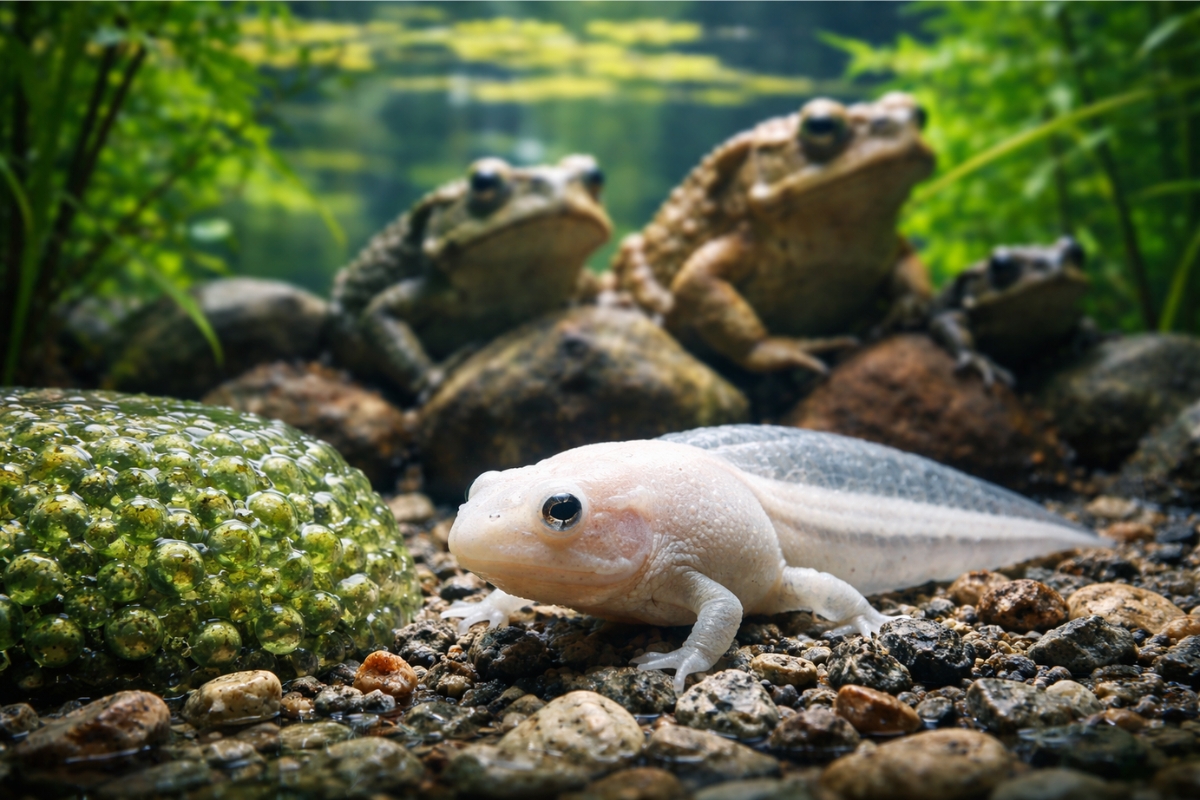


The Strategy Uses Genetic Editing to Prevent Metamorphosis and Reduce the Next Generation of Cane Toads in Critical Breeding Areas
Australia has begun testing an unusual idea to tackle one of the country’s most persistent biological invasions: creating cane toad tadpoles that never become adults.
The goal is to cut the problem at its source, before the animals grow, leave the water, and advance into new areas, further impacting native fauna.
The proposal draws attention because it shifts the focus of control. Instead of chasing already spread adults, the action targets the point where the population begins, the breeding sites.
-
Motorola launched the Signature with a gold seal from DxOMark, tying with the iPhone 17 Pro in camera performance, Snapdragon 8 Gen 5 that surpassed 3 million in benchmarks, and a zoom that impresses even at night.

-
Satellites reveal beneath the Sahara a giant river buried for thousands of kilometers: study shows that the largest hot desert on the planet was once traversed by a river system comparable to the largest on Earth.

-
Scientists have captured something never seen in space: newly born stars are creating gigantic rings of light a thousand times larger than the distance between the Earth and the Sun, and this changes everything we knew about stellar birth.

-
Geologists find traces of a continent that disappeared 155 million years ago after separating from Australia and reveal that it did not sink, but broke into fragments scattered across Southeast Asia.

The Cane Toad Was Introduced to Australia in 1935 and Became One of the Country’s Greatest Environmental Pests
The cane toad, species Rhinella marina, was introduced to Australia in 1935 and spread rapidly through northern regions.
The species adapted quickly, faced few natural barriers, and began to dominate environments where native animals cannot compete equally.
Over time, the problem shifted from being localized to becoming a constant threat to entire ecosystems.
The New Strategy Tries to Halt the Invasion Before the Adult Phase, When the Toad Begins to Spread on Land

The adult phase is the one that allows the cane toad to move long distances and occupy new territories.
The project’s idea is to prevent this transition, keeping the animal confined to the aquatic environment and reducing the arrival of adults in the natural environment.
In practice, the plan seeks to cut off the invasion’s progress before the “jump” out of the water.
CRISPR Cas9 Enters the Scene to Turn Off the Hormonal Trigger That Transforms Tadpole Into Toad
The technique uses CRISPR Cas9 to alter a point linked to the hormonal control of metamorphosis.
The target is the production of thyroxine, a hormone that triggers the transformation of the tadpole into an adult toad.
Without this signaling, the animal remains in the aquatic phase and does not complete the cycle that would make it an even more aggressive terrestrial invader.
“Peter Pan” Tadpoles Remain in the Water and Can Devour Eggs of Their Own Species on a Larger Scale

Cane toad tadpoles already exhibit cannibal behavior, consuming eggs and larvae of the same species.
The proposal exploits this behavior and seeks to amplify the effect, creating tadpoles that stay in the water longer and continue consuming eggs.
There is evidence that they can eat three or four times more eggs than non-edited tadpoles, reducing the next generation right from the start.
The Greatest Challenge of the Method Is That the Tadpole That Does Not Grow Also Does Not Reproduce, and This Hampers the Scale of the Project
A central point is that the tadpole that never becomes adult also does not reach the reproductive phase.
This limits the natural production of new individuals with the same modification and creates a bottleneck for scaling the strategy.
Therefore, the project needs to consider how to maintain the method at scale without depending on editing each animal indefinitely.
What Still Needs to Be Resolved Before Thinking About Wide Use in the Natural Environment
The strategy involves delicate decisions because it interferes with ecological dynamics in real environments.
Tadpoles with a greater appetite for eggs can alter local relationships and require careful control to avoid creating undesirable effects.
The focus is to target the cane toad without amplifying risks to native species that also depend on those same aquatic environments.
The creation of the cane toad edited to remain as a tadpole signals a change in direction in the fight against invaders in Australia.
Instead of chasing the problem after it spreads, the proposal seeks to prevent the pest from gaining ground, advancing through the country, and amplifying environmental damage.








Maybe take a page from diseases like hemophilia, and attach the edited gene to the X-chromosome. Females can be “carriers” since they have 2 X chromosomes, but males would only have the one defective chromosome and would not mature, cannibalizing all the others. “Carrier” females who avoid being eaten would mature and mate, passing on the defective gene to the next generation.