





 Portuguese
  English
  Spanish
  3 min of reading
  0 comments


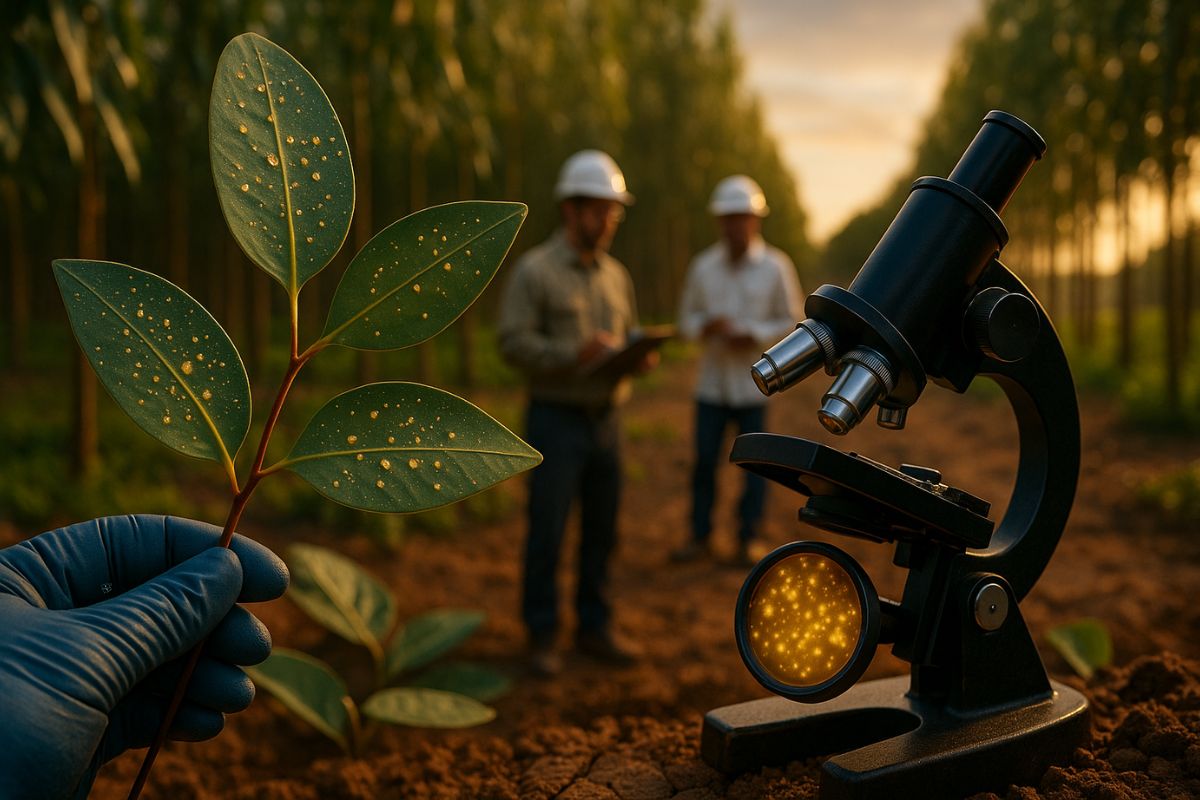
2025 Study Shows That Eucalyptus Accumulates Gold Particles in Parts Per Billion, Allowing for the Identification of Underground Deposits Without Drilling.
A new study released on September 5, 2025 revealed that eucalyptus leaves can carry microscopic traces of gold, serving as a natural marker for hidden deposits. The discovery has attracted the attention of the scientific community and the mining industry by paving the way for a cheaper and more sustainable prospecting method, capable of reducing the environmental impact of mining.
According to researchers, eucalyptus does not generate gold but absorbs particles of the metal through its deep roots. These particles reach the branches and leaves, where they are stored in minimal concentrations, detectable only with high-precision equipment.
How Does Eucalyptus Accumulate Gold?
The roots of eucalyptus can reach deep soil layers, where groundwater sometimes contains small amounts of heavy metals, including gold.
-
Man builds functional 5-meter submarine in his garage using gas cylinders, PVC pipes, and a refrigerator motor, and navigates with the vessel on a lake in Colombia.
-
Millions of people have been eating yam for centuries without knowing that this humble tuber contains a compound called diosgenin, which scientists have now discovered can improve memory and help control blood sugar levels.

-
Scientists from an international project drill 1,800 meters of ice in Antarctica using hot water and discover details about one of the most intriguing places on planet Earth.
-
Seen from space, a colossal volcano nearly 5,000 meters high in Russia has released 1,600 km of smoke over the Pacific, forming “devil’s horns” of lava and revealing the brutal force of the Ring of Fire.


By absorbing this water, the tree transports the metal to the leaves.
This process acts as a defense mechanism, as the plant disperses toxic elements to reduce their concentration in the trunk.
The result is that the leaves function as a “natural X-ray”, revealing the existence of underground deposits in areas where direct drilling would be costly or unfeasible.
However, scientists emphasize that the amount of gold accumulated in the leaves is insignificant for commercial extraction, serving only as an indicator.
The Importance for Mining
According to the study, the chemical analysis of leaves can identify gold in concentrations of parts per billion (ppb), sufficient precision to guide mineral research.
This method represents a more sustainable alternative to intensive drilling, reducing costs and preserving the environment in prospecting areas.
Mining companies and governments see the finding as a strategic tool, especially in remote or hard-to-access regions.
Rather than opening large exploration fronts, it would suffice to collect eucalyptus leaves to indicate promising areas.
Environmental Factors That Influence
The accumulation of gold in leaves varies according to the environment.
Older leaves and dry periods tend to concentrate more particles, as the plant’s transpiration increases during these times.
This seasonal variation can guide the best periods for collection and analysis, making the technique even more precise.
These findings help explain why some results may fluctuate between nearby regions and reinforce the need for scientific calibration before large-scale application.
Global Perspectives
Although still in its early stages, experts believe that the technique could be expanded to other continents, transforming the way new gold deposits are located.
The potential is enormous for countries with extensive forests and mineral-rich soils, such as Brazil, Australia, and South Africa.
The use of eucalyptus as a prospecting tool could represent a revolution in mining, balancing economic and environmental interests in a sector historically marked by severe impacts.
In your opinion, can the use of trees as “natural detectors” of gold make mining more sustainable, or does it open the door to new environmental conflicts? Do you believe this method should be adopted in Brazil? Please leave your opinion in the comments — we want to hear from those living this debate in practice.








Seja o primeiro a reagir!