





 Português
  Inglês
  Espanhol
  3 min de leitura
  0 comentários


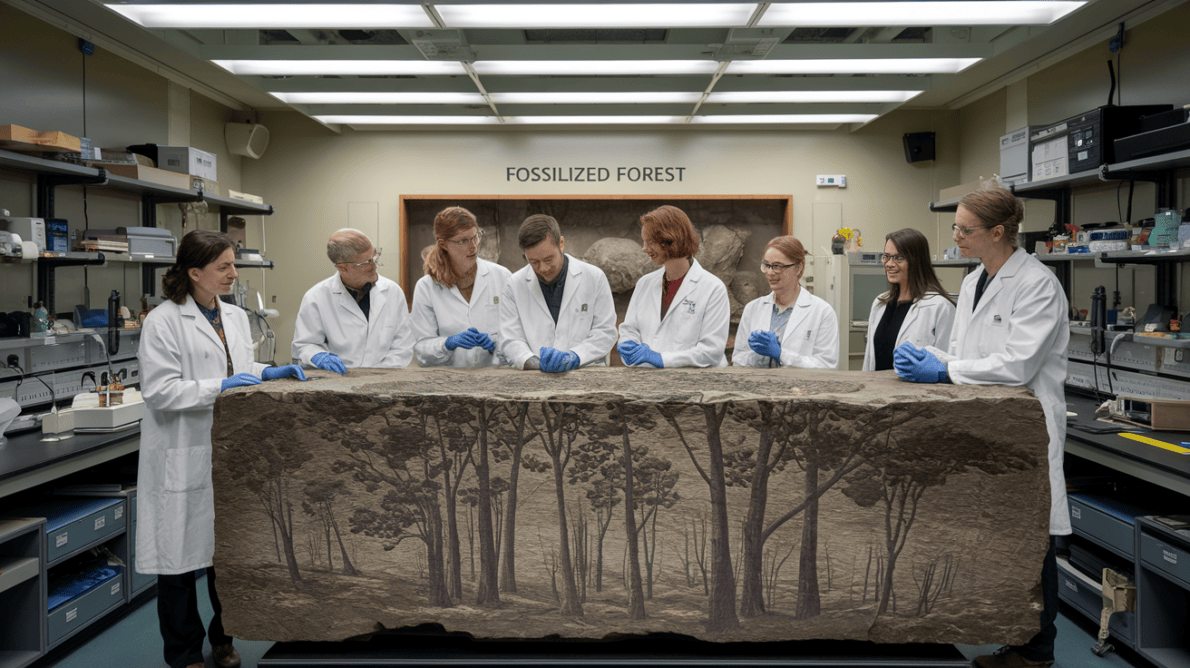
Brazilian Researchers Identified a Fossilized Forest of 260 Million Years in Rio Grande do Sul, One of the Most Impressive Paleontological Sites in Brazil. The Discovery Could Help Understand the Effects of Ancient Global Climate Changes.
The fossilized forest found in Brazil, more specifically in Dom Pedrito, in the region of the gaucho pampas, near the border with Uruguay, is considered one of the most complete records of the Permian period in the Southern Hemisphere. The rediscovery was led by a team from the Federal University of Pampa (Unipampa) and published on April 2 in the scientific journal Journal of South American Earth Sciences.
Although the site, known as Cerro Chato, was initially identified in 1951, it was only in 2021 that detailed excavations brought to light more than 200 fossils of plants preserved in excellent condition — including leaves, roots, branches, and trunks.
Fossilized Forest of 260 Million Years Shows What the Gondwana Environment Was Like


The plant species found are typical of the ancient supercontinent Gondwana, which included the area where Brazil is located today. Among the fossils are examples of horsetails, lycophytes, ferns, and conifers. Scientists highlight the high level of preservation: many plant remains were mineralized while still alive, allowing for a precise reconstruction of the ecosystem of the time.
-
A bright yellow mushroom imported from Asia escaped from a cultivation farm in the United States in 2010 and is now aggressively spreading across 25 states, destroying entire communities of native fungi in American forests.

-
Buried under China, a colossal machine weighing 20,000 tons began operating as the largest neutrino detector on the planet and, in just 59 days, surpassed results that science took half a century to achieve.

-
Iran enters the center of a climate alert after the war emitted 5.6 million tons of CO2 in two weeks, surpassing the annual pollution of entire countries.

-
Lunar exploration may change after a Chinese probe finds a “cavity” of radiation that reduces the impact on astronauts by up to 20% at certain times on the Moon.

The Permian period, 260 million years ago, was marked by an intense global climate crisis, with rising temperatures and increased aridity. This scenario caused one of the largest mass extinctions in history, which decimated various plant and animal species. The analysis of the fossilized forest found in Brazil offers a unique opportunity to understand how these changes affected ecosystems and how some plant lineages managed to adapt — giving rise to the current flora.
The fossils are being studied at the Laboratory of Paleobiology of Unipampa, where they will continue to provide data on climate, soil, and biodiversity from the remote past.
Other Fossilized Forests in Brazil Reveal Deep History
Brazil has proven to be a true paleontological treasure. In 2022, another significant finding was disclosed by researchers from the Federal University of Paraná (UFPR): a fossilized forest of 290 million years, located in Ortigueira (PR), composed of 164 trees from the lycophyte lineage, which could reach heights of up to 18 meters.

According to geologist Thammy Ellin Mottin, who was responsible for the discovery during her doctoral studies, the forest was preserved exactly as it was in life, fossilized within the rock. The research was published in the international journal Palaeogeography, Palaeoclimatology, Palaeoecology and highlighted the importance of Brazil in the global paleobotany landscape.
The Oldest Fossilized Forest in the World Is in England
In addition to the fossil forests found in Brazil, the title of the oldest fossilized forest in the world currently belongs to a formation discovered in the south of England, in the regions of Devon and Somerset. The trees are approximately 390 million years old and are between four and five million years older than previous records found in the United States.
These plants belong to the group cladoxylopsida, ancestors of today’s horsetails and ferns, and feature fossilized trunks up to two meters long. The fossils were identified on the coast of the ancient continent Old Red Sandstone, revealing another key piece of plant evolution.
Understand the Importance of Studying Fossilized Forests
The analysis of fossilized forests allows scientists to reconstruct environmental scenarios from the past and understand how plants and ecosystems responded to extreme climate changes. This information is valuable not only to understand the history of the Earth but also to project the impact that the current climate crisis may have on modern environments.
The discovery of the fossilized forest of 260 million years in Brazil is a milestone for South American paleontology and shows how our territory hosts precious records of a lost world — and perhaps a mirror of our climatic future.
Source: Olhar Digital







-

-

-

8 pessoas reagiram a isso.