





 Portuguese
  English
  Spanish
  7 min of reading
  0 comments


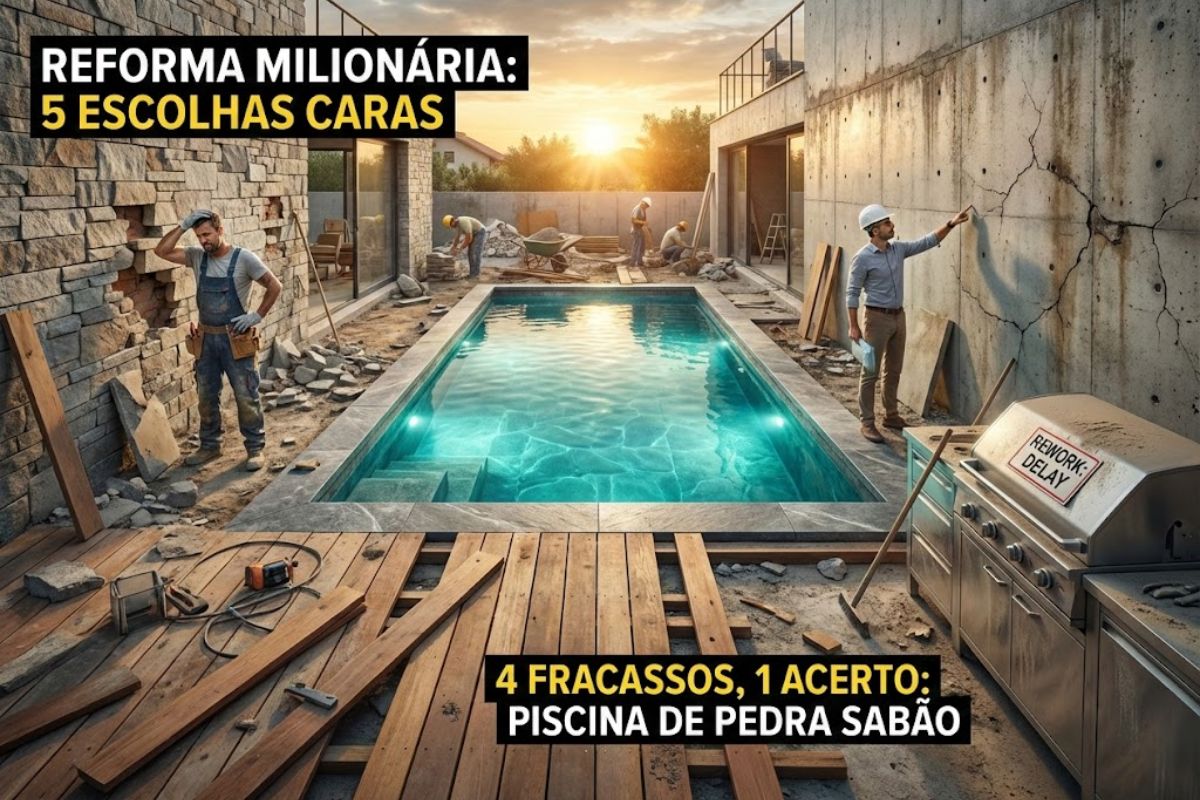
The Story of a Renovation Shows How Moledo Stone, Exposed Concrete, On-Site Wood Flooring, and Soapstone Pool Can Increase Costs, Require Specialized Labor, and Cause Delays, While the Outdoor Stainless Steel Counter Provides Low Maintenance Today.
A report about a renovation nicknamed Casa Matriz detailed how an engineer decided to test, in his own home, solutions that yield striking photos on social media. The result was an inventory of hits and misses: rework, waste, and delays emerged when execution did not keep pace with aesthetic ambition.
Still on December 31, 2025, the report gathered five expensive choices, highlighting Moledo stone, exposed concrete, and on-site wood flooring, along with an outdoor stainless steel counter and a soapstone pool that, unlike the other tests, was described as the best technical and daily-use choice.
The Logic of the Renovation That Became a Laboratory
Casa Matriz was treated as a renovation with a spirit of experimentation.
-
50 viaducts, 4 tunnels, 28 bridges, and 40 kilometers of bike paths: BR-262 in Espírito Santo will receive 8.6 billion reais for the largest engineering project in the state’s history, inspired by the Immigrant Highway in São Paulo.

-
Brazil produces too much clean energy and doesn’t know what to do with it: over 20% of solar and wind capacity was wasted in 2025 while investors flee and 509 renewable generation projects were abandoned in the last year.

-
Piauí will produce a new fuel that replaces diesel without needing to change anything in the truck’s engine and reduces pollutant gas emissions by half: truck drivers from all over the Northeast are already celebrating the news that will arrive later this decade.

-
A new Brazilian shopping center worth R$ 400 million will be built in an area equivalent to more than 4 football fields, featuring 90 stores, 5 cinemas, a supermarket, a college, and parking for 1,700 cars, potentially generating 3,000 jobs.

Instead of repeating a predictable list of finishes, the engineer transformed construction decisions into hypotheses: some promised social media visuals but came at a cost in execution, timeline, and tolerance for error.
The renovation did not fail due to a lack of ideas, but rather due to excessive complexity without a prepared team.
In this type of renovation, the cost is not just about materials.
Included in the price is the time of the work, the learning curve of the labor force, and the impact on simultaneous fronts.
When a finish depends on perfection from the first pouring or the first laying, rework tends to be costly because it affects everything that comes afterward.
Moledo Stone: When a Beautiful Facade Becomes a Risk Item
Moledo stone appears as the first major test.
At Casa Matriz, more than 500 square meters of Moledo stone were applied to facades and ceilings, with costs cited around R$ 300 per square meter, not including specialized labor.
On a large scale, Moledo stone ceases to be a detail and becomes a system: it requires logistics, piece selection, joint standardization, and consistent execution.
The problem described was the execution.
The mason, according to the report, learned during the work, and the initial laying of Moledo stone was crooked, with irregular joints and sections that needed to be redone.
The final effect can be modern, but the tolerance for misalignment is minimal, and each correction increases material waste and labor hours.
The practical learning presented was to reduce risk on the first project.
For a renovation without a history of an experienced team, the recommendation was to use Moledo stone in small areas, between 10 m² and 15 m², as a point panel, and hire a professional with specific experience with the material.
Moledo stone on a large area only pays off when the execution meets the finishing requirements.
Exposed Concrete: The Finish That Requires Planning and Costs More
Exposed concrete is treated as the second game-changer.
In the renovation, facades and even bedrooms were left unplastered and unpainted, with exposed concrete as the final finish.
The myth debunked is straightforward: exposed concrete is not a cheap finish, as it shifts costs to form, bracing, and treatment.
The report quantified this shift: around R$ 150,000 extra was associated with forms, bracing, release agents, and surface treatment, just to ensure that the exposed concrete looked presentable.
In exposed concrete, aesthetics are born at the structural stage. A bubble, a leakage of slurry, a hole mark, or a vibration fault turns into an apparent defect and generates costly corrections.
When well executed, exposed concrete was described as having a clean and authorial look, even in environments without a ceiling.
But the text makes clear the prerequisites: an experienced team, technical monitoring, and planning.
In regions where labor for exposed concrete is rare, the risk of stains and corrections increases, and costs can escalate more than expected in the renovation.
On-Site Wood Flooring: Savings That Turn Into Dust and Delays
The third test was on-site wood flooring.
The attempt to save on raw wood flooring, laid, sanded, and varnished on-site, produced the classic side effect: dust spread everywhere, delayed schedules, and stalled fronts.
In a renovation with several stages happening in parallel, sanding and varnishing wood floors interfere with painting, electrical work, carpentry, and fine cleaning.
The report acknowledges that the visual outcome of the wood flooring was good but criticizes the cost-benefit when the delay is factored in.
The operational conclusion was to swap labor done in-house for industrialization.
Instead of producing the wood flooring on-site, the suggested approach is to buy pre-made, factory-varnished flooring and simply lay it down, reducing variability and compressing the renovation schedule.
In this block, a complementary win appeared: the use of inverted baseboards, well-dried, together with the flooring, matching with bare walls and helping to reduce custom carpentry costs.
In other words, the renovation gained efficiency when it removed complexity from within the site and kept the finish within what the team could deliver.
Outdoor Stainless Steel Counter: Durability, Cleanliness, and Low Maintenance
The outdoor stainless steel counter emerged as a solution that worked for daily use.
It was installed exposed to rain and sun, integrated into the kitchen and pool area.
The material describes a custom-made 1.10m basin, creating a continuous visual and facilitating cleaning, with a uniform appearance maintained over time.
From a usage standpoint, the outdoor stainless steel counter was linked to a routine of receiving guests, dealing with grease, water, and weather fluctuations.
Stainless steel appears as a technical response to reduce maintenance, whereas natural stone can stain and wood may require regular care.
There is an important factual limit: the text does not detail the cost of the outdoor stainless steel counter nor specify thickness, metal alloy, or fixing method.
The learning is about performance and maintenance, not about budget comparison.
Soapstone Pool: The Best Success Among the Tests
The soapstone pool was described as the greatest success of Casa Matriz. The aesthetic differential mentioned is the greenish hue and continuous finish, with fewer joints compared to traditional solutions.
In construction, fewer joints mean fewer failure points and less area susceptible to infiltration and maintenance.
The technical performance of the soapstone pool was presented in four aspects.
The first is heat retention, with the stone helping to keep the water warm longer.
The second is stability in immersion, with behavior considered positive in constant contact with water.
The third is comfort for skin and hair, described as a more pleasant sensation. The fourth is a comfortable surface to the touch, avoiding excessive roughness.
Here, precision also matters: the report does not provide footage, cost per square meter, or details about adhesive, joints, and waterproofing.
Still, among the elements of the renovation, the soapstone pool was the only one classified as a solution that delivered aesthetics and performance without significant rework costs.
Five Choices, One Pattern: What Really Increases Renovation Costs
By gathering Moledo stone, exposed concrete, wood flooring, outdoor stainless steel counter, and soapstone pool, the pattern becomes clearer: costs skyrocket when finishes demand excellence in execution and do not allow for cheap corrections.
In management terms, the renovation faced three factors.
The first factor is learning during execution.
Moledo stone and exposed concrete punish the learning curve because errors become apparent and require redo.
The second factor is interference from fronts: the on-site wood flooring takes up time on the schedule and contaminates stages with dust and varnish odor.
The third factor is specification and purchase: when the solution is custom-made, like the outdoor stainless steel counter, the work depends on suppliers and manufacturing timelines.
To reduce risk, the editorial lesson of the renovation is to test on a smaller scale before expanding. This applies to Moledo stone in reduced panels, to exposed concrete in pilot sections, and to wood flooring in samples.
The renovation becomes predictable when mockups, prototypes, and checklists replace improvisation.
Casa Matriz reinforces an uncomfortable point for those planning a renovation: a pretty trend does not pay the bill when the site is not prepared.
Moledo stone and exposed concrete can be excellent, but require method and trained labor.
The on-site wood flooring delivers aesthetics but costs in dust and delays. The outdoor stainless steel counter and the soapstone pool appear as choices that balanced form, function, and maintenance.
If you are in the renovation phase, the safest path is to turn inspiration into specification: make samples, simulate details, validate suppliers, and include rework and delays as formal risks on the schedule.
The renovation becomes cheaper when the aesthetic decision is accompanied by an execution plan.
Which of these choices would you make in your renovation and which would you avoid without hesitation: Moledo stone, exposed concrete, wood flooring, or soapstone pool?









Seja o primeiro a reagir!