





 Portuguese
  English
  Spanish
  4 min of reading
  0 comments


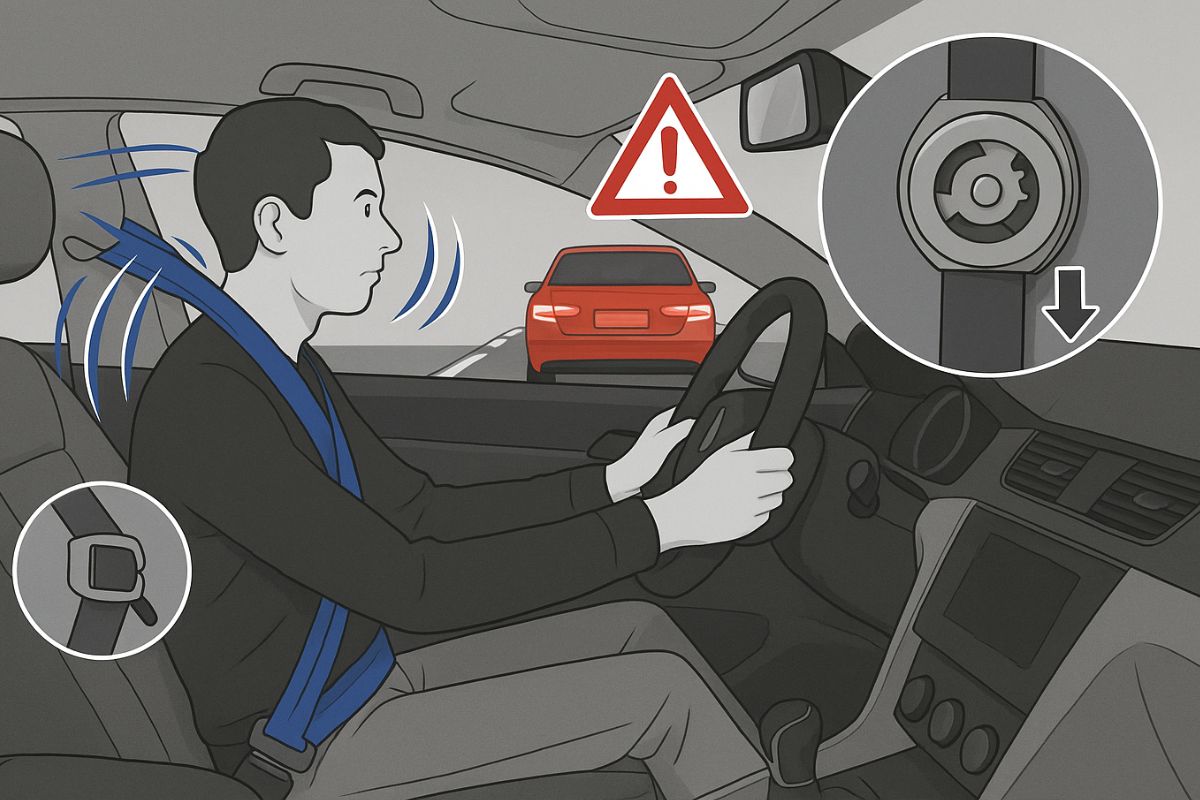
Understand The Ingenious Mechanisms That Make The Seat Belt Lock Instantly In Abrupt Braking Or Quick Pulls, Ensuring Your Protection In The Vehicle.
Have you ever wondered how your car’s seat belt knows exactly when it needs to lock? That slow pull that gently releases it, but turns into a firm barrier in the face of a sudden movement, is not magic. It’s pure engineering, designed to save lives.
Let’s uncover the inner workings of this essential vehicle safety item. Get ready to learn the secrets behind the “magic box” that controls the locking of your seat belt and understand why it is so crucial.
The “Secret Box”: The Heart Of The Seat Belt Mechanism
Inside the car column, hidden from our sight, there is a device where the seat belt is coiled. This “box” is the control center of the system. Besides holding the fabric of the belt, it houses a powerful spring, similar to that of a tape measure, responsible for pulling the belt back when we release it.
-
Son of a seamstress from the rural area of Ceará who did not speak English wins a scholarship of over 2 million reais at Williams College, one of the top 10 universities in the United States, covering everything including dormitory, meals, and annual trips to Brazil.

-
Bill Gates revealed that the true secret behind every great achievement is not a brilliant leap but rather small improvements repeated over the years, and the data from his own career and the fight against climate change prove that he is right.

-
With 22 thousand tons of steel, a height nearly three times greater than the Eiffel Tower, and a cost of R$ 1.6 billion, China is building the highest bridge on the planet over a colossal canyon, reducing a crossing time of over 2 hours to just over 2 minutes.

-
With more than 635,000 doctors, Brazil sees competition increasing in large cities, and recent graduates are competing for shifts at an accelerated pace while the countryside still faces shortages.


It is important to note that there are basically three types of three-point seat belts. The older ones were of fixed length, adjusted manually. Most common cars use the retractable system that we will detail. And more sophisticated vehicles may feature pretensioners, which work in conjunction with the airbag, tightening the seat belt against the body at the time of a collision to maximize protection.
The First Alert: How Car Deceleration Triggers The Seat Belt

One of the secrets to the locking of the seat belt in situations like a sudden brake or a crash lies in a mechanism sensitive to deceleration. Inside the assembly, there is a small steel ball (ball) positioned over a kind of ramp or funnel.
When the car experiences a sudden movement (deceleration or rapid acceleration), inertia causes this ball to move from its resting position. As it moves, it pushes a small plastic piece that acts as a trigger, initiating the locking process of the gear where the seat belt is coiled. Interestingly, this mechanism usually only works correctly if the belt assembly is in a vertical position; if it is lying down, the belt may not release.
Reaction To Speed
And when the car is stationary and you pull the seat belt very quickly? Why does it lock? In this case, another mechanism comes into play, based on the rotation speed of the drum where the belt is coiled.
There is a piece, often shaped like a “moon”, that acts as a weight and is held in place by a light spring. If the belt is pulled with excessive speed, the centrifugal force overcomes the spring force, causing the tip of this “moon” to move outward. This tip then engages with teeth present in the main gear of the spool, locking it. It’s a very sensitive and effective system.
The Main Lock: The Robust Lock That Secures Your Safety
The mechanisms described above – both the steel ball and the speed-sensitive “moon” – are actually actuation systems for the main and more robust lock of the seat belt. This final lock is usually composed of one or more metal levers.
When the plastic system of the ball is activated by deceleration, or when the “moon” locks the gear due to a quick pull, a pin is moved. This pin, in turn, pushes the metal lever, which fits tightly into the spool structure or into metal teeth on the axis itself, preventing the seat belt from loosening. It is this metal lock that truly withstands the force exerted on the belt in an impact.
A Vital System
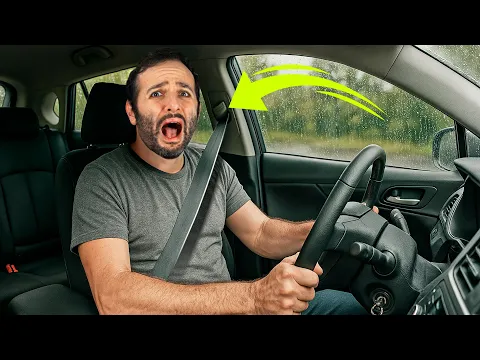

Each component of the seat belt mechanism is crucial for its proper functioning. Removing parts, such as the steel ball, can seriously compromise the effectiveness of the belt in a real accident situation, even if it continues to lock on quick pulls. The safety provided by the complete assembly is a result of the interaction of these multiple systems.
In Brazil, the use of the seat belt began to become mandatory on federal roads in 1989, but it was with the Brazilian Traffic Code of 1997 that its use became compulsory in all vehicle seats, both front and rear. Despite nearly three decades of this legislation, awareness about the importance of the seat belt for all occupants is still a challenge. Wearing it correctly is a simple act that saves lives.








Seja o primeiro a reagir!