





 Português
  Inglês
  Espanhol
  7 min de leitura
  0 comentários


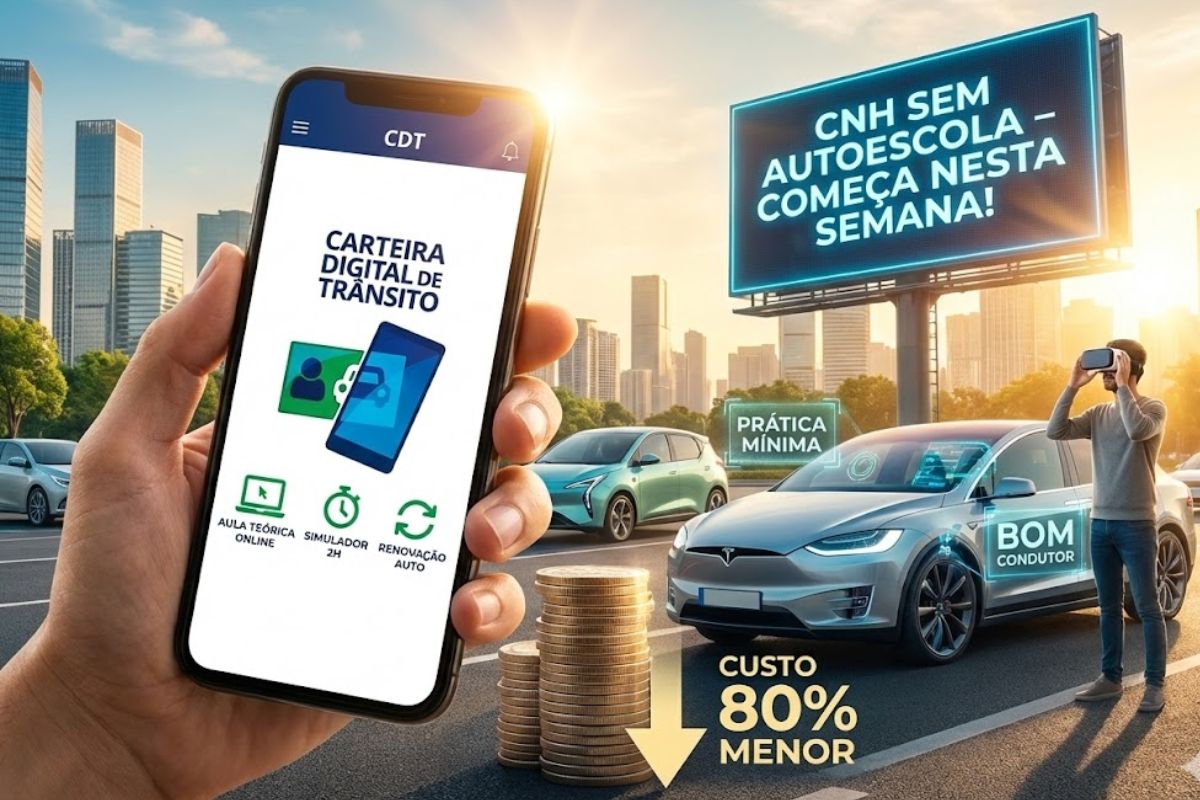
Launched on Tuesday, December 9, 2025, the new rules for the CNH eliminate the mandatory driving school, bring free theory to the CNH do Brasil app, reduce minimum practice to 2 hours, standardize tests, promise to cut costs by up to 80%, and automatically renew the good driver card in the country
The new rules for obtaining a CNH come into effect this week, following approval by the National Traffic Council in early December and the launch of the CNH do Brasil app at a ceremony scheduled for Tuesday, December 9, 2025, at the Palácio do Planalto. The publication of the regulations in an extra edition of the Official Federal Gazette is expected on the same day, with immediate validity throughout the country.
With the change, the federal government promises to reduce the cost of the CNH by up to 80%, allowing free theoretical classes through the app, decreasing the minimum practical hours from 20 to 2, and offering automatic renewal without charges for those considered “good drivers,” as well as allowing the use of private cars and accredited independent instructors.
New CNH Rules Come into Effect This Week
According to the Minister of Transport, Renan Filho, the new rules for obtaining the CNH will take effect as soon as they are published in an extra edition of the Official Federal Gazette, scheduled for Tuesday, December 9, 2025.
-
Brazilian city gains industrial hub for 85 companies that is equivalent to 55 football fields.

-
Peugeot and Citroën factory in Argentina cuts production by half and opens a layoff program for more than 2,000 employees after Brazil drastically reduced purchases of Argentine vehicles.

-
A Brazilian city gains a factory worth R$ 300 million with the capacity to process 200 thousand tons of wheat per year, a mill of 660 tons/day, silos for 42 thousand tons, and an industrial area of 276 thousand m².

-
Havan will leave the shopping mall in Blumenau to inaugurate something that the chain has never done before: a megastore in half-timbered style in the Historic Center of the city, which is expected to be completed in May and change the landscape of local retail.


From this publication, the entire qualification process will be remodeled, with driving schools no longer being mandatory and stages moving to the digital environment.
The National Traffic Council approved the changes at the beginning of the month, paving the way for what the government classifies as a “modernization and digitization of the licensing system.”
The core idea is to replace the requirement of presence in a driving school with a more flexible model, based on a free online course and the freedom for the candidate to choose how they will complete the practical part.
CNH do Brasil App Replaces CDT and Focuses on Theoretical Content
The government will launch the CNH do Brasil app, an updated version of the Digital Traffic License (CDT), during a ceremony at the Palácio do Planalto.
The new platform will be the center of the qualification process. Through the app, future drivers will be able to access theoretical content, complete a free online course, and follow all steps until the issuance of the license, which will be delivered in digital format.
The theoretical content will be available in the app at no cost, and there will no longer be a mandatory minimum hour load for in-person classes in driving schools.
The online course will be free but mandatory: only after completing it will the candidate receive the certificate that allows them to schedule the theoretical exam with the Detran.
Minimum Practice Reduced to 2 Hours and Instructor Can Be Independent
One of the most noticeable changes will be in the practical part. Currently, candidates need to complete at least 20 hours of driving lessons at a driving school. With the new rule, the minimum requirement drops to just 2 hours, opening up room for each citizen to hire only the amount of classes they deem necessary.
The candidate will be able to choose to continue in a traditional driving school or hire an independent instructor accredited by the Detran, even using their own private car for the lessons.
The independent instructor will be identified in the CNH do Brasil app and must register all lessons taught in the system. At the end, the student will receive a certificate that qualifies them for the practical exam.
Minister Renan Filho states that “each citizen will hire the hours they need to learn,” highlighting that those who already drive a motorcycle or car daily will likely not need the former 20 hours to prepare.
According to him, the fixed hourly requirement turned lessons into a kind of barrier to access, rather than a training tool.
Step-by-Step on How to Obtain the First CNH via the App
Under the new rules, a large part of the qualification process can be done digitally, with some mandatory in-person points. The expected pathway for those who want to obtain their first CNH will be as follows:
- The citizen accesses the CNH do Brasil app or, if preferred, takes the free theoretical course on a computer, cell phone, or tablet. The course is free but mandatory.
- Upon completing the theoretical part, the candidate receives a certificate that allows them to schedule the theoretical traffic exam.
- Before the exam, it will be necessary to go to the Detran for biometric collection and photo, a mandatory in-person step that remains required.
- The medical exam and psychological evaluation will still be conducted with accredited doctors and psychologists, following the criteria already established today.
- After passing the theoretical exam, the future driver can choose either to seek a driving school or to hire an accredited independent instructor for practical lessons.
- Next, they will take the in-person practical exam. If approved, the system will automatically issue the digital CNH, which will be available in the CNH do Brasil app.
Those who fail the first practical exam will have the right to retake the exam a second time at no additional cost, according to the plan presented by the government.
Additionally, there will no longer be a maximum one-year deadline to complete the qualification process, allowing more flexibility for the candidate.
Automatic and Free CNH Renewal for “Good Drivers”
Another relevant change affects those who already have a license. The government intends to grant automatic and free CNH renewal for drivers considered “good drivers.”
Those eligible for the benefit will have no points for traffic violations recorded on their license in the year preceding expiration.
The driver meeting these criteria will receive a “good driver seal” and will have their CNH renewal processed without the need for a new exam, maintaining the current expiration period of the document.
The government’s logic is simple: if the driver went the entire period without recording infractions, it is understood that they drive appropriately and do not need to undergo the same in-person procedure.
According to Minister Renan Filho, “if you are driving well, it is a sign that you do not need a new exam,” an argument used to justify waiving bureaucratic steps when there are no infraction records.
The renewal will continue to generate a digital CNH, which will be available in the app, reducing the need to travel to service centers.
Up to 80% Cut in CNH Costs and Social Impact
Today, obtaining a CNH can cost up to around R$ 5,000, depending on the state and the structure of the driving school. The government claims that, with the end of the requirement for in-person classes in driving schools, the reduction of the minimum practical load, and the digitization of the stages, it will be possible to reduce the total cost by up to 80%.
Data from the National Traffic Secretariat indicates that 20 million people drive without a license in Brazil and another 30 million are of age to obtain a license but cannot afford the current process.
The government’s bet is that, with the new rules, a significant portion of this public will regularize their situation, expanding the base of legalized drivers and increasing official revenue with more accessible fees.
The minister also states that there will be no unemployment in the sector, arguing that instructors currently linked to driving schools will be able to act as independent instructors, maintaining the activity with a different compensation model.
For him, the end of the requirement does not “close doors,” but changes the way of contracting, making the driving instruction market more competitive.
Nationally Standardized Theoretical and Practical Tests
Another promise is that, with the new model, both the theoretical and practical tests will be standardized nationwide. Currently, each Detran creates its own exams, which generates discrepancies in approach and content between states.
From the implementation of the changes, students all over Brazil will take the same test, based on a national question database.
The CNH do Brasil app will offer simulations with the same questions that may appear on the official exam, allowing candidates to practice in advance. In the Minister’s view, this increases the transparency of the process: the more the citizen studies the questions, the more they learn the traffic rules.
He compares the model to the Enem, with one central difference. While the Enem needs to limit spots and keep the questions confidential, in the licensing test the goal is for the maximum number of candidates to pass, provided they know the traffic rules, which would justify making the content available in advance through simulations.
Cheaper and Digital CNH: Progress or Risk for Traffic?
With the new rules, the federal government redesigns the path to obtain and renew the CNH, betting on free online courses, fewer mandatory hours behind the wheel, and greater use of the digital license.
For some, this may mean more inclusion and regularization for millions of drivers; for others, reducing the minimum practice hours and automatic renewal may raise doubts about the effective training of drivers.
And you, do you think these changes in the CNH will facilitate access without compromising traffic safety, or could the reduction of practical classes and automatic renewal increase risks on the roads and highways?









-

Uma pessoa reagiu a isso.