





 Portuguese
  English
  Spanish
  5 min of reading
  2 comments


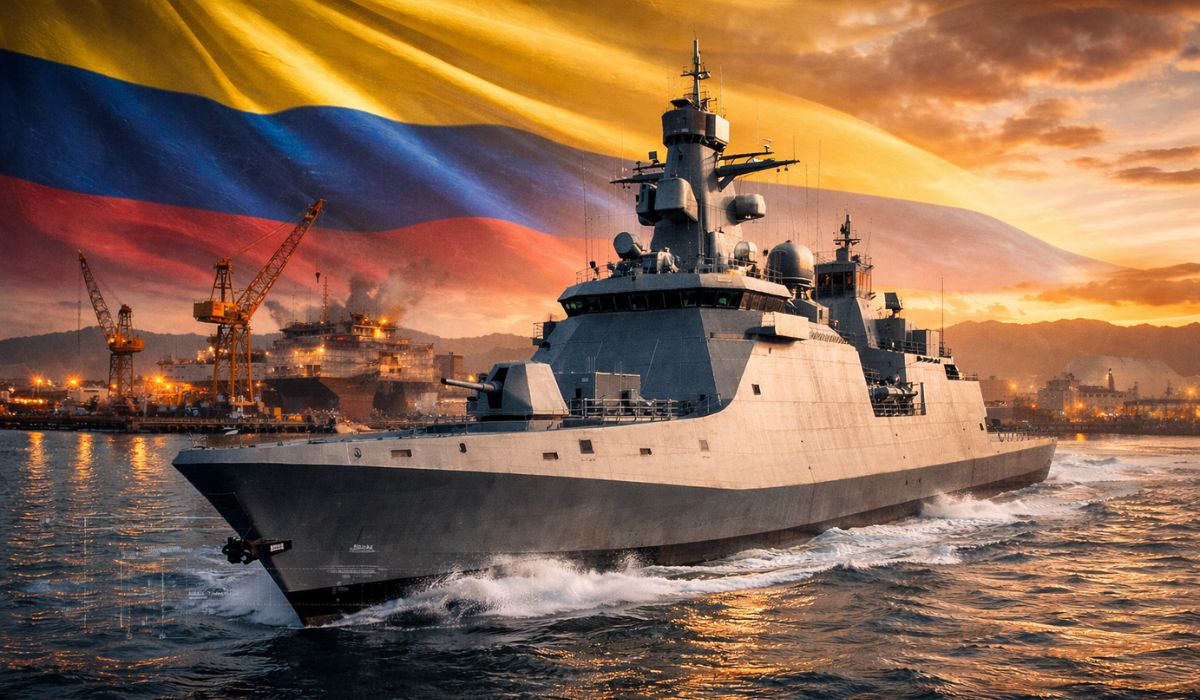


A Colombian Naval Program Based on the SIGMA 10514 Project Makes Progress with Local Construction in Cartagena and Promises Industrial Strengthening, While the Schedule and Final Configuration of the Ship Remain on the Radar of Experts and Specialized Coverage.
Colombia has structured the construction, in a national shipyard, of a new frigate based on the Dutch SIGMA 10514 project.
The ship, measuring 107.5 meters in length, will be built in Cartagena by the state-owned Cotecmar, with technical support from the Damen group, and is part of the program known as the Strategic Surface Platform (PES).
The initiative is linked to the Colombian Navy’s plans to renew its escort capabilities and to enhance the country’s ability to project, integrate, and maintain complex platforms within its territory.
-
Motorola launched the Signature with a gold seal from DxOMark, tying with the iPhone 17 Pro in camera performance, Snapdragon 8 Gen 5 that surpassed 3 million in benchmarks, and a zoom that impresses even at night.

-
Satellites reveal beneath the Sahara a giant river buried for thousands of kilometers: study shows that the largest hot desert on the planet was once traversed by a river system comparable to the largest on Earth.

-
Scientists have captured something never seen in space: newly born stars are creating gigantic rings of light a thousand times larger than the distance between the Earth and the Sun, and this changes everything we knew about stellar birth.

-
Geologists find traces of a continent that disappeared 155 million years ago after separating from Australia and reveal that it did not sink, but broke into fragments scattered across Southeast Asia.

The announcement and the initial steps of the program occur during a time when South American governments have once again prioritized maritime security and the protection of trade routes in public defense documents and debates.
At the same time, regional authorities cite transnational pressures, such as drug trafficking, organized crime, and surveillance challenges in the Caribbean and Pacific, as factors influencing naval planning.
Strategic Surface Platform and the SIGMA 10514 Project
The PES program was designed to deliver a multifunctional frigate built in Colombia, but derived from a model already adopted by other navies.
The choice fell on the SIGMA family from Damen, associated with a modular architecture.
In corporate statements, Damen itself indicated that the agreement with Cotecmar provides for technical support and the supply of components to enable the local construction of the ship.
The superlative “most powerful,” mentioned in part of the specialized news, appears based on comparative assessments that are not always publicly verifiable.
Direct comparisons require detailed data on sensors, missiles, electronic warfare, and system integration, which may vary depending on the final configuration.
Therefore, the points confirmed objectively today are the size of the ship, the origin of the project, and the industrial leap involved in the construction in the country.
Cotecmar, Cartagena, and Certifications in Naval Construction
Headquartered in Cartagena, Cotecmar concentrates the industrial execution of the program and will need to gather stages such as structural assembly, system integration, and preparation for future maintenance.
Industries monitoring the defense naval sector indicate that the shift from an external purchase model to a locally assisted production model is one of the central elements of the PES, as it involves manufacturing and integration processes that tend to be more complex than simple procurement of ready-made platforms.
Also integrated into the planning are certification and technical verification routines, common in projects of this nature.
Damen announced, at the end of 2024, the signing of a contract related to the PES frigate with the classification society Lloyd’s Register, in an agreement described as part of the effort to assess compliance with international naval construction standards.
Dimensions of the Frigate: 107.5 Meters and Modular Architecture
The length of 107.5 meters is the number consistently repeated in statements and technical reports about the program.
Sector publications also mention a beam of 14.02 meters, a dimension used to characterize the hull and the space available for sensors, armaments, and structures such as a hangar, depending on the adopted arrangement.
The displacement appears with variations in specialized coverage, according to the stage of the project and the equipment package considered.
There are references to something close to 2,800 tons and others indicating “nearly 3,000 tons.”
This difference often occurs because the final displacement depends, among other factors, on the set of weapons, radars, electronic warfare systems, and standards of autonomy and habitability.
The modular logic is one of the points associated with the SIGMA 10514 in Damen’s public descriptions.
According to the company, the project was designed to facilitate construction in modules, which may allow the participation of local shipyards and planning for upgrades throughout the life cycle.
In practice, the possibility of updating depends on the integration design and the choice of systems, in addition to future budgetary decisions.
Fleet Renewal and Delivery Scheduled for 2030
The Colombian program is presented as part of a gradual fleet renewal and an attempt to preserve escort capabilities with current standards.
In reports and analyses from the defense sector, the delivery of the first unit has been cited for 2030, associated with the timetable released concerning the program stages and industrial milestones.
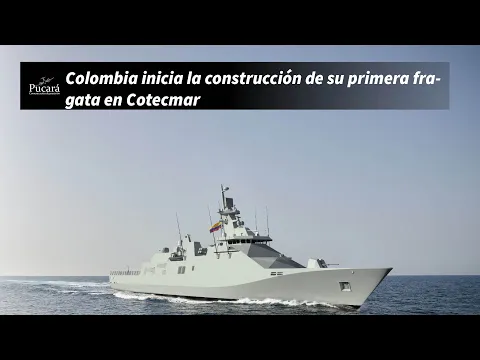

However, information on the total number of ships does not appear uniformly across different open sources.
Part of the specialized news mentions the intention to reach up to five units in phases, but details such as the final contracted number, complete schedule, and budget may vary depending on political decisions and fiscal availability.
Without a consolidated public document with these data, the scenario remains contingent on what is officially confirmed.
Multimission Operations, Maritime Surveillance, and Interoperability
The frigate is described in the news as a multimission platform, with possible uses in patrol and maritime surveillance, protection of areas of interest, defense of routes, and participation in exercises and operations with partners.
Sources monitoring the program also point out the expectation of compatibility with standards used by Western navies, which theoretically facilitates combined activities.
Even so, effective interoperability depends on concrete choices of communication, sensors, identification systems, and armaments.
In the industrial plan, the Colombian government and sources from the sector have emphasized the intention to strengthen local maintenance and upgrading capabilities.
The argument presented is to reduce external dependence for life cycle services, which often represent a significant portion of the total cost of ships over decades.
Still, the final level of autonomy tends to depend on the degree of nationalization and the rules for supplying sensitive components, which, in many cases, remain under the control of exporting companies and countries.
Economic Impact and Employment in the Defense Industry
Projects of this size typically mobilize a wide chain of suppliers, services, and professionals, from naval steel to integration engineering and testing.
In specialized coverage about the PES, there are expectations for the generation of direct and indirect jobs and for forming qualified labor, associated with the construction cycle and services linked to the program.
The long-term impact, according to recurring analyses from the sector, would be connected to the consolidation of reusable industrial capabilities in future projects, provided the country can maintain continuity of investment and demand.
This outcome, however, depends on factors such as support contracts, the ability to absorb technology, and industrial policy decisions over the coming years.







Ojo titular 3 toneladas? No es fragata, es una lancha, guarde las proporciones
no es el buque mas poderoso de latinoamerica ni micho menos..en primer lugar y por lejos estan las tamandare de Brazil luego las fragatas Chilenas aunque mas antiguas son mas completas y mayor potencia de fuego