





 Portuguese
  English
  Spanish
  6 min of reading
  0 comments


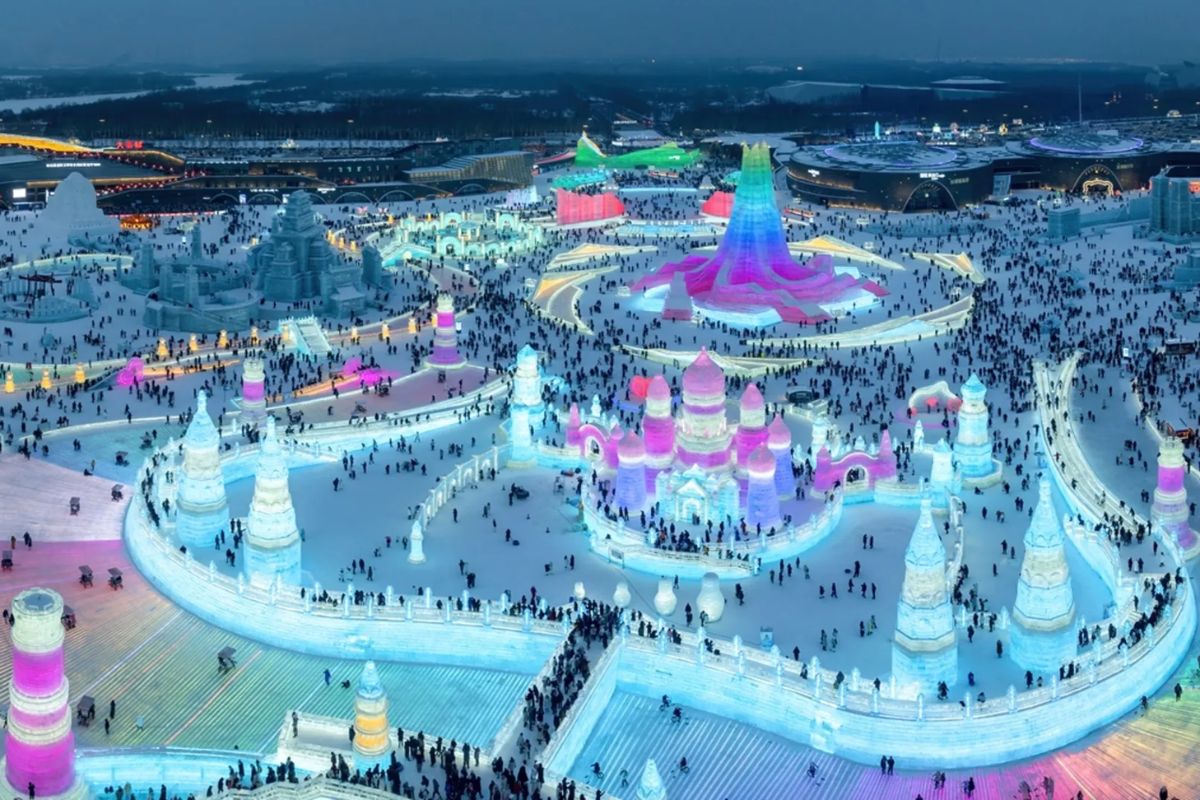
With Ice Stored for Ten Months and 1.2 Million Square Meters Under Construction, Harbin Erects a Giant Frozen City, Claims the Title of Largest Ice Park in the World, Consolidates the Ice and Snow Park, and Transforms Winter Tourism into a Driver of Seasonal Jobs in the Region
Harbin has turned winter into a central economic strategy by building, year after year, a giant frozen city that occupies 1.2 million square meters. The project combines blocks of ice stored for over ten months, cranes, specialized teams, and tight schedules so that when the cold hits, visitors find a sort of theme park sculpted in ice, presented by authorities as the largest ice park in the world.
More than just a backdrop for photos, Harbin Ice-Snow World was designed as a walkable ice and snow park, with entrances, organized circulation, and structures that can be explored for hours, especially at night when the lighting creates a second layer of experience. In this model, winter tourism transitions from being merely a byproduct of the weather to operating as a planned mechanism for revenue, temporary jobs, and associated services.
How Harbin Builds a Giant Frozen City Block by Block

At the end of November, the industrial landscape of Harbin repeats itself with slight variations: cranes, excavators, and long lines of workers move blocks of ice across a surface still undergoing transformation.
-
A megaproject worth R$ 89 billion is advancing in Iraq and promises to change the game in global trade by creating a new corridor between Asia and Europe, reducing traditional routes and repositioning the country as a logistics powerhouse.
-
Goodbye bedside table: floating shelves become a trend in 2026 by freeing up space in the bedroom, improving circulation, bringing visual lightness, and integrating technology without taking up floor space.

-
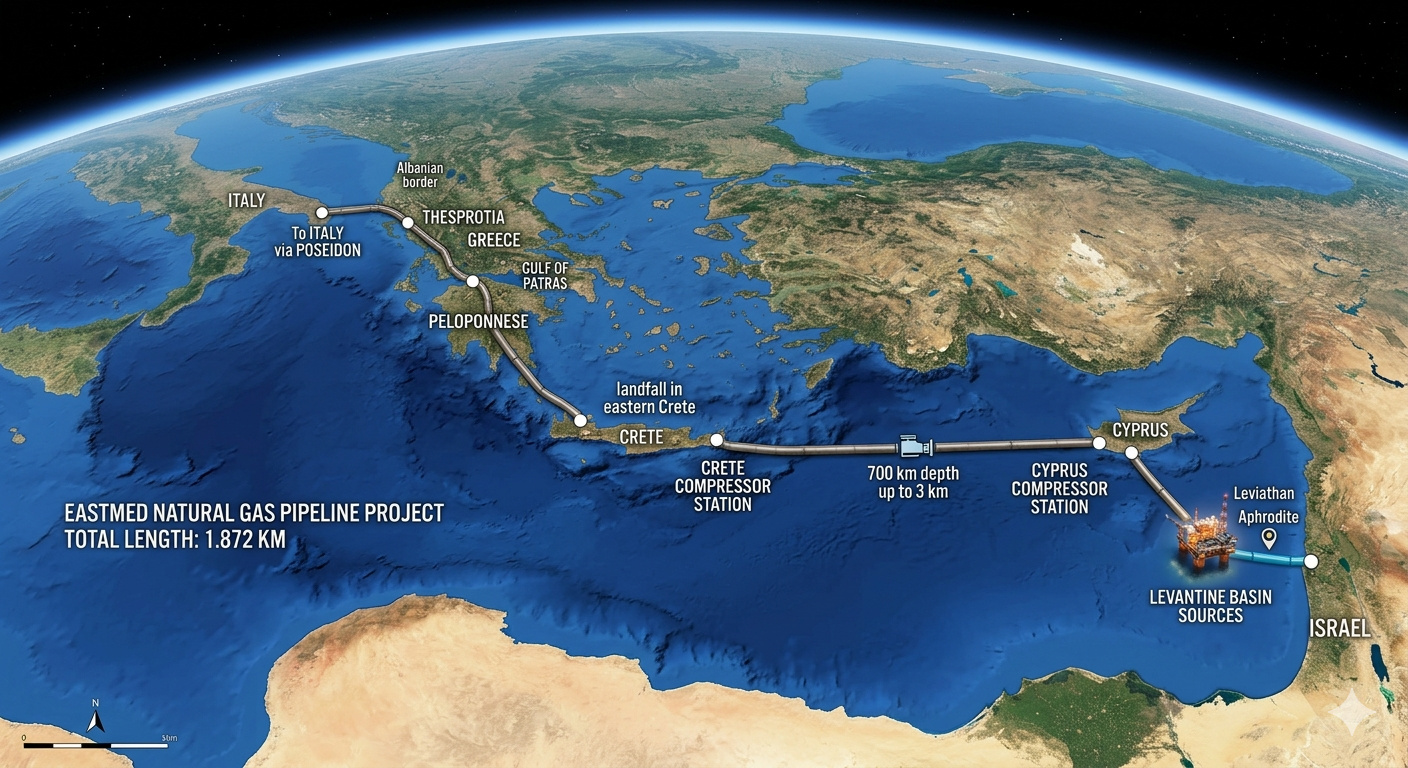
Israel, Greece, and Cyprus signed an agreement in 2020 to transport gas from the Mediterranean to Europe via a 1,872 km pipeline, but Turkey claimed sovereignty over part of the maritime route, and the project never materialized.
-
Israel, Greece, and Cyprus signed an agreement in 2020 to transport gas from the Mediterranean to Europe via a 1,872 km pipeline, but Turkey claimed sovereignty over part of the maritime route, and the project never materialized.

Thanks to ice stored during the previous season and preserved for over ten months, construction begins even before the river is fully frozen, shortening deadlines and allowing for an increase in area for the new cycle.
The stated goal is to erect, this winter, a giant frozen city covering around 1.2 million square meters.
The construction site is organized like a large real estate development, but with a different logic: walls, towers, staircases, and slides are born from blocks of ice cut, transported, and positioned with precision, following plans that will be used for only a few weeks and then literally melt away.
At the end of the project, visitors passing through the gates find an environment that resembles a theme park more than a temporary exhibition.
The experience involves movement within a provisional city, with circulation axes, spacious areas for staying, observation points, sliding ramps, and zones designated for specific activities.
It is in this space that Harbin practically validates the idea of being the largest ice park in the world, translating into infrastructure what were once mere isolated sculptures.
Ice and Snow Park: From Local Tradition to Largest Ice Park in the World
Before becoming a global showcase, Harbin already celebrated winter with local practices, such as hand-carved ice lanterns that began appearing in the mid-20th century.
This tradition culminated in the first Harbin Ice and Snow Festival on January 5, 1985, still in a dispersed and highly symbolic format.
The scale jump came in 1999 when the Harbin Ice and Snow World was created as an independent space, with access, its own design, and a proposal closer to a structured ice and snow park.
Since then, the occupied area has grown, as has the volume of materials, the need for heavy machinery, and the presence of planned construction processes.
Today, the ambition is explicit: position Harbin as a global reference and claim the title of the largest ice park in the world.
The city competes for attention with established events like the Sapporo Snow Festival in Japan and the Quebec Winter Carnival in Canada.
The difference, according to official Chinese data, is less about the number of sculptures and more about the form.
Sapporo distributes works across various urban points, Quebec combines parades and culture in multiple spaces, while Harbin concentrates most of the experience in a single venue, designed as a large temporary recreational installation.
In this arrangement, the ice and snow park ceases to be merely a photogenic landscape.
Staircases can be used, platforms accommodate the public, slides are designed for continuous sliding, and new attractions are added each season.
For the current edition, ice fishing areas, cross-country skiing circuits, group snow games, and an additional stage complementing the already known Dream Stage have been announced.
Winter Tourism as a Machine for Visitors, Revenue, and Jobs
The numbers released by Xinhua help dimension the impact of this strategy. In the last season, Harbin received 90.36 million visitors, with estimated revenue of 137.22 billion yuan.
The Ice and Snow World does not solely account for these figures, but serves as a focal point for winter tourism, concentrating accommodation, restaurants, transportation, and ancillary services around the main attraction.
The construction and operation of the space require an extensive chain.
The construction site mobilizes technicians, machine operators, structural and lighting specialists, who work under negative temperatures to build the giant frozen city within the scheduled timeframe.
At the opening phase, the demand shifts profile and starts to include visitor service personnel, security, cleaning, maintenance, and tourism logistics.
In many cases, these are temporary jobs that recur with each cycle and depend on prior planning.
This recurring design makes winter tourism transition from being merely an occasional peak of activity to resembling a “sector” with its own calendar and processes.
The city also features an indoor ice and snow park, designed to operate year-round as an extension of the outdoor complex.
Thus, the largest ice park in the world begins to function as a showcase for a broader strategy, aiming to capture income not only in peak season but also during periods when snow no longer guarantees the stability of external structures.
Logistics, Limits, and Recurrence of a City That Melts Every Year
Despite its monumental appearance, the Ice and Snow World is, from its inception, an explicitly temporary project.
The park is assembled every year, operates for a few weeks, and is dismantled when temperatures no longer ensure the integrity of the constructions, reducing risks for visitors and workers.
This ephemeral nature, however, does not imply improvisation.
The prior storage of ice, the organization of work fronts, and the design of internal routes indicate that this is a highly planned ice and snow park, rather than an isolated event.
Each season allows for flow adjustments, recalibration of lighting use, and testing of new circulation formats to better manage the crowds brought in by winter tourism.
At the same time, the strategy has clear limits. A city based on ice blocks cannot be permanent, and a large part of the jobs created is tied to the specific cycle of intense cold.
The response found by Harbin has been the reinforcement of associated activities, such as the indoor park, and the deepening of local capacity to design, build, and operate complex short-duration spaces.
With this, the giant frozen city serves as a laboratory for techniques, logistics, and services that can, in part, be reused in other urban and tourism projects.
At the center of this process lies a continuous bet: the largest ice park in the world only makes sense if it continues to attract visitors, maintaining a delicate balance between visual spectacle, structural safety, and economic viability.
In other words, each winter it’s necessary to prove again that the model still makes sense for the local government, businesses, and workers.
In the face of a city that rebuilds, every year, a giant frozen city to fuel winter tourism, do you think this type of seasonal megaproject is sustainable in the long run or tends to lose strength as other destinations start competing for the same audience?








-

Uma pessoa reagiu a isso.