





 English
  Francês
  Alemão
  Italiano
  Japonês
  Norueguês
  Portuguese
  Spanish
  3 min of reading
  48 comments


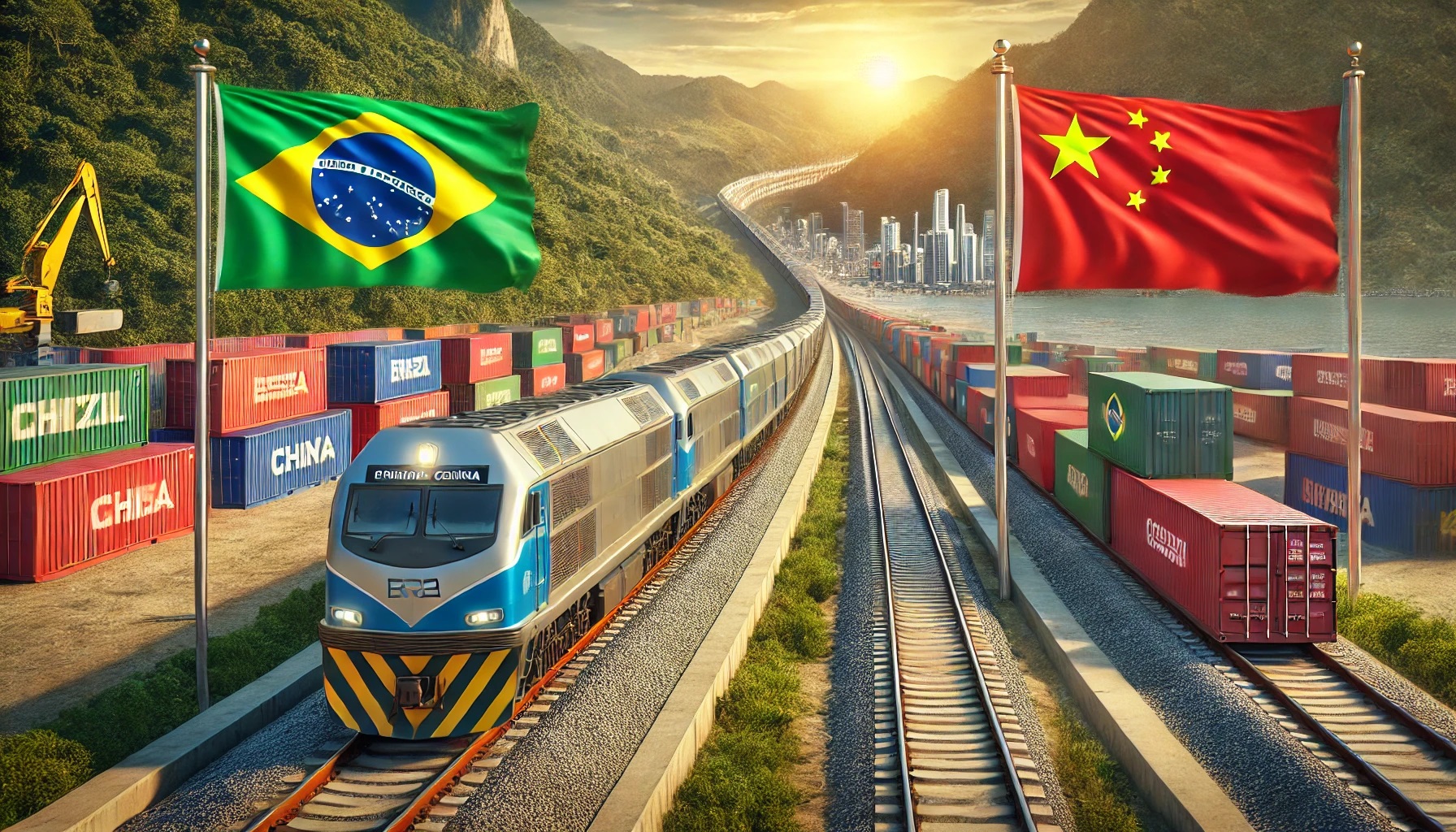


New Railway Will Connect Brazil and China: Countries Close Partnership and Promise Billion-Dollar Investment in Megaproject for Construction of New Transoceanic Railway with 17 Thousand Km in Length in Brazil, check out the details below.
Railway with 17 Thousand Km: The physical distance between South America and China may be approximately 17 thousand km, however economic partnerships reduce this distance, bringing these regions closer than ever. A new megaproject, called the transoceanic railway, promises to revolutionize not only trade relations but also logistics between South America and Asia, opening new routes and opportunities for both continents with a new railway that will connect Brazil and China.
Railway with 17 Thousand Km That Will Connect Brazil and China in New Megaproject of +400 Billion Dollars
The Transoceanic Railway megaproject is a manifestation of the globalized world we live in, where physical distances are shortened by the shared vision and cooperation between nations. The new railway will connect Brazil and China and aims to redefine negotiation dynamics and trade routes between South American and Asian countries.


The Belt and Road Initiative has already demonstrated China’s ability to unite distant regions, promoting trade and cultural exchange. Now, by focusing on South America, the country aims not only to consolidate trade partnerships but also to invest in infrastructure projects that promise to transform the continent’s logistics and economy.
-
If the USA were to go to war with Brazil, Washington’s greatest fear would not be the attack itself, but facing a vast territory, prolonged resistance, and a costly, chaotic, and unpredictable occupation.

-
In 2013, Nicaragua sold the concession for a canal to rival Panama to a Chinese billionaire who lost 85% of his fortune, disappeared, and was declared bankrupt. Now the project resurfaces with a new route, a new Chinese partner, and a cost of $64.5 billion.
-
New shoe factory in Ceará is expected to create 400 jobs and strengthen the local economy.
-
No one imagined it, but a mixture of sawdust with a mineral that fights fires surprises scientists with a result that changes the course of fire-resistant construction.


The economic relationship between China and South America has seen substantial growth in recent years, with bilateral trade surpassing US$ 490 billion. The Transoceanic Railway will provide a new trading route that can shorten distances and significantly reduce costs.
The new railway will connect Brazil and China, benefiting the directly involved nations but also has the potential to positively impact the entire South American region, facilitating access to Asian markets and vice versa.
Understand the Challenges of the Transoceanic Railway Megaproject
Although the megaproject has transformative potential, the logistical and financial challenges that accompany a project of such magnitude cannot be ignored.
The complex South American geography, which includes the vastness of the Amazon Rainforest and the grandeur of the Andes, poses considerable obstacles due to the difficult terrain and sensitive ecosystems.
Despite these challenges, China’s experience in infrastructure megaprojects suggests that these obstacles can be successfully tackled. Conceived in the 1950s as the Trans-South American Railway, the idea of connecting the Atlantic and Pacific oceans via a railway crossing the South American continent gained new momentum in the 21st century.
In 2008, the project was relaunched by the Brazilian government as the Transoceanic Railway, focusing on integrating the country’s regions and boosting the economy.
Understand What the New Brazilian Railway Will Be Like
With a total length of approximately 4,400 kilometers, the railway is divided into three major sections within Brazilian territory. The first section connects the Port of Açu to the North-South Railway, the second links Campinorte to Porto Velho, on the banks of the Madeira River, and the third extends from Porto Velho to the border with Peru, in Cruzeiro do Sul.
This extensive railway network will allow for the integration of various regions of the country and connection with important producers and consumers. The partnership between Brazil, Peru, and China for the construction of the Transoceanic Railway gained new momentum in 2014, with the signing of an agreement that enabled studies and projects. However, it was in 2022 that Brazil, Peru, and China resumed efforts to move forward with the Transoceanic Railway project.
In August 2024, China announced it would invest US$ 100 billion in the railway project, strengthening this partnership and positioning the railway project as strategic for the Belt and Road Initiative.









Que reportagem rasa, e incoerente com a manchete. Infelizmente o formato de notícias online virou somente um alvo para ganhar clicks para subsidiar anúncios
Mais uma orgia tupiniquim. Um País onde o povo só pode viajar de carro, ônibus ou avião querem fazer isso. Ferrovias são necessárias pra nós livrar da escravidão das estradas perigosas com carretas etc. Temos q poder viajar de SP a outros Estafos , como Goias por ex , sem aviao.
Vai um Grande sucesso para os países vizinhos e fronteiras