





 Portuguese
  English
  Spanish
  7 min of reading
  2 comments


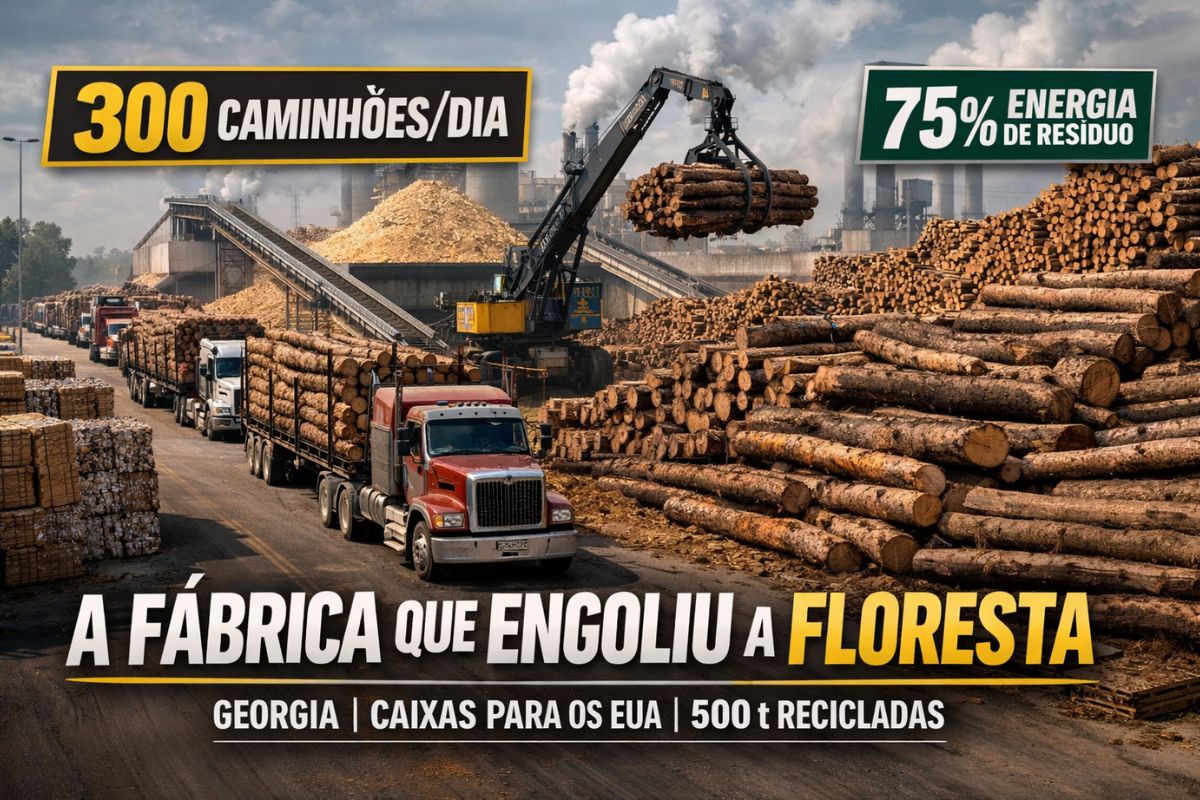


In Georgia, the largest paper and box company in the world receives 300 trucks loaded with trees daily, recycles 500 tons of cardboard, and generates 75% of its energy by burning waste while transforming private pine forests into cellulose, industrial carbon, and thousands of boxes that supply consumption in the USA.
In 2022, the very sustainability report from International Paper exposed the climate cost of operating the largest paper and box company in the world, showing that the carbon released in processing the trees already exceeds more than double the emissions from burning fossil fuels in its operations, while the factories continue converting pines into energy, pulp, and packaging for the American market.
At a company plant in the state of Georgia, about 300 trucks of freshly cut trees arrive every day, a dedicated recycling line processes 500 tons of used cardboard per day, and an internal plant generates 75% of the energy that the factory consumes by burning waste. All this happens in a region known as America’s wood basket, where the forest cover in the United States has remained virtually stable since the 2000s, even with the pressure from the pulp and paper industry.
Pine Forests Become Industrial Investment in the South of the USA

The raw material for this machinery starts long before the factory door. Foresters show areas that were cut about ten years ago and quickly replanted with fast-growing pines, in cycles that can take around thirty years between one harvest and another.
-
50 viaducts, 4 tunnels, 28 bridges, and 40 kilometers of bike paths: BR-262 in Espírito Santo will receive 8.6 billion reais for the largest engineering project in the state’s history, inspired by the Immigrant Highway in São Paulo.

-
Brazil produces too much clean energy and doesn’t know what to do with it: over 20% of solar and wind capacity was wasted in 2025 while investors flee and 509 renewable generation projects were abandoned in the last year.

-
Piauí will produce a new fuel that replaces diesel without needing to change anything in the truck’s engine and reduces pollutant gas emissions by half: truck drivers from all over the Northeast are already celebrating the news that will arrive later this decade.

-
A new Brazilian shopping center worth R$ 400 million will be built in an area equivalent to more than 4 football fields, featuring 90 stores, 5 cinemas, a supermarket, a college, and parking for 1,700 cars, potentially generating 3,000 jobs.


After the harvest, landowners sell the trees to various industries, which transform them into lumber, posts, cellulose, and corrugated packaging.
The logic of the largest paper and box company in the world and its suppliers is clear: transform forest into financial asset, ensuring a stable market for wood and, in return, providing an economic incentive for these areas to be maintained as pine plantations instead of being converted into crops, parking lots, or other permanent land uses.
Critics, however, remind that pine monocultures are not the same as natural forests.
The southern United States harbors only a small portion of the world’s forests but accounts for a disproportionate share of global cellulose and paper production, making the region a symbol of high productivity for some and high exploitation for others.
Wood Yard With Giant Piles and Firefighting Sprinkler

Upon arriving at the Georgia factory, the trucks unload logs from farms and forests within an approximate radius of 120 miles.
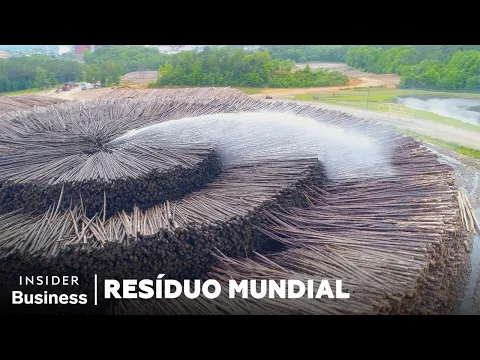
Part remains stacked in gigantic mounds, ensuring enough raw material to keep the line running 24 hours a day. A sprinkler system keeps the wood moist, reducing the risk of fire in the stacks.
A crane feeds a large debarker drum that strips the bark from the logs.
This bark is not thrown away. It becomes fuel in the plant’s boilers.
Next, the debarked logs go to a shredder that transforms them into wood chips, accumulated in a mountain that can reach nearly 1 million tons stored, a volume that takes approximately ten days to be completely processed.
Heavy Chemistry, Steam, and Energy Generated from Its Own Waste
In the stage known as pulping, the pine chips follow a conveyor belt to enormous digesters. Inside, steam and chemicals dissolve the lignin, the natural glue that holds the fibers together.
The goal is to release long, strong fibers, ideal for structural papers, while discarding the sticky part.
The process generates gases with a sulfur-like smell, responsible for the typical odor of paper mills, but International Paper claims to capture much of these gases to reduce the smell and emissions.
What remains of the chemical mixture and wood residues is called black liquor.
Instead of becoming hazardous waste, this liquor is concentrated and burned in a recovery boiler, producing steam and allowing the reuse of part of the chemicals used in the process.
The plant operates almost like a chemical park, and thanks to this recovery, it produces about 75% of its own energy, reducing the purchase of fossil fuels compared to the past, although it still releases large quantities of carbon when processing trees.
Before the pulp becomes paper, the line also receives a boost of recycled fibers.
This is where the 500 tons of post-consumer cardboard that arrive from distribution centers and supermarkets located within a radius of hundreds of kilometers come in.
The system is designed to remove dirt, grease, tape, and even food remnants, allowing even pizza boxes to be recycled safely.
Giant Machines Transform Pulp into Structured Paper Rolls

With virgin and recycled fibers mixed in large tanks of water and chemicals, the wet mass follows to a machine known simply as the paper machine.
The equipment is so long that the sheet dries gradually, first being pressed to expel water, then passing through heated cylinders at over 93 degrees Celsius.
At the end of the line, the result is still a continuous paper, rolled into huge rolls. Only in the next step does it gain the shape recognizable to the public as a box.
These rolls are sent to corrugated packaging plants, where the largest paper and box company in the world converts the material into products tailored for supermarkets, industries, and e-commerce.
From Paper Roll to Corrugated Box Arriving at the Consumer’s Door
In a box plant, like the one International Paper operates in Midwestern states, the heart of the line is the corrugator.
In it, one of the layers of paper is heated and pressed against grooved rollers, creating the waved flutes that give rigidity to the packaging.
Smaller flutes allow for better printing but are less resilient. Larger flutes sacrifice print quality to gain mechanical strength.
By combining different types of flutes and paper grammages, the company can produce more than 1.6 million different box designs, ranging from tiny packaging, the size of a ring box, to structures large enough to protect a washing machine.
After the gluing of the layers, the sheets pass through printing presses and cutting machines that define the final shape, almost always sent flat to save space during transport.
The cutouts and leftovers return to the recycling plant, closing another internal cycle of the chain.
High Recycling, but Permanent Dependence on New Trees
In the United States, more than 70% of used cardboard is recycled, a rate well above that of aluminum, glass, or plastic.
About 80% of Americans have access to cardboard collection on their curbs, which helps maintain the flow of used boxes back to factories. This high rate is one of the pillars of the sustainability narrative of the largest paper and box company in the world.
But experts remind that cardboard cannot be recycled indefinitely. Studies indicate that paper fibers withstand about seven recycling cycles.
Each time, the fibers shorten and weaken until they degrade so much that they escape through the screens of the process and are no longer utilized.
Even in a hypothetical scenario where 100% of boxes return to recycling, it would still be necessary to introduce virgin fiber, which keeps the pressure on pine plantations alive.
Pine Plantations, Natural Forests, and Carbon Balance
International Paper claims that more than 90% of the fiber it uses comes from trees in the southern United States, mostly on private properties.
The company says it offers a market that allows landowners to maintain areas as commercial forests and pay for replanting, preventing the land from being converted into permanent uses, such as intensive agriculture or infrastructure.
At the same time, environmental organizations argue that these pine plantations are replacing more diverse natural forests.
Research cited by environmentalists indicates that native forests can store much more carbon than commercial plantations, in addition to providing services such as filtering drinking water and reducing erosion.
Management techniques that preserve large trees and part of structural complexity can bring plantations closer to a more sustainable model, but experts warn that this requires highly skilled forestry that is not always applied in practice.
To reinforce its image of responsibility, the largest paper and box company in the world highlights certifications stamped on its boxes and reports that a significant share of the fibers used comes from forests certified by sustainable management standards.
The dispute between the conservation narrative and industrial reality, however, remains open in the forests of the Southern USA, where millions of pines continue to enter trucks to become energy, carbon, and boxes circulating the planet.
In light of this situation, do you think the model of the largest paper and box company in the world truly balances conservation and profit, or is it going too far in turning forests into disposable packaging?









Muito interessante o sistema de reciclagem dentro da própria planta de processamento das madeiras.. Sera que as fabricas recentemente inaugurada e em construção no MS – Brasil, seguem estes critérios?
Com certeza, muito conveniente em todos os sentidos, bora tenha de se considerar que uma floresta plantada não oferece os mesmos benefícios ecológicos em relação á floresta nativa, temos de entender dois aspectos básicos, compare-se a produtividade superior das áreas cultivadas em relação á nativa, e considerando a alta demanda por produtos da espécie, qual seria o tamanho da devastação, se o processo fosse realizado em florestas nativas….