





 English
  Francês
  Alemão
  Italiano
  Japonês
  Norueguês
  Portuguese
  Spanish
  6 min of reading
  0 comments


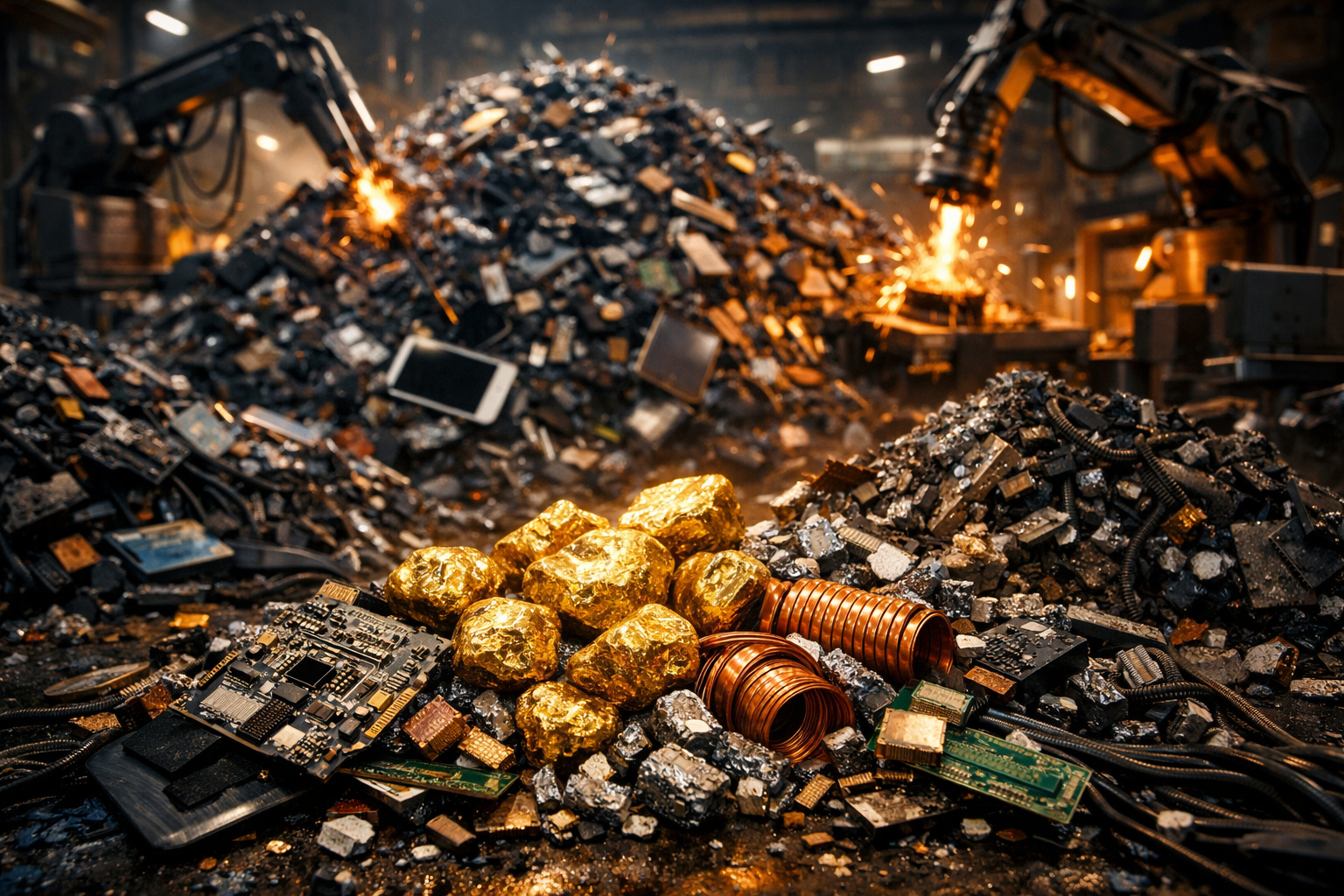
E-Waste Now Totals 62 Million Tons Per Year and Contains US$ 91 Billion in Metals. Discover How Urban Mining Transforms Circuits into Gold and Copper.
In 2022, the planet produced 62 million tons of e-waste, according to the Global E-Waste Monitor 2024, published by United Nations agencies. It is the highest volume ever recorded in history. If all this material were loaded onto large trucks, it would form a line capable of wrapping several times around the Earth. But what seems like just a gigantic environmental problem has also become a new economic frontier. Within this ocean of broken cell phones, obsolete computers, discarded televisions, and unusable cables lies a true mine of valuable metals.
Circuit boards, connectors, and chips contain gold, copper, silver, palladium, platinum, and various critical metals used in batteries, wind turbines, and electronic equipment. In some cases, the concentration of these elements is so high that e-waste can be richer in precious metals than many natural ores exploited by traditional mining. This phenomenon has given rise to the concept of urban mining, a growing industry that transforms technological scrap into strategic raw materials for the global economy.
The E-Waste That Grows Faster Than Any Other Waste on the Planet
E-waste — known internationally as e-waste — includes any discarded electrical or electronic device. This encompasses everything from smartphones and computers to refrigerators, televisions, routers, and industrial equipment.
-
New shoe factory in Ceará is expected to create 400 jobs and strengthen the local economy.

-
No one imagined it, but a mixture of sawdust with a mineral that fights fires surprises scientists with a result that changes the course of fire-resistant construction.

-
From empty land to a high-end house, wooden construction uses a lightweight system, metal structure for the foundation, ventilated ceramic cladding, and special windows to create an efficient and comfortable living space throughout the year.
-
From vacant land to a high-end house, wooden construction uses a lightweight system, a metal structure for support, ventilated ceramic cladding, and special windows to create an efficient and comfortable living space throughout the year.

The growth of this type of waste has been explosive over the past two decades. Rapid technological evolution constantly reduces the lifespan of devices, while the expansion of the digital economy increases the number of devices in circulation.
According to the Global E-Waste Monitor 2024, global generation of e-waste increased 82% since 2010. Projections indicate that the global volume could reach 82 million tons by 2030.
Even with this accelerated growth, only 22% of this material is formally recycled. The rest ends up in landfills, is illegally exported to developing countries, or is informally disassembled under precarious conditions. This reality creates two simultaneous problems: enormous waste of valuable resources and a growing environmental risk.
The Hidden Gold Inside Cell Phones and Computers
What makes e-waste particularly interesting for urban mining is the concentration of valuable metals present in its components.
Circuit boards — the green panels filled with metallic traces found in almost all electronic devices — contain small amounts of gold used to ensure reliable electrical connections that are resistant to corrosion.

Although each individual device contains only fractions of a gram, the accumulated volume is impressive. Estimates show that one ton of electronic boards can contain up to 800 grams of gold. For comparison, many gold mines operate with ores that contain only 5 grams per ton of rock.
This means that certain types of e-waste can have gold concentrations up to 100 times greater than natural ore exploited in conventional mines.
In addition to gold, circuits also contain large amounts of copper, used in conductive pathways. This metal is essential for practically all electrical infrastructure in the world, from power cables to industrial motors.
The US$ 91 Billion Hidden in Global E-Waste
The UN report estimates that e-waste generated in 2022 contained approximately US$ 91 billion in recoverable metals.
Among the most valuable elements present in this material are:
- copper
- gold
- silver
- palladium
- iron
- aluminum
Copper alone represents a huge chunk of this value. As the metal is widely used in electrical cables and electronic components, large amounts end up in discarded devices.
The recovery of these metals not only generates economic value but also reduces the need for extraction in traditional mines.
Conventional mining involves massive excavations, intensive energy consumption, and the generation of large volumes of waste. Urban mining, on the other hand, works with materials that are already concentrated and refined within industrial products.
How Urban Mining of Electronic Metals Works
The process of recovering metals from e-waste involves several technological steps. First, the devices are collected and sorted by type of equipment. Smartphones, computers, televisions, and other devices have different compositions and require distinct recycling processes.
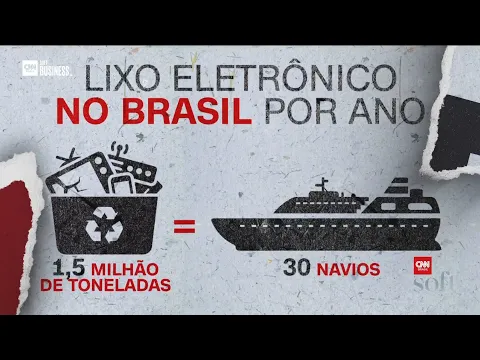
Next comes disassembly. In modern industrial facilities, robots and specialized workers remove batteries, screens, plastic casings, and electronic boards.
These components are then subjected to mechanical processes that crush and separate materials by density, magnetism, and electrical conductivity. The resulting material is treated in metallurgical refineries using chemical or thermal processes capable of extracting individual metals with high purity.
This type of refinery operates similarly to the facilities used in traditional mining, but instead of raw ore, the raw material is crushed electronic circuits.
Specialized Refineries Are Emerging in Several Countries
With the increase in e-waste generation, various companies have begun investing in specialized metal recovery refineries. Large industrial complexes have emerged in Europe, the United States, Japan, and China. These facilities process thousands of tons of electronic scrap per year.
Some refineries are able to recover over 95% of the metals present in electronic boards, transforming technological waste into raw materials ready to return to industry. Companies like Umicore in Belgium and several Asian recyclers operate some of the most advanced facilities in the world in this sector.
These refineries are capable of simultaneously extracting dozens of different elements present in electronic devices.
Critical Metals for Batteries and Renewable Energy
In addition to precious metals, e-waste also contains elements considered strategic for the energy transition.
Among them are:
- cobalt
- nickel
- rare earth elements
- lithium
These materials are essential for technologies such as electric vehicle batteries, wind turbines, and high-efficiency motors.
The mining of these elements often occurs in environmentally sensitive or politically unstable regions. Therefore, the recovery of metals from discarded products is seen as a strategic alternative to reduce dependence on new mines. Urban mining can become an important source of critical materials for the low-carbon economy.
The Global Recycling Challenge Is Still Enormous
Despite the economic potential, e-waste recycling still faces significant obstacles. A large portion of discarded devices never makes it to recycling centers. Many are forgotten in drawers or end up in landfills.
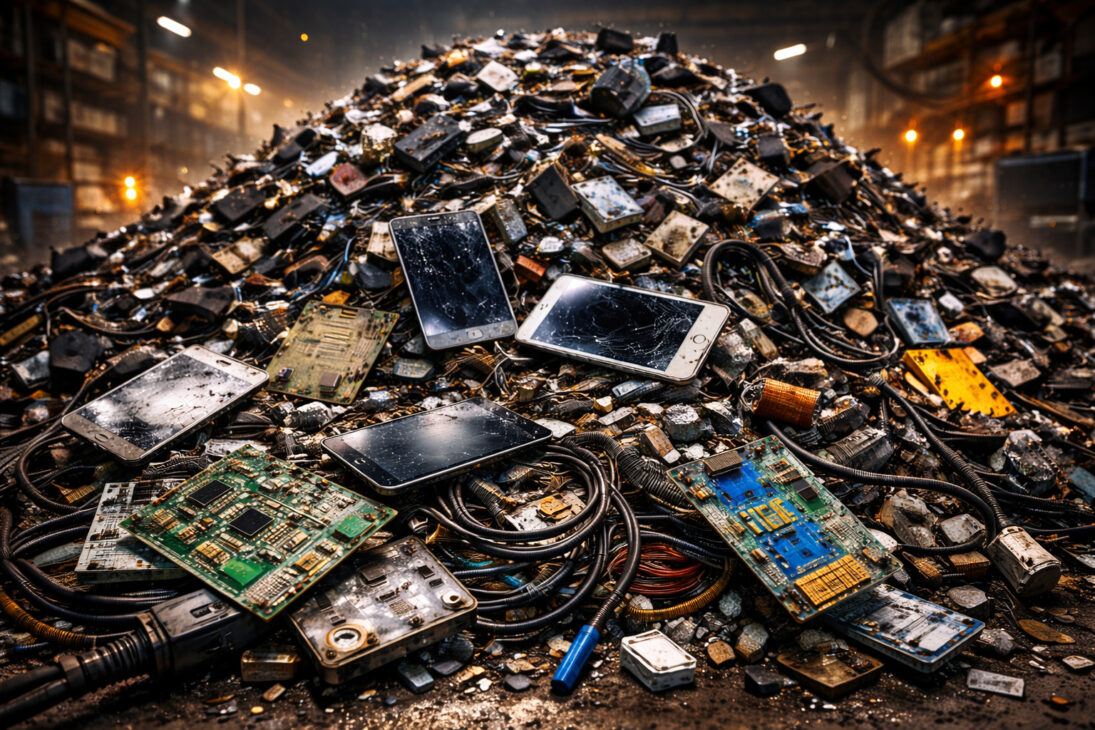
Another problem is the existence of informal recycling chains in various countries. In some locations, workers manually disassemble electronics and burn components to recover copper and other metals, releasing toxic substances into the environment.
These practices pose health risks and waste a large portion of the valuable materials that could be recovered through more efficient industrial processes.
A New Form of Mining Without Digging Mountains
Even with these challenges, experts believe that urban mining will play an increasingly important role in the global economy.
As billions of electronic devices continue to be produced and discarded, the planet is creating a gigantic stockpile of concentrated metals within technological products.
Unlike conventional mining, which requires digging tons of rock to extract small amounts of metal, urban mining works with materials that have already undergone industrial refining stages. This significantly reduces energy consumption and waste generation.
In many cases, recovering metals from electronic products can be more efficient than extracting them from natural deposits.
E-Waste as the Mine of the Future
The growth of urban mining reflects a broader shift in how the global economy views natural resources. Instead of viewing discarded products merely as waste, more and more industries are starting to treat them as reservoirs of valuable raw materials.
Old cell phones, computer boards, and obsolete electronic equipment are turning into a new class of mineral resources — not buried in the ground but spread throughout the cities.
If efficient collection and recycling systems are scaled up, e-waste could become one of the most important sources of metals for the technology industry in the coming decades. In this scenario, the digital scrap accumulated in cities could end up functioning as a massive urban mine, supplying specialized refineries and reducing pressure on natural ecosystems.
What was once seen only as waste is now starting to be recognized as an essential part of the metal supply chain for the 21st century.









Seja o primeiro a reagir!