





 Portuguese
  English
  Spanish
  6 min of reading
  0 comments


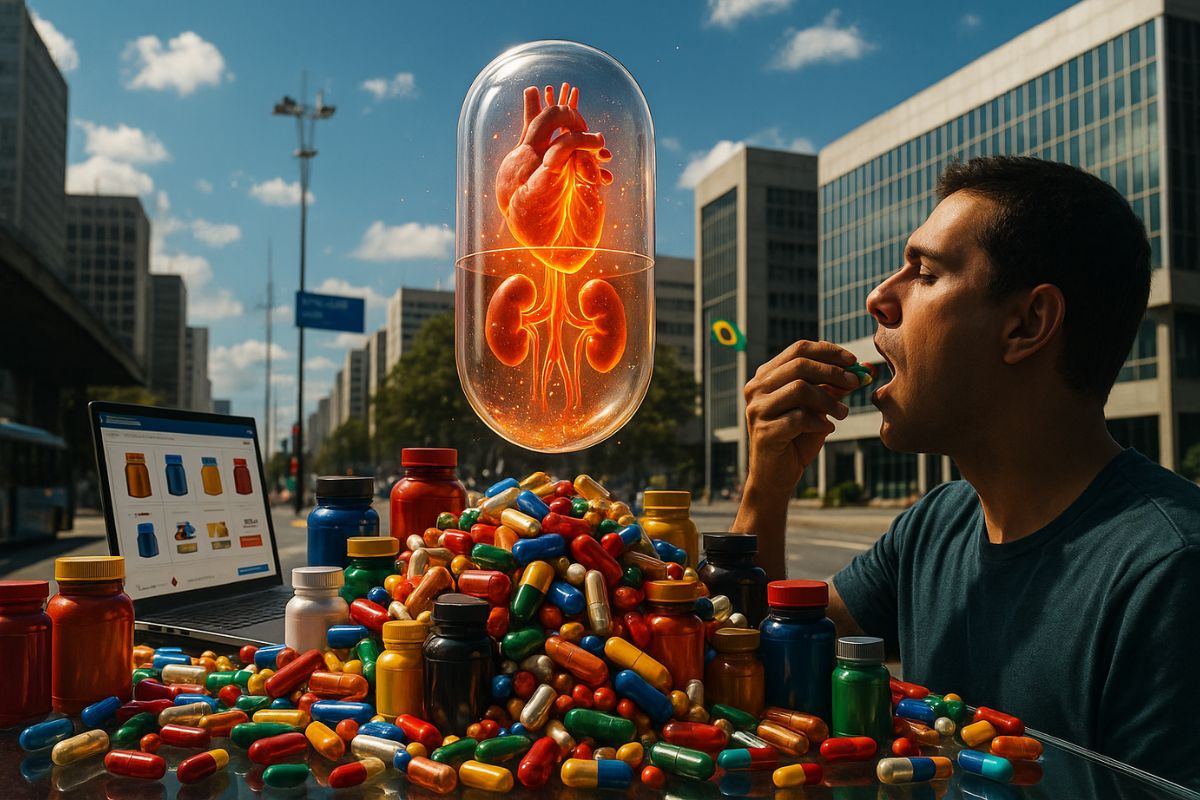
As The Supplements Market Grows And Promises Energy, Weight Loss And Instant Well-Being, Anvisa Finds Serious Flaws In Ingredients, Doses And Labeling, Extends The Deadline For Companies To Adapt To 2026, And Leaves Consumers Lost Between Enticing Labels And Silent Health Risks In The Day-To-Day Life Of Gyms And The Internet.
Two out of three supplements evaluated by Anvisa show some type of irregularity. The agency’s most recent survey, completed by July 2025, indicates a 65% failure rate among the analyzed products, with problems in ingredients, doses, shelf life, purity, and stability studies, basic steps to guarantee minimum safety for consumers.
This failure rate, in a market that already moves billions of reais a year, exposes the fragility of health control in a sector driven by promises of well-being, sports performance, and rapid weight loss. Even so, Anvisa decided to extend the deadline to September 2026 for companies to comply with safety and quality standards that were supposed to be implemented starting this year.
Explosive Growth, Delayed Regulation
According to industry data, the consumption of dietary supplements in Brazil grew about 300% in the last decade, driven by gyms, social media, fitness influencers, and the idea that a capsule resolves fatigue, localized fat, and lack of focus.
-
50 viaducts, 4 tunnels, 28 bridges, and 40 kilometers of bike paths: BR-262 in Espírito Santo will receive 8.6 billion reais for the largest engineering project in the state’s history, inspired by the Immigrant Highway in São Paulo.

-
Brazil produces too much clean energy and doesn’t know what to do with it: over 20% of solar and wind capacity was wasted in 2025 while investors flee and 509 renewable generation projects were abandoned in the last year.

-
Piauí will produce a new fuel that replaces diesel without needing to change anything in the truck’s engine and reduces pollutant gas emissions by half: truck drivers from all over the Northeast are already celebrating the news that will arrive later this decade.

-
A new Brazilian shopping center worth R$ 400 million will be built in an area equivalent to more than 4 football fields, featuring 90 stores, 5 cinemas, a supermarket, a college, and parking for 1,700 cars, potentially generating 3,000 jobs.


During the same period, Anvisa saw the number of problems related to these products explode. Between 2020 and 2025, 63% of food investigations opened by the agency involved supplements, the highest rate among all regulated categories.
Irregularities range from absence of stability studies, which show whether the supplement maintains its composition until the end of its shelf life, to use of prohibited ingredients, labels with false therapeutic claims, and products without adequate purity testing.
Recent cases led to the ban of brands like Insuzin and Prostnar, marketed as natural supplements but containing undeclared substances in the formula.
For consumer protection experts, this illustrates how the market still operates in a gray area between food and medicine.
When Supplement Becomes A Risk To The Liver, Heart And Kidneys
Endocrinologist at the Brazilian Society of Endocrinology and Metabolism (SBEM), Geórgia Castro warns that the use of supplements without guidance, especially manipulated vitamins, concentrated proteins, and thermogenics, can overload vital organs.
According to her, the idea that “natural products are harmless” is a dangerous myth. Excessive fat-soluble vitamins, such as A, D, and E, can lead to toxicity, while undeclared stimulant substances can trigger tachycardia, arrhythmias, increased blood pressure, intense anxiety, and insomnia.
With prolonged use and without monitoring, the combination of multiple supplements increases the risk of liver damage, renal overload, and cardiovascular problems.
Patients arrive with three, four, five different bottles purchased from gyms, foreign websites, or marketplaces, often without any registration with Anvisa and without professional supervision.
Sports nutrition specialist, nutritionist Juliana Crivellaro emphasizes that there is no real performance gain when supplementation is done randomly.
For her, a supplement only makes sense when there is proven deficiency in tests or specific indication, and not as an automatic response to promises of “accelerated hypertrophy” or “weight loss in 30 days.”
The Capsule That Promised To Lose 16 Pounds In A Month
The communicator Priscila (a fictional name, at the interviewee’s request) decided to test a supplement bought online that promised to eliminate up to 16 pounds in a month.
The label seemed harmless: spirulina, green tea, hibiscus, horsetail, ginseng, collagen. Nothing indicating immediate risk, and no clear reference to Anvisa beyond generic information.
Shortly after taking the first capsule, as instructed by the seller, Priscila began to sweat cold, experienced tachycardia, dizziness, and pupil dilation. For two days, she couldn’t eat without feeling intense nausea. Scared, she stopped using it immediately.
The case illustrates the problem of products sold as “natural”, but that may contain undeclared pharmacological substances, in doses that would never be approved for a regular medication. In these situations, without formal registration and safety studies, there’s no way to know what is really inside the capsule.
How To Know If The Supplement Is Registered With Anvisa
To reduce the risk of falling for scams or using irregular products, the nutraceutical physician Danielli Orletti, founder of the Orletti Institute of Lifestyle Medicine, recommends a kind of minimum safety checklist before purchase:
- Notification or registration number with Anvisa on the label, mandatory for products under the latest regulations
- Be suspicious of miraculous promises, such as “rapid weight loss,” “cure for chronic disease,” “increased libido in a few days,” or “muscle gain without effort”
- Check CNPJ and the manufacturer’s name, avoiding brands without clear address or data
- Research the product on Anvisa’s consultation portal, using the name or notification number provided on the packaging
- Buy only from physical stores and pharmacies that issue an invoice, avoiding ads on personal profiles and suspicious links on social media
According to the specialist, no serious supplement needs to promise magical effects in a few days. When the promise is exaggerated, the alarm signal should be immediate.
What Anvisa Says And Why The New Rules Were Postponed To 2026
When approached, Anvisa states that it has maintained ongoing inspections and that the extension of the deadline for compliance with regulations until September 2026 does not suspend sanitary control over supplements.
The agency justifies the decision based on the technical complexity of the required tests and the limited capacity of laboratories, both public and private, to absorb the volume of analyses needed in a short time.
According to the agency, new products launched since 2024 must already comply with the rules for composition, labeling, and stability studies as defined by regulation.
In public hearings, representatives from Anvisa acknowledged that the sector is still far from ideal compliance, but claim that market monitoring and inspections at establishments continue to be in progress, with a special focus on misleading health claims and suspected fraud.
Industry Requests Predictability, Pharma Companies Speak Of Unfair Competition
On the industry side, ABIAD, which brings together a part of the supplement manufacturers, states that the associated companies already comply with Anvisa’s requirements and advocate for regulatory stability as a condition to compete and invest.
For the entity, clear rules and defined deadlines help separate those who follow safety standards from those operating informally.
At the same time, the association acknowledges that the inspection needs to more aggressively target irregular producers, who use the internet and legal loopholes to escape control.
Meanwhile, the vice-president of the Grupo FarmaBrasil, Adriana Diaféria, believes that the delay in the full implementation of the rules creates an environment of unfair competition.
While some companies invest in testing, quality, and traceability, another portion takes advantage of the lack of effective oversight to put on the market cheaper and unsafe products, driving prices down and confusing consumers.
Internet, Counterfeiting And The Blind Spot Of Oversight
The advancement of e-commerce has made enforcement even more complex for Anvisa. Both the agency and IPS Consumo, led by Juliana Pereira, point out that the biggest risk today lies in online sales.
In marketplaces, social media profiles, and foreign websites, supplements circulate with packaging very similar to well-known brands, but that have no connection to the original manufacturer. These are difficult-to-trace products, often shipped from fake or intermediary addresses and quickly removing ads as soon as complaints arise.
In these cases, the consumer believes they are buying a regulated product, but receives something without provenance, without quality control, and off the inspection radar. When serious side effects occur, it is common that there is no invoice, proof of origin, or even a company contact channel.
Consumer protection experts emphasize that, in light of this scenario, individual responsibility also carries weight.
Reading the label, consulting Anvisa, seeking medical advice, and being suspicious of miraculous promises has ceased to be just a recommendation and has become a basic measure of self-protection.
In the end, Brazil lives a contradiction: an accelerating supplements market, stricter regulation postponed to 2026, and a growing offer of miraculous capsules with a 65% failure rate in official tests.
Between the Promise of More Energy and Health and the real risk to the liver, heart, and kidneys, the line is much thinner than it seems in advertising.
And you, have you checked if the supplements you take are regulated by Anvisa or do you still just trust the label and online recommendations?









-

-

2 pessoas reagiram a isso.