





 Portuguese
  English
  Spanish
  5 min of reading
  0 comments


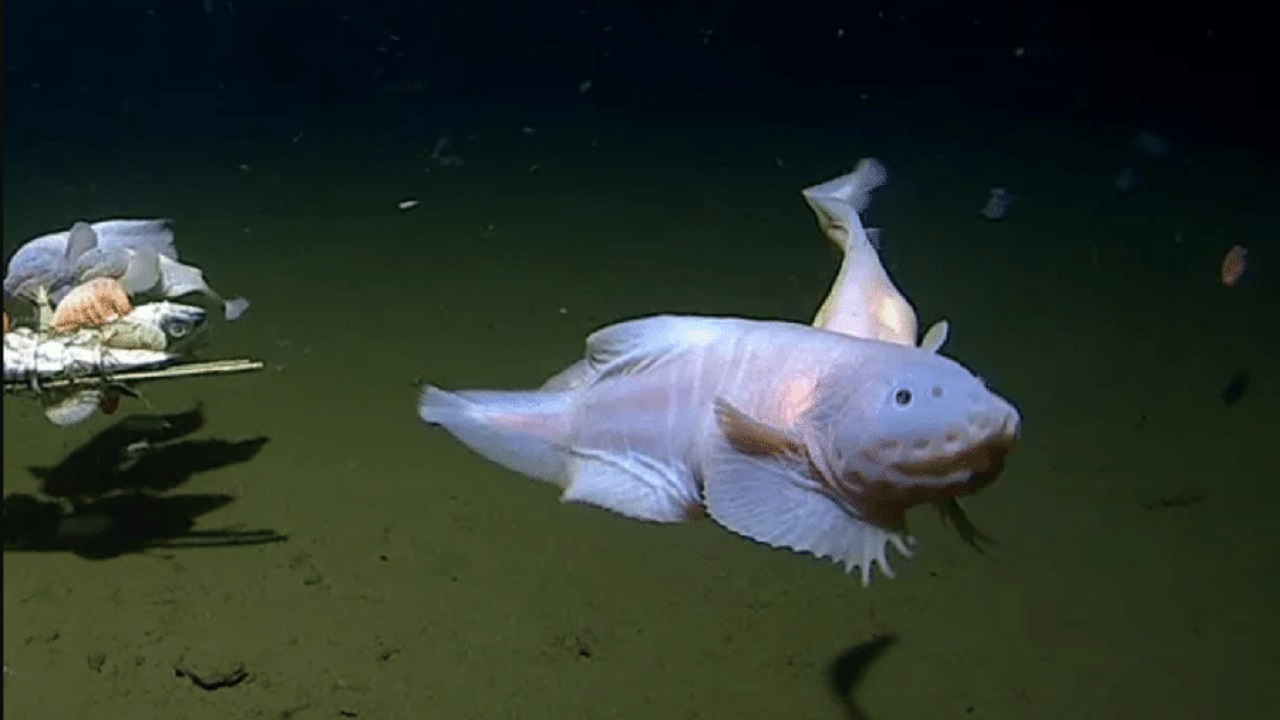
Expedition Films Snailfish Pseudoliparis at 8,336 M, Absolute Depth Record, and Reveals How Marine Life Defies Biological Limits.
Most of the ocean remains invisible to us. The deeper you go, the greater the feeling of crossing into another planet: the light fades, the temperature drops, the pressure increases, and almost everything we know as “life” ceases to exist. However, a recent expedition to the Pacific Ocean Trenches, involving Japanese and Australian researchers, produced one of the most impressive discoveries in marine biology in recent years: the deepest record of a living fish in history, captured at a depth of 8,336 meters.
This footage shows a small translucent animal, seemingly fragile, floating calmly in an environment where the pressure is over 1,000 times greater than at sea level. The fish belongs to the genus Pseudoliparis, known as snailfish, and was found in the Izu-Ogasawara Trench, off the coast of Japan. The new mark surpasses the previous record by 158 meters, recorded in 2017 in the Mariana Trench, and dangerously approaches the known biological limit for fish, estimated to be between 8,200 and 8,400 meters.
The result is not an isolated find: it is part of a scientific effort of over 15 years led by Professor Alan Jamieson, an expert in hadal ecology and a pioneer in exploring the planet’s deepest zones. According to him, “the maximum depth these animals can withstand is truly surprising,” and the new record helps to understand how much life can endure before collapsing under pressure.
-
Motorola launched the Signature with a gold seal from DxOMark, tying with the iPhone 17 Pro in camera performance, Snapdragon 8 Gen 5 that surpassed 3 million in benchmarks, and a zoom that impresses even at night.

-
Satellites reveal beneath the Sahara a giant river buried for thousands of kilometers: study shows that the largest hot desert on the planet was once traversed by a river system comparable to the largest on Earth.

-
Scientists have captured something never seen in space: newly born stars are creating gigantic rings of light a thousand times larger than the distance between the Earth and the Sun, and this changes everything we knew about stellar birth.

-
Geologists find traces of a continent that disappeared 155 million years ago after separating from Australia and reveal that it did not sink, but broke into fragments scattered across Southeast Asia.
How This Record Was Obtained and Why It Is So Important
The expedition used autonomous landers equipped with cameras, baits, and depth sensors, capable of descending to the hadal floor without the need for a crew.
Unlike old reports made by submarines, such as those from the 1960s, modern images allow for accurate verification of depth, eliminating misinterpretations and discarding confusions with organisms like sea cucumbers.


In addition to the video, the team also achieved a rare additional feat: they captured the first fish below 8,000 meters, albeit in small numbers, suggesting that certain trenches in Japan may serve as ecological refuges for these extreme organisms.
It is a curious counterpoint to what was happening in the Mariana Trench, where Pseudoliparis had already been recorded “brushing” the 8,000-meter mark, but always in reduced numbers. According to Jamieson, “around Japan, they are actually quite abundant,” which indicates that each trench has its own ecology, with different niches and varying availability of food.
What Are Snailfish (Liparidae) and Why Do They Dominate the Deep Zones
Despite their fragile name, snailfish belong to an extremely successful family, with over 400 described species and a remarkable ability to occupy from tide pools to the deepest zones of the Earth.
According to researcher Rupert Collins from the Natural History Museum, they are among the fastest-evolving fish, which means they generate new species at unusual rates.
Those that live in the hadal zone belong to the genus Pseudoliparis, and their bodies exhibit a series of impressive adaptations:
• soft and flexible skeleton, essential for withstanding compression
• gelatinous outer layer, instead of scales
• intense mucus production, internally and externally
• absence of a gas-filled swim bladder, which would burst under pressure
• proportionally larger stomach, allowing for large meals when food is available
• specialized lipids, keeping cells flexible
• elevated TMAO (trimethylamine N-oxide) production, stabilizing proteins under pressure
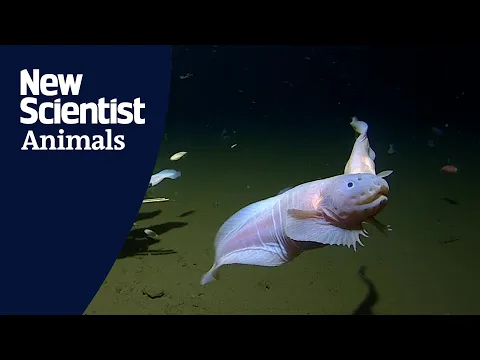
These elements reveal an important fact: living on the edge, snailfish rely on energy efficiency. The gelatinous layer, for instance, is not only protection: it reduces drag, facilitates swimming, and saves energy, a scarce resource in the depths.
Another curiosity: the deepest Pseudoliparis are not enormous adults but tiny juveniles, which surprised scientists during the expedition. They appear to hatch from relatively large eggs, allowing them to be born as pressure-tolerant juveniles, skipping the larval stage — which would not withstand the depth.
The Biological Depth Limit and What It Means
Since the early 20th century, many reports have attempted to determine how far a fish can live.
In 1901, the eel Abissobrotula galatheae was captured at great depth during trawling, and a second specimen was collected in the 1950s. But as trawls do not record the exact depth at the moment of capture, these data are considered insufficient.
In the 1960s, during the first crewed dive to the bottom of the Mariana Trench, the crew reported seeing a fish at over 10,000 meters — something now considered unlikely, possibly a misinterpretation of a sea cucumber.
With the advancement of ROVs and landers, starting in the 2000s, it became possible to film, measure, and verify the presence of fish accurately. Since then, the zone between 8,000 and 8,200 meters has become the critical point of research. This is because, according to Collins and other experts:
“Between 8,200 and 8,400 meters, it is estimated that fish can no longer accumulate enough TMAO to stabilize their proteins.”
Without this molecule, proteins begin to denature, membranes lose integrity, and physiology fails — which suggests a molecular limit of life.
This prediction was theoretical, but the filming of Pseudoliparis at 8,336 meters is practically in the middle of that range, reinforcing the hypothesis that we are very close to the absolute limit.
Why This Matters for Biology and the Future of Marine Exploration
The discovery has significant consequences:
- Defines a measurable biological limit, something rare in ecology.
- Shows that life does not disappear abruptly, but declines as pressure increases.
- Provides clues for biotechnology, as proteins that function under high pressure could inspire new materials, industrial enzymes, and biomedical compounds.
- Helps understand the resilience of life, in the context of astrobiological research and extreme adaptation.
But perhaps the most symbolic impact is another: by recording a fish at the physical limit of the planet, science reminds us that we still know very little about deep ecosystems.
Most of the hadal zone remains unexplored. Each trench is an isolated world, with its own conditions, unique populations, and unknown species to science.
The small fish at 8,336 meters is not just a record: it is an invitation to continue looking down, toward a planet that remains largely mysterious and invisible, even in the 21st century.








-

-

-

-

-

-

114 pessoas reagiram a isso.