





 Português
  Inglês
  Espanhol
 5 min de leitura
  0 comentários


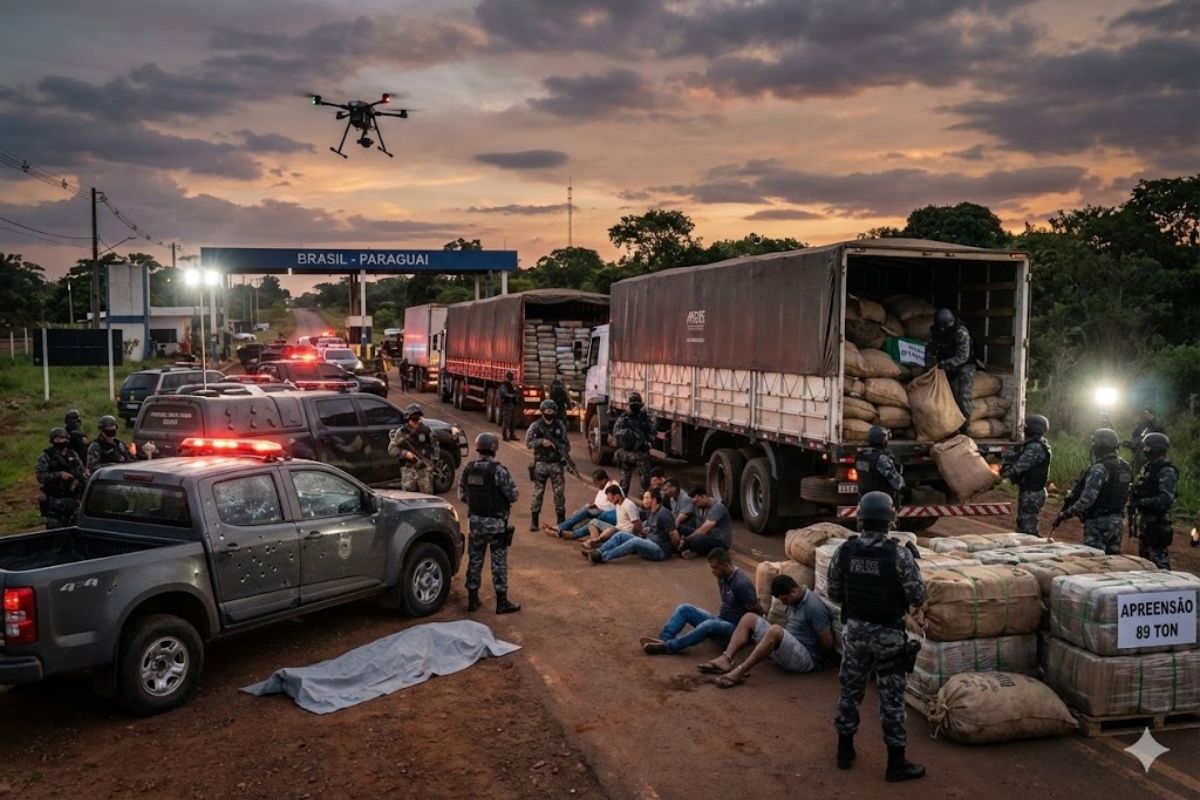
Recalculation by Paraguayan Authorities Confirmed That the Major Operation Launched on December 3, Near the Border With Paraná, Seized 89 Tons of Marijuana in a Convoy of 19 Vehicles, Left One Suspect Dead, Five Arrested, and Reinforced Alert About Routes to Brazilian Megacities Such as São Paulo and Rio de Janeiro.
The major operation coordinated by the National Anti-Drug Secretariat (Senad) of Paraguay took two days of counting, between Wednesday (3) and Friday (5), to confirm the volume of 89 tons of marijuana seized in Salto del Guairá, a city linked to Paraná by dry land. Initially estimated at 50 tons, the load was recalculated, raising the case to the level of the largest seizure ever recorded on Paraguayan highways.
In addition to dismantling a convoy of 19 vehicles adapted for the exclusive transport of drugs, the action left one suspect dead after an exchange of fire, five people arrested, and one man injured, highlighting the level of risk and violence associated with the Brazilian route of international drug trafficking that supplies large urban centers.
How the Major Operation Was Set Up at the Border

The major operation began early Wednesday morning (3), when Senad teams started monitoring a convoy that had departed from Curuguaty heading toward the border region with Brazil. The target was a large-scale marijuana shipment, carried by a heterogeneous fleet of trucks, cars, and pickups.
-
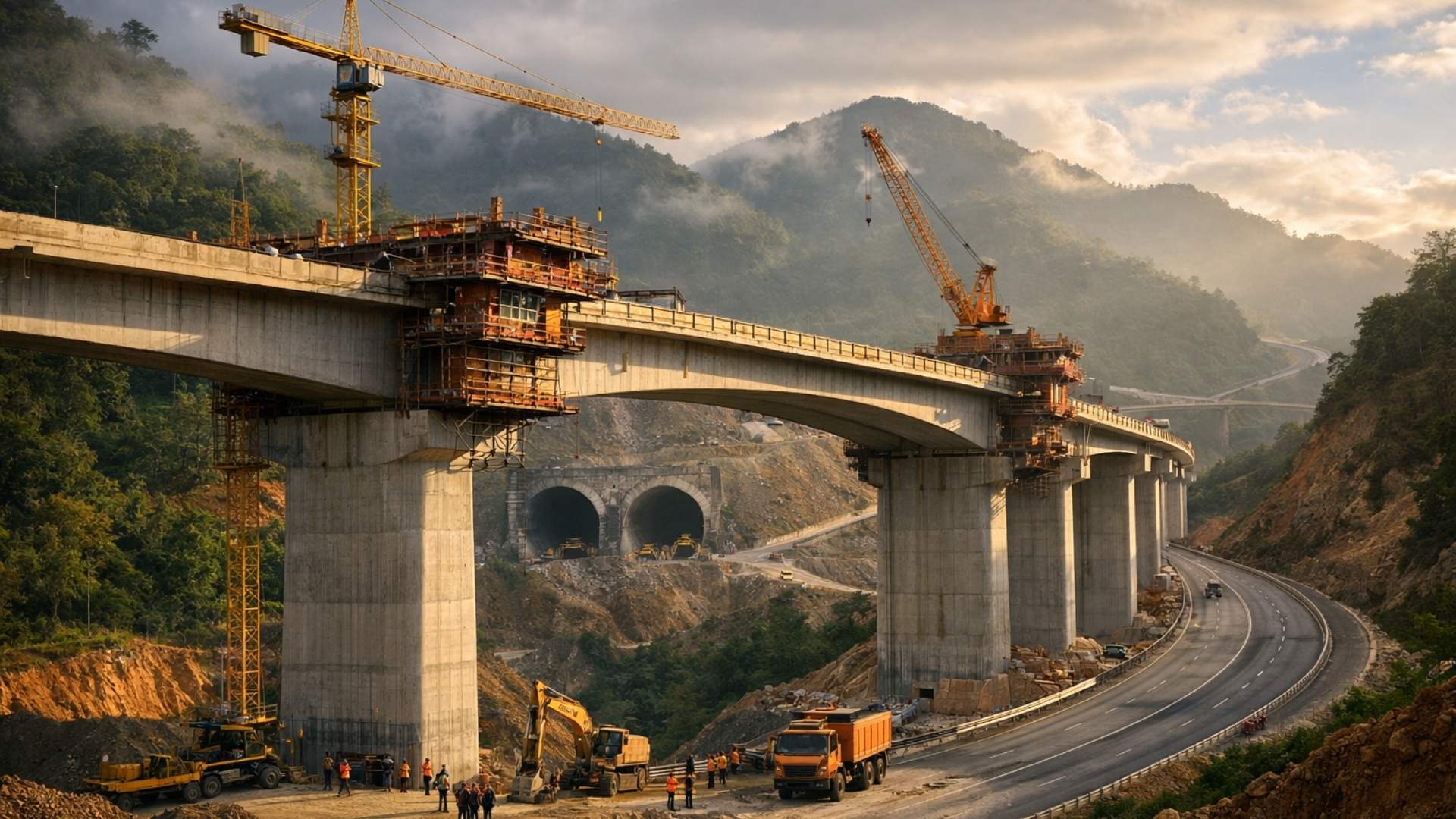
The government puts R$ 8.6 billion on the table to change the highway (BR) with 50 overpasses, 28 bridges, 4 tunnels, and 40 km of bike lanes in 180 km of historic duplication.
-
BRL 20.1 Million Bridge Project Kicks Off: 200-Meter Construction to Improve Access in Three Cities in Minas Gerais
-
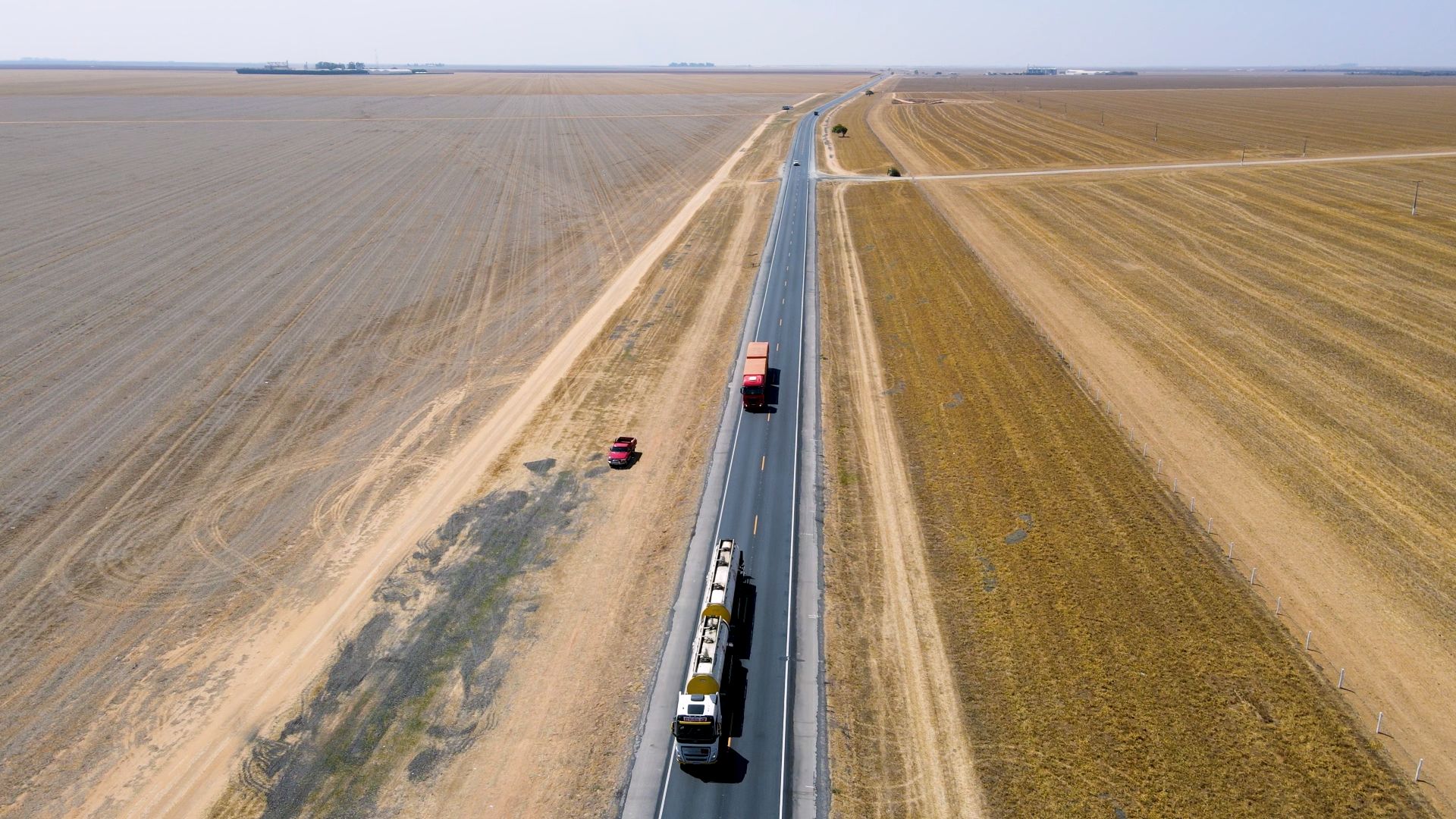
‘Endless Road’ In Brazil Is One of The Largest In The World: 145 Km Stretch On An Important Highway (BR) Crosses The West Of Bahia And Had 135.9 Km Revitalized With R$ 35.3 Million
-
Engineer From ITA Who Worked at Embraer Leads Free Flow Expansion With National Artificial Intelligence and Technology for Toll Without Barriers in Brazil


According to Paraguayan authorities, the convoy consisted of 19 vehicles, including two tractor-trailers, one truck, 14 pickups, and two cars. All were prepared to carry only the driver and the load, with no space for passengers, reinforcing the logistical nature of the criminal operation.
The interception took place in Salto del Guairá, along the banks of the Paraná River, at a strategic point for the flow of drugs toward Brazilian territory. Agents reported that the group was already traveling along the city’s main highway when they received the order to stop, triggering the tensest phase of the major operation.
Pursuit, Gunfight, and Action Summary
At the time of the approach, some of the drivers attempted to break through the police cordon and flee down the highway. There was a pursuit and exchange of fire.
According to Senad, official vehicles were hit by gunfire, which forced the teams to intensify the use of containment tactics.
During the confrontation, one suspect was killed and another was injured. Five people linked to the convoy were ultimately arrested in the act.
With the group, agents found hundreds of packaged and labeled bales of marijuana, organized to facilitate subsequent distribution to different destinations.
The counting of the load required two days of work, with continuous weighing of the seized bales.
The final total of 89 tons exceeded initial estimates of 50 tons and established the action as the largest seizure of marijuana on Paraguayan highways ever recorded by local authorities.
The Route of Marijuana to Brazilian Megacities
Investigations indicate that the final destination of the load intercepted by the major operation was Brazil.
According to Senad, shipments of this magnitude typically cross the border in the Salto del Guairá region, then travel through roads in Paraná and Mato Grosso do Sul, and from there, are redistributed to megacities like São Paulo and Rio de Janeiro.
This border–Paraná–Mato Grosso do Sul axis has consolidated as an international trafficking logistics corridor, taking advantage of extensive highway networks, high truck traffic, and sections with limited surveillance.
Criminal organizations use convoys with multiple vehicles to dilute risks, divide the load, and attempt to confuse police actions.
Even so, the major operation demonstrates that the scheme is known to law enforcement.
The structure seized in Paraguay reveals a professionalized transportation pattern, with vehicles prepared for long distances and drivers trained to respond to approaches, including with armed violence.
History of Major Seizures and Pressure on Trafficking
The case in Salto del Guairá is not isolated in the region.
In December of last year, in the same border area, another operation intercepted 58 tons of marijuana on a rural road, less than four kilometers from the Paraná River, also on the border between Brazil and Paraguay.
The escalation of seized volumes indicates that criminal groups continue to bet on increasingly larger shipments, in an attempt to offset potential losses due to individual seizures.
At the same time, major operations like the one involving 89 tons have a significant financial impact on trafficking logistics, raising costs and making continuous supply more difficult.
Senad states that it is keeping investigative lines active to identify other members of the organization, track financiers, and map support points along the route.
The goal is to dismantle not only the intercepted convoy but the entire supply chain, from planting areas to intermediaries operating at the border with Brazil.
Next Steps for Authorities at the Border
With the repercussions of the major operation and the confirmation that it is the largest seizure on Paraguayan highways, the trend is towards strengthening cooperation between the security forces of Paraguay and Brazil in the border area.
The route passing through Paraná and Mato Grosso do Sul remains a priority, both for overt actions and for intelligence investigations.
Paraguayan authorities indicate that new joint actions may occur, especially in rural corridors near the Paraná River, which historically serve as passageways for large cargo shipments.
The expectation is that the pressure on these routes will cause changes in trafficking tactics, with shifts in sections and greater dispersion of convoys.
Meanwhile, the volume seized in Salto del Guairá reinforces the alert about the impact of international drug trafficking on public security, illicit economy, and the strengthening of criminal organizations operating in the peripheries of large urban centers in Brazil.
Do you think that major operations of this scale can truly weaken criminal organizations or just push trafficking to even more dangerous routes closer to borders?









-

-

-

-

-

-

39 pessoas reagiram a isso.