





 Portuguese
  English
  Spanish
  10 min of reading
  10 comments


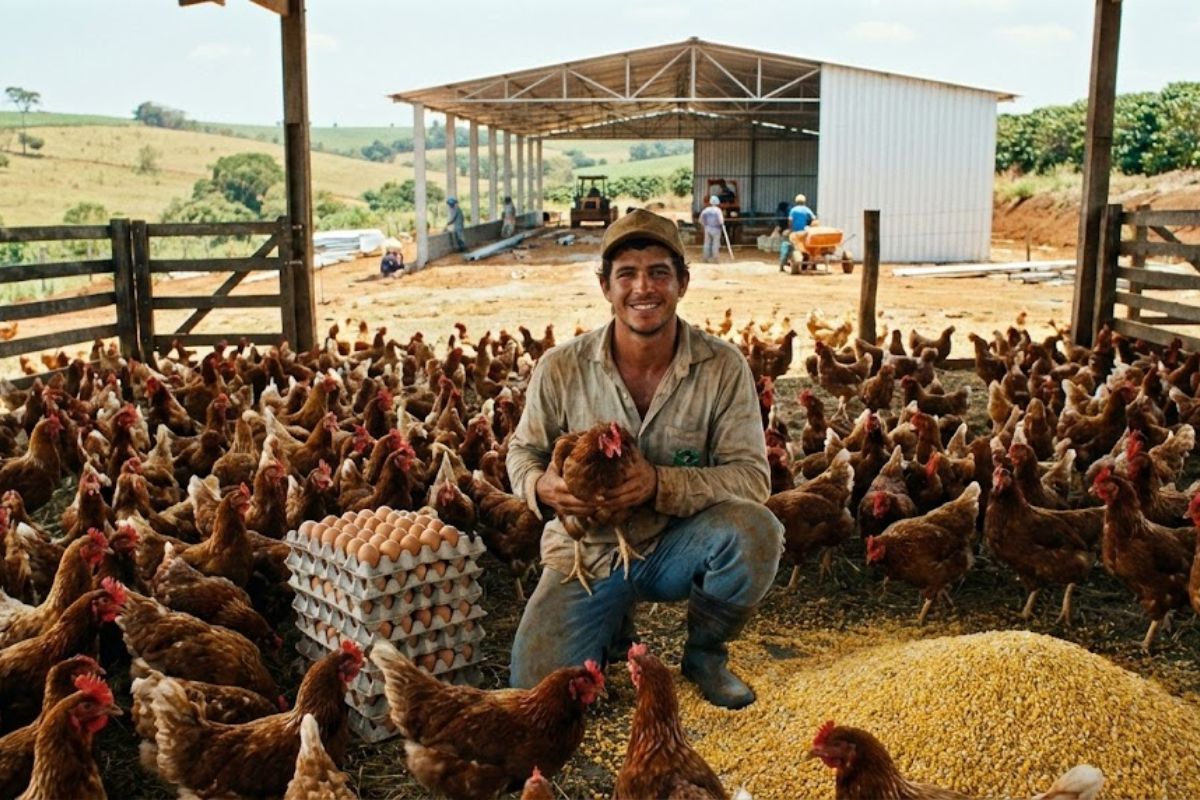


In Raul Soares, Minas Gerais, the young man transforms his family’s farm into a free-range chicken farm, utilizes the old milk barn, grows his own corn, mixes feed, organizes three flocks, and is already preparing to double production with a new shed for locally valued eggs.
The free-range chickens of Rafael took over the old milk barn and changed the course of the family farm. At 22 years old, he already manages 1,800 birds in production, collects an average of 1,500 eggs per day, makes feed with corn grown on the farm, and transformed a 45-year-old barn into a modern poultry farm, with fans, sprayers, a lighting program, and coffee straw bedding.
While maintaining the free-range chickens producing at a high level, Rafael also manages a herd of dairy cows, milking about 300 liters of milk per day from 22 cows and closely oversees the construction of a new 300-square-meter barn to house an additional 2,100 birds. All of this on a farm of 180 hectares, where his father takes care of the beef cattle and the son decided to bet heavily on free-range eggs as the main business.
From Milk Barn to Free-Range Chicken Farm

Before becoming a free-range chicken farm, the main barn was a milk barn used for over four decades. The building, measuring about 220 square meters, had a half wall of cement, a central trough, and a low ceiling. Rafael saw an opportunity there.
-
They said no to 26 million dollars and would do it all over again: mother and daughter from Kentucky reject a million-dollar offer from a mysterious company that wants to build the largest data center in the state on more than 2,000 acres of rural land.

-
While corn requires rain and is expensive, sorghum produces almost the same volume per hectare at a cost up to 80% lower and uses less water, and it is revolutionizing dairy farming in the Triângulo Mineiro, where producers save hundreds of reais per hectare.
-
A rural producer from Urubici cries as he shows 50 tons of plums thrown on the ground because no one wanted to buy them, and in desperation, he records a video asking anyone to come to the property to pick the fruits before they rot.
-
Unable to pass through Hormuz, Brazil activated a plan B that uses Turkey as a gateway to the Middle East: the route through Gibraltar and the Mediterranean is longer and more expensive but ensures that chicken, beef, and corn continue to reach Arab markets.

He renovated the structure, reinforced columns, closed walls, installed fans, a water sprayer system, and custom-made wooden nests. Where cows once entered, now flocks of free-range chickens in high laying phase come in, managed for thermal comfort and health.
The farm, covering 180 hectares, already had a history of milk and beef cattle. The father continued with the Nellore cattle. Rafael decided to buy the dairy cows from the other property using money from the eggs and brought everything to the poultry area.
While his father focuses on cattle, he focuses on milk and free-range chickens, creating two integrated sources of income on the same rural structure.
From Road Vendor to Owner of His Own Farm
Before the free-range chickens, Rafael lived on the road as a salesman for his father’s tobacco factory. He started selling at 15 to 16 years old, traveling through Northern Minas and Southern Bahia, spending 15 to 20 consecutive days as a driver’s companion. He learned the sales logic early.
In a bar conversation, a friend named Léo suggested entering poultry farming. The project did not progress for the friend, but Rafael embraced the idea alone, took the proposal to his mother, and decided to set up the farm in Cornélio, a district of Raul Soares.
Today, he continues with the salesman profile, but with a different product. He wanted to stop selling only for his father and start selling something of his own, and he found this product in free-range eggs. He organizes the routes, negotiates with supermarkets, determines packaging and price, and spends entire days on the road delivering the boxes.
Three Flocks, Different Breeds, and Fine-Tuned Management in the Same Barn

Inside the main barn, Rafael works with three flocks of free-range chickens at different ages, divided by simple internal walls, but with well-organized management.
On one side is the youngest flock, with about 600 birds, 23 to 24 weeks, just reaching peak laying. Production is already hitting around 95 percent, even with smaller eggs. The birds are from lines like Novogen Brown and Novogen Tint, known for high production.
On the other side, he keeps a flock of GLC, with more diverse egg colors and darker shells, which are highly valued when it comes to free-range eggs. Rafael comments that the GLC is more aggressive, more nervous, and less productive than the Novogen, but delivers a “free-range look” that customers see on the tray.
A third flock mixes Novogen Brown and Novogen Tint with around 600 birds, just over one year old and productivity in the range of 82 to 85 percent, still considered good for age. In total, combining all three flocks of free-range chickens, he maintains about 1,800 birds in production.
Coffee Straw Bedding, Automatic Water, and Light Program
At first, Rafael struggled with simple nipple drinkers. It soaked the bedding, leaked water on Sundays, caused headaches, and posed a disease risk. Once he managed to get automatic drinkers from poultry farms in the region, the routine changed: the bedding stopped soaking and the health improved.
The bedding for the free-range chickens is made of coffee straw, brought from a producer friend in the mountain region. The coffee straw forms a fluffy bedding, absorbs moisture well, and later becomes highly valued fertilizer for corn crops.
In many regions, this material is sold even in bags, and Rafael knows that if he needed to buy it, a truckload of several bags would incur significant costs, but for now, he works with partnerships.
To maintain high laying in a low-light region at certain times of the year, he adopted a controlled light program. The lights turn on at 5 PM, turn off at 7:30 PM, turn back on at midnight until 1:30 AM, and return at 4 AM.
This scheme helps the free-range chickens maintain their laying rhythm even during darker days, avoiding sudden drops that many producers report in the region.
Separated Brooders, Timely Vaccination, and Isolation of Sick Chickens
The chick chicks of free-range chickens do not go directly to the adult barn. Rafael buys day-old chicks, houses them in another part of the farm, uses electric heaters for warmth, and carries out the entire rearing phase separately, including vaccination and beak tipping with his own machine, to prevent excessive pecking without needing to de-beak strongly.
When the birds reach about 12 weeks, they enter the main barn already more developed, with vaccinations up to date. From there, he maintains only spot reinforcements, such as infectious bronchitis via spraying, which he can apply across the entire flock.
Chickens that become ill or show nasal discharge, weakness, or odd behavior are separated to another space, where he administers individual treatment to avoid putting the entire flock at risk.
The idea is to remove the problem bird from the view of the other free-range chickens as quickly as possible, preventing fights and contagion.
Farm Corn, Specific Nutrient, and Annatto for Yolk Color
One of the points that sets Rafael’s system apart is the production of his own corn for feed. The family already cultivated corn for silage and grain for cattle. Now, the same structure caters to the free-range chickens.
The corn is harvested in low areas, with small plots of 2 to 3 hectares distributed, which requires more work with machinery but ensures autonomy.
The feed mixture is made at a larger feed factory owned by his aunt, next to silos. There, each batch yields about 1,000 kilograms of feed in a few minutes.
Rafael orders soybean meal, specific nutrients, and other ingredients, stocks everything up, and when needed, calls the operator to prepare a batch. He then loads the already prepared feed onto the truck and takes it to the farm.
He uses a specific poultry layer nutrient, precisely aimed at free-range chickens, without ingredients prohibited by free-range egg regulations.
For yolk color and desired appearance, Rafael works with coloring purchased in Southern Bahia and also with annatto seeds, crushed in the family grinder, producing a natural pigment.
In daily consumption, the 1,800 free-range chickens eat about 180 kilograms of feed per day, which is about 100 grams per bird, within the classic laying range.
Rotational Pasture, Single Paddock, and Green in the Trough
Even with a focus on the barn, Rafael makes a point of maintaining a routine of letting the free-range chickens into outdoor paddocks. Today he works with one large paddock that serves the three flocks, but on a rotation scheme: each day one flock has access to the area.
Around lunchtime, he lets the chosen flock out, and the birds spend a period foraging, soaking up the sun, spreading out on the ground, and digging holes.
Then, at the end of the day, they return on their own to the barn, where they sleep safely. The future intention is to divide the paddock into smaller areas to be able to let all the flocks out daily, without confusion.
As the space is limited, he complements the “green” by bringing leaves and fruits from São Caetano and other greens into the paddocks, enhancing the appeal of free-range chickens that have access to pasture and fresh plants.
Double Routine: 300 Liters of Milk Per Day and Production of Free-Range Eggs
In addition to the free-range chickens, Rafael manages the milking of 22 dairy cows, extracting about 300 liters per day, always in the morning and afternoon.
The milk does not take a holiday, Christmas, or New Year. He comments that milking is more work than raising chickens, because any cow with mastitis, a stubborn cow, or change in routine already alters everything.
It was with money from free-range eggs that he bought the dairy cows from his father at another farm and brought them to this area. Today, in practice, the young man lives between the milk room, the free-range chicken barn, and the road, selling the production.
To manage everything, he works with about five people on the farm, including collaborators, almost permanent masons for construction, and partners in milking. One of his main right-hand men is Gabriel, who initially was skeptical about the idea of “leaving cattle to work with chickens,” but ended up becoming a true partner in the daily work and even has his own cows in the herd.
Heavy Logistics, Small Cities, and Falling Prices
Every week, Rafael loads his truck and faces the roads of Minas to distribute the production of free-range chickens.
The routes include Raul Soares, São Pedro, Rio Casca, Ponte Nova, and even Mariana, on journeys of 60 to 160 kilometers, often with mountain roads, stones, and bridges that suffer during the rainy season.
He delivers to medium supermarkets, neighborhood markets, partner sales points, and private clients, always trying to concentrate larger volumes on fewer customers to reduce the number of kilometers traveled. In small towns of 5,000 inhabitants, he has also managed to create space for free-range eggs.
Today, a dozen free-range eggs sells for around 8.60 to 9 reais, reaching 10 or 12 reais for direct consumer sales. Closed boxes have reached 330 reais, but the market has retreated, and he works at around 255 to 260 reais per box, in a general declining scenario he estimates at about 15 percent.
When the classification yields very small eggs, especially in the new flock, he has difficulties competing with very cheap industrial white eggs. The solution is to use some for donation, sending smaller boxes to APAE, nursing homes, and local entities, instead of letting them go unsold.
New 300-Square-Meter Barn for 2,100 Free-Range Chickens
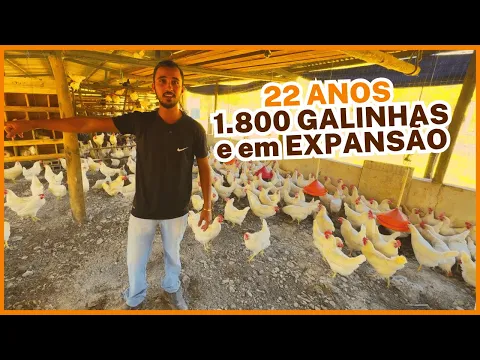

Ambitious, Rafael did not stop at the first barn. Next to the current structure, he is building a new 300-square-meter barn, measuring 10 by 30 meters, designed from the beginning for 2,100 free-range chickens, respecting around 7 birds per square meter.
The terrain is challenging. Due to the topography and the risk of flooding, the barn required a high retaining wall, which increased construction costs. He estimates that he has already spent about 40,000 reais just on the structure so far, with around 12,000 reais just for the retaining wall.
The roof will be made with special zinc sheets, which reflect more heat, combined with a lattice-type internal lining to reduce the temperature inside the barn.
The height of the ceiling will be 4 meters, and the great concern was to build a structure without central pillars, allowing tractors to enter to handle bedding or remove material, if necessary.
Next to the barn, he is building a own distribution center, with a packing room, storage area for packaging, space for feed, and complete sanitary barriers, with footbaths and sinks.
The project includes an egg passage opening between the barn and the distribution center, without direct contact of staff with the poultry area, meeting registration and inspection requirements.
Distribution Center, Stamp, and Regularization in Progress
While the new distribution center is not ready, the farm operates with a small building next to the feed factory, where the eggs from the free-range chickens are received, stamped with the date, packed in dozens or 30-cell trays, and stored on shelves until delivery day.
Rafael has already submitted the documents to regularize the farm and the distribution center with a regional consortium serving several municipalities.
The idea is to sell with an official registration, gain access to more markets, and strengthen the free-range egg brand of the farm, which today already supplies several supermarkets in the region.
Free-Range Chickens, Income, and Advice for Those Wanting to Start
In Rafael’s view, free-range chickens are less work than dairy cows, but require the same level of commitment.
For him, the secret is to sell well, know the market, and not underestimate management. Free-range eggs pay better, but only if accompanied by consistency, shell quality, yolk color, and a true story behind the tray.
His advice for those thinking of following this path is simple and direct: don’t think it’s just about putting free-range chickens in the backyard and waiting for the eggs to appear.
He recommends seeking technical consulting, videos, courses, quality information, and thoroughly understanding costs, market, and routine before making the first installation.
Today, with 1,800 free-range chickens in production, around 1,500 eggs per day, 300 liters of milk, and a new barn rising next door, Rafael shows that it is possible to move from the passenger seat of a vendor’s truck to sitting in the producer’s chair, even in a small town with plenty of hills ahead.
And you, would you dare to start a free-range chicken farm like Rafael’s in your area, or do you still think this type of business isn’t for you?









Com certeza se tivesse condições
Tenho interesse no esterco das galinhas
Quando eu era jovem, eu queria montar um galinheiro somente com galinhas caipiras. Atualmente, estou com 68 anos, aposentado, e continuo gostando dessa atividade. É uma pena eu não ter recurso para dar início a este sonho. Gostei desta reportagem.