





 Portuguese
  English
  Spanish
  6 min of reading
  0 comments


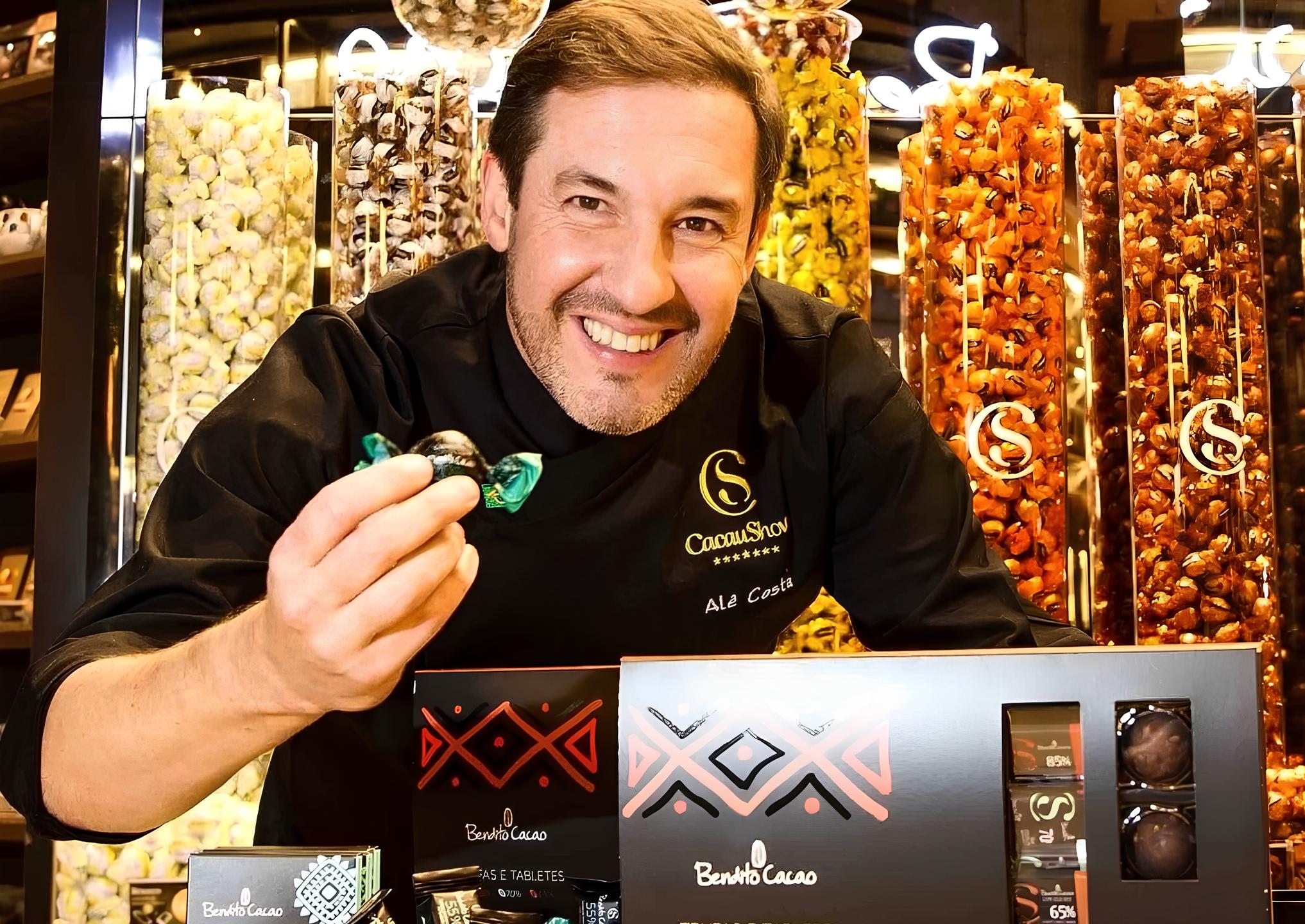
At just 17 years old, Alexandre Costa started what would become the largest fine chocolate chain in the world. Discover the true origin of Cacau Show, an inspiring story of overcoming, entrepreneurship, and market vision.
The creation and origin of Cacau Show dates back to 1988, when a young man from São Paulo named Alexandre Tadeu da Costa decided to venture into entrepreneurship without experience, without his own capital, and without an academic background in business. At 17, he was still a high school student and helped his mother sell chocolates door to door. The simplicity of this activity concealed the embryo of one of the greatest success stories in Brazilian retail. Discover also what happened to Cacau Show after the brand’s success.
The beginning was modest: Alexandre used only a notebook and a pen to record orders. In a short time, he was already packaging, selling, and delivering the chocolates he resold from his mother. It was from this routine that the idea of creating his own brand emerged. Born there was the Cacau Show, which would later become a market phenomenon.
Creation of Cacau Show: A Bold Bet with Only US$ 500
Two years after his first sales experience, Alexandre decided to go solo. In 1988, he received an order for 2,000 Easter eggs weighing 50g for a large company. Excited, he accepted the order without having the means to produce it. Crisis struck when he realized he wouldn’t be able to deliver on time. Salvation came from a lady who knew how to make chocolates and helped him fulfill the order.
-
Historic bankruptcy of Centauro shocks the market, and the century-old company puts more than 500,000 products, machines, and complete infrastructure up for online auction.

-
New shoe factory in Ceará is expected to create 400 jobs and strengthen the local economy.

-
No one imagined it, but a mixture of sawdust with a mineral that fights fires surprises scientists with a result that changes the course of fire-resistant construction.
-
From empty land to a high-end house, wooden construction uses a lightweight system, metal structure for the foundation, ventilated ceramic cladding, and special windows to create an efficient and comfortable living space throughout the year.




This episode, which could have marked the premature end of the idea, turned out to be the true turning point. With US$ 500 borrowed from an uncle, Alexandre began stocking chocolates at a friend’s house and started producing them handmade. He personally made sales at bakeries and small shops in the area. This was the practical beginning of the creation of Cacau Show, a company officially founded in 1988.
What Happened to Cacau Show: From Handcrafted Production to Global Leadership
Over the following decades, Cacau Show grew impressively. The first physical store was only opened in 2001, in the city of Piracicaba (SP), in a space of 40 square meters. Until then, all operations were focused on reselling at partner commercial points.
But it was the investment in the franchise system that drove the expansion. Starting in the 2000s, the company began opening its own stores and franchises at an accelerated pace. In 2005, Alexandre founded the brand’s factory in Itapevi (SP), covering 17,000 square meters and investing R$ 15 million.
In February 2008, Cacau Show reached the impressive mark of over 295 stores operating in Brazil, in addition to several more under development. By inaugurating store number 316 in Manaus, the company surpassed the American Rocky Mountain and became the largest fine chocolate franchise chain in the world.
Success Strategies: Innovation, Affordable Pricing, and Sensory Experience
What sets Cacau Show apart in the market is not just scale, but the ability to constantly innovate. From early on, the company focused on product quality at affordable prices. “Our price is equivalent to a quarter of that charged by competitors,” says Alexandre Costa in interviews.
Inspired by Belgian tradition, Alexandre also brought the concept of gourmet truffles to Brazil. Cacau Show began producing more than 15 million truffles per month, with 20 different flavors, including exotic versions like pepper and mint.
Additionally, the brand works with the five senses. The store is designed to stimulate smell, sight, taste, and touch, enhancing the pleasure of shopping. “Working with smell, taste, and sight pleases consumers, who feel a sense of indulgence,” explains Heloísa Omine, a specialist in sensory marketing.
Exponential Growth: Numbers That Tell a Story of Overcoming
To understand the impact of Cacau Show on the Brazilian market, one must look at the numbers:
| Year | Revenue (R$) | Number of Stores |
|---|---|---|
| 2001 | R$ 500,000 | 1 |
| 2005 | R$ 30 million | 70 |
| 2008 | R$ 60 million | 316 |
| 2010 | R$ 200 million | 1,000 (goal) |
| 2024 | R$ 4.5 billion | 3,800+ |
Source: Exame, PEGN, Official Cacau Show Website
The current revenue exceeds R$ 4.5 billion, with more than 3,800 stores spread across Brazil and international expansion underway.
The DNA of Cacau Show: Social Vision and Valuing Brazilians
Another important factor for the company’s success is its social purpose. From the beginning, Alexandre Costa implemented corporate responsibility actions. The brand promotes inclusion programs, youth training, and investments in underprivileged communities through the Instituto Cacau Show.
Moreover, the entire supply chain values the work of small Brazilian cocoa producers, fostering the domestic market and promoting the sustainable development of national raw materials.
Challenges Faced: Crises, Competition, and Reinvention
Although Cacau Show’s journey is one of success, the path has not been obstacle-free. The company faced moments of economic instability in Brazil, rising cocoa prices in the international market, and competition from brands like Kopenhagen, Lindt, and importers.
Even so, Cacau Show was able to reinvent itself. It focused on seasonal dates like Easter and Christmas to boost sales and launched specific lines for diverse audiences, such as the “LaCreme” (targeted at a mild palate) and the “Bendito Cacao” (a more intense line, aimed at pure chocolate with a higher cocoa content).
What Happened to Cacau Show After Becoming a Giant?
With the advancement of digital transformation, the company also invested in e-commerce and its own applications. Today, Cacau Show offers delivery, a monthly subscription for chocolate kits, and omnichannel customer service. The COVID-19 pandemic accelerated this digitalization, and the company emerged even stronger from the period.
More recently, the brand has been investing in its own cafés, such as Cacau Show Gelato and Cacau Show Café, expanding its reach beyond chocolate. It has also invested in physical experiences, such as the “Choco Tour,” a guided visit to the factory in Itapevi, and partnerships with artists for exclusive collections.
Lessons from the Founder: From Notebook to Commanding an Empire
The example of Alexandre Costa shows that there are no barriers for those with vision, determination, and the courage to start small. With a pen, a notebook, and US$ 500 borrowed, he built an empire that is a reference in entrepreneurship in Brazil.
In interviews, he often repeats: “Never give up on what makes your heart beat faster. I started with nothing, and I am living proof that it is possible.”
Today, in addition to being a businessman, Alexandre is the author of the book Flavor of Victory and a speaker, sharing his journey with new entrepreneurs. The origin of Cacau Show continues to inspire generations dreaming of transforming ideas into great businesses.
The creation of Cacau Show is more than a success story: it is a milestone in national entrepreneurship. What happened to Cacau Show, from its first steps to global leadership, reveals how a brand can remain faithful to its roots while conquering the world.
And it all started with the boldness of a 17-year-old boy who decided he could do more. Today, Cacau Show is a symbol of quality, innovation, and Brazilian spirit.









-

-

-

-

-

-

13 pessoas reagiram a isso.