





 Portuguese
  English
  Spanish
  7 min of reading
  0 comments


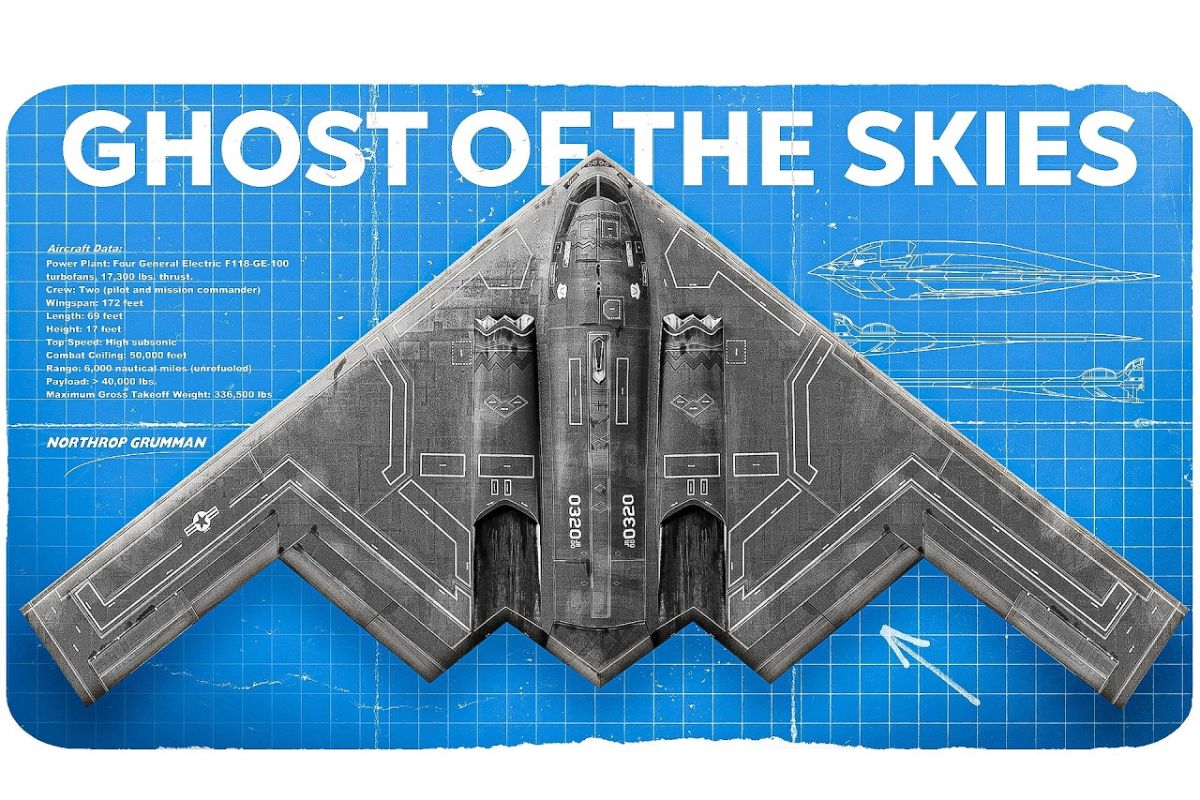
With A 50-Meter Flying Wing, Radar-Absorbing Materials, A Range Of Nearly 11,000 Kilometers, And A Capacity To Carry 20 Tons Of Weapons, The B-2 Bomber Was Designed As The Definitive U.S. Response To Breaching Soviet Defenses And Keeping Nuclear Deterrence Alive During The Cold War.
At the height of the dispute between Washington and Moscow, the B-2 Bomber emerges as a kind of “ghost” of the skies, designed to traverse the most protected airspace on the planet, drop its payload, and retreat without being seen by enemy radars. At a cost of around $2 billion per aircraft, it becomes not only the most expensive plane ever built but also a symbol of how far engineering and electronics could go to maintain the balance of nuclear power.
Behind its futuristic silhouette, the B-2 Bomber concentrates an extreme combination of aerodynamics, composite materials, sensors, and control systems that position it in a league of its own within military aviation. Nothing about it is merely aesthetic: every angle, every panel, and every opening was designed to reduce radar, heat, and even noise signature recognized by defense systems.
From The Cold War To The Program That Reinvented Strategic Bombing

The starting point for the B-2 Bomber is the tense environment of 1975, with the Cold War at its peak and B-52 squadrons flying in a state of permanent alert.
-
Scientists detect a rare and frightening phenomenon in the Pacific Ocean that could trigger a devastating Super El Niño as early as 2026, and American experts say it is one of the strongest ever recorded in history.

-
Researchers from Embrapa have discovered how to transform the saline water found in 140,000 wells in the Brazilian Semi-Arid region into a tool for producing food in an area where agriculture has always relied solely on rainfall.

-
China inaugurates a ghost factory that operates in the dark 24 hours a day without any human workers and produces 10 million smartphones a year using 97% of equipment developed by the company itself.

-
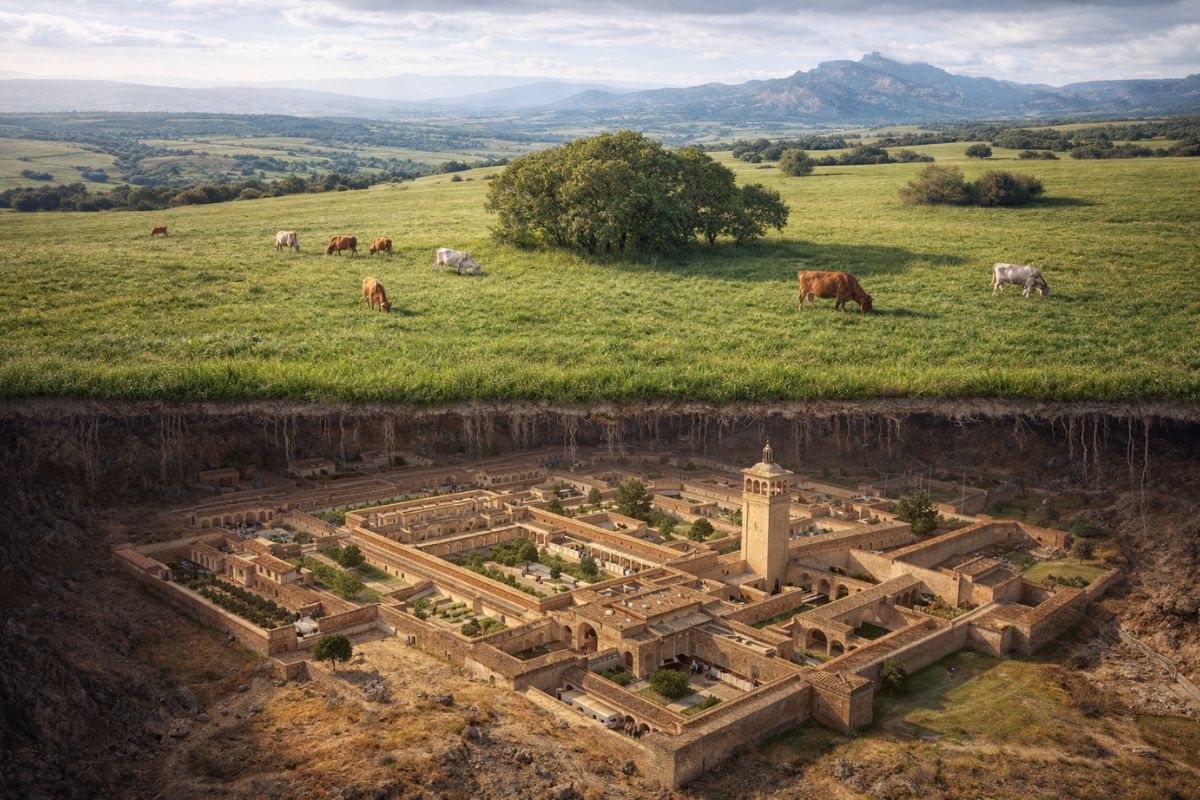
A thousand-year-old caliphate city may be hidden beneath a pasture in Spain where anyone could walk by without noticing anything, but LiDAR technology has revealed terraces, walls, and a planned urban grid beneath the surface.
These enormous “flying fortresses” were central to American nuclear deterrence, patrolling routes over the Arctic, Alaska, Greenland, and the Mediterranean, ready for an attack in minutes.
The problem is that over time, the Soviet Union developed air defense systems capable of detecting and destroying these heavy aircraft with relative ease.
Air Force generals came to recognize that sending B-52s into Soviet airspace would be akin to operational suicide.
If the enemy began to believe they could neutralize the bomber fleet, the risk of a first strike would dramatically increase.
The response comes in the form of the Advanced Technology Bomber Program, the ATB.
The mission was clear and radical: to create a bomber capable of penetrating the densest defenses on the planet as if it were invisible, delivering its payload, and exiting before the adversary noticed the intrusion.
It is in this context that the B-2 Bomber takes shape, not merely as a new aircraft but as a complete repositioning of the long-range strategy.
The Flying Wing That Came Back From The 1940s

Although it may seem like an idea born from the 1980s laboratories, the conceptual basis of the B-2 Bomber dates back to the end of World War II.
In 1946, as the country turned to civil reconstruction, engineer Jack Northrop insisted on a radical concept: a flying wing without a traditional fuselage, without a tail, just a large continuous aerodynamic surface.
In 1947, this vision took shape in the YB-49, a jet prototype with about 50 meters of wingspan.
It was decades ahead of its time but faced a fundamental obstacle: without modern computers, controlling a flying wing of that size was extremely difficult, making the aircraft unstable and complex to operate.
In 1949, in a tough decision for Northrop, all the prototypes were destroyed, as if the very idea had been buried.
When the ATB Program was launched in the 1970s, history made a complete turn.
The Northrop Corporation returned to the forefront and revived the flying wing, now combined with digital control systems and advanced electronics.
The B-2 Bomber represents this “second chance” for the original idea, this time supported by decades of technological development and by a practically blank check from the U.S. government.
Stealth Design: Shape, Materials, And Electronic Control
What makes the B-2 Bomber so different at first glance is precisely its integrated flying wing shape. Instead of a cylindrical fuselage and distinct tail surfaces, it is essentially a large continuous aerodynamic plane.
This design minimizes sharp edges and surfaces that might reflect radar waves toward the signal emitter.
The surface of the B-2 Bomber is coated with radar-absorbing materials, a specialized covering that converts part of the emitted energy into heat instead of reflecting it back as an echo.
This is not common paint but layers designed specifically to “swallow” radar radiation and reduce the aircraft’s cross-section to an equivalent target size of a tiny object on a surveillance screen.
In addition to the shape and materials, the very construction of the B-2 Bomber’s “skin” is designed for stealth. Large, smooth panels with minimal visible seams avoid corners and protrusions that could create unwanted reflections.
The structure uses lightweight graphite and carbon composites, which are rigid and much less visible to radar than conventional metal alloys.
Any millimeter misalignment in the assembly can turn an area into a reflector, requiring manufacturing tolerances comparable to a high-precision watch, scaled up to a 100-ton aircraft.
Digital Stability For A Wing That Accepts No Errors
From an aerodynamic standpoint, flying wings are notoriously unstable.
Without a tail, they tend to yaw and roll easily, making manual control more difficult and requiring constant corrections.
The B-2 Bomber solves this problem with an advanced fly-by-wire system, which replaces mechanical controls with electronic signals mediated by computers.
Instead of relying solely on the pilot’s skill, the B-2 Bomber uses dozens of onboard computers to make continuous adjustments to the control surfaces, keeping the aircraft stable in all flight regimes.
This digital layer allows a plane with a wingspan the size of a football field to perform maneuvers unthinkable for a structure of that size if only direct commands were used.
The integration between flight control, sensors, and mission systems is so profound that the B-2 Bomber behaves as a single platform, where electronics and aerodynamics are inseparable. Fly-by-wire, self-protection, navigation, and weapons management function as parts of a single brain distributed along the flying wing.
Hidden Engines And Reduced Thermal Signature
Another central element of the B-2 Bomber is how propulsion is handled.
The aircraft utilizes four General Electric turbofans buried deep within the structure, with air intakes carefully positioned on the top of the wing.
This prevents the compressor blades from being exposed directly to radar, one of the most critical reflection points in conventional aircraft.
At the exhaust, the hot gases are mixed and dispersed over a larger area at the rear, reducing the infrared signature.
The goal is for the B-2 Bomber to appear less visible to both radar and heat sensors, complicating detection by missile and multi-spectral surveillance systems.
The practical result is an aircraft that tries to leave minimal “footprints” in the sky, even when crossing long distances at high altitudes.
Range, Payload, And Mission Profile Of The B-2 Bomber
Behind the stealth, the B-2 Bomber is essentially a long-range attack vector.
It was designed to carry about 20 tons of armament in its internal compartments, the equivalent of filling the hold with the weight of several cars.
This payload can include GPS-guided conventional bombs, capable of hitting dozens of targets in a single incursion, or specialized munitions for destroying deeply buried bunkers.
Its range on a single tank is around 11,000 kilometers, enough to cross oceans and hit targets on other continents without intermediate stops.
With aerial refueling, the B-2 Bomber can operate practically anywhere on the planet from remote bases, configuring a projection capability rarely seen in manned platforms.
Cruising speed at high altitudes approaches 900 kilometers per hour, and the operational ceiling reaches about 50,000 feet, above most commercial routes.
The crew consists of two military personnel, a pilot and a mission commander, responsible for managing not only the flight but also complex navigation, armament, and self-protection systems.
The B-2 Bomber can operate in all weather conditions, day or night, using advanced radars and terrain-following modes to fly in profiles that maximize its stealth.
The Extreme Cost Of Maintaining The Most Expensive Bomber On The Planet
All this combination of shape, special materials, advanced electronics, and small-scale production transforms the B-2 Bomber into one of the most expensive projects in aviation history.
Each unit is estimated to cost around $2 billion, a figure greater than the annual GDP of many small economies, highlighting the scale of investment concentrated in a single cell.
In addition to development and construction costs, maintaining the B-2 Bomber is intensive.
Radar-absorbing coatings, for example, need to be inspected and reapplied periodically, and onboard systems require constant updates to keep up with advances in sensors and air defenses.
The result is an aircraft that demands budget, infrastructure, and highly specialized personnel to remain operational, but in return, it offers a depth penetration capability that is practically unmatched.
From The B-2 Bomber To The B-21 Raider
Over time, even an iconic project like the B-2 Bomber needs a successor.
The United States Air Force is already pointing towards the B-21 Raider as the next step in stealth aviation, an aircraft designed to fulfill not only the role of an intercontinental bomber but also as an intelligence node in a broader network of connected systems.
The proposal is for the B-21 to maintain the stealth philosophy of the B-2 Bomber, but with lower acquisition and maintenance costs, as well as greater flexibility of use.
If the B-2 Bomber represents a technological showcase of its time, the B-21 attempts to transform this concept into something more scalable, with a possibly larger fleet adapted to the digitized combat environment of the 21st century.
Meanwhile, the B-2 Bomber remains a landmark of engineering and strategy, an aircraft that changed the way long-range operations are thought of in hostile environments.
Its combination of flying wing, control electronics, stealth materials, and global range still sets the standard for much of modern bomber design.
In the end, the B-2 Bomber is at the same time a showcase of power and a reminder of the extreme cost of maintaining such capability.
And for you, which aspect of the B-2 Bomber is most impressive: the nearly radar-invisible stealth, the intercontinental range, or the ability to carry 20 tons of weapons on a single mission?









-

-

3 pessoas reagiram a isso.