





 Portuguese
  English
  Spanish
 6 min of reading
  2 comments


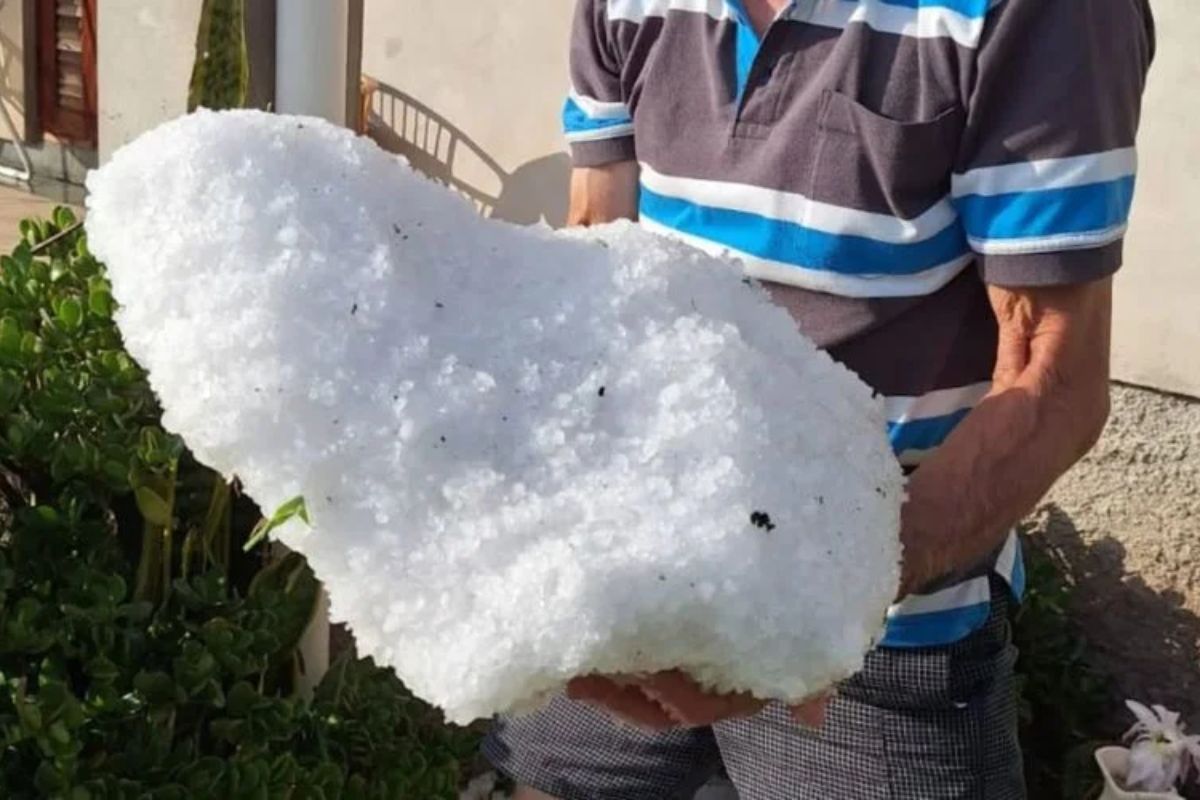


With Hail Destroying Crops and Houses in the Interior of Rio Grande do Sul, a Hail Cannon Costing Half a Million Reais Has Become the New Weapon of Viticulturists to Attempt to Save Grapes, Break Stones in the Air, and Avoid Irreversible Damages. While Producers Go into Debt to Install the Technology, the Gaucho Government Is Already Studying to Directly Finance Equipment in Higher Risk Areas.
While hail destroys crops and affects tens of thousands of residents in RS, the hail cannon from Gaucho wineries fires shock waves to fragment ice stones still in the clouds, costs about R$ 500 thousand, and is already motivating official studies for direct public funding to rural producers exposed to recurring storms.
The latest episodes of strong hail in the state, with damages to around 37 thousand residents in a single weekend, have reinforced the sense of vulnerability in the countryside. In fine fruit regions, such as grapes for wines and sparkling wines, a single storm can compromise the entire harvest and years of investment in structure and brand. In light of this scenario, producers have agreed to take the risk to the limit and bet on the hail cannon as a technological insurance of last resort, even though the cost is equivalent to the value of a small urban property.
Hail Cannon Becomes a Half-Million Shield to Protect Grapes

Installed in vineyard areas, the hail cannon is a large piece of equipment, mounted on a fixed base and aimed at the sky.
-
A “silent skill” is allowing Brazilians to earn up to R$ 22,000 per month without a degree and become indispensable for companies that rely on millions of data to survive.

-
Researchers at the Toyota Research Institute found that if a human uses robotic arms to flip a pancake 300 times in an afternoon, the robot learns to do it on its own the next morning, and this is currently the most promising method to solve the biggest bottleneck in modern robotics.

-
Goodbye iron: a common item in households is starting to lose space to technology that smooths clothes in minutes without an ironing board and with less energy consumption.

-
Antarctica reveals an unusual clue high in the Hudson Mountains, and what appeared to be just an isolated rock began to expose a secret hidden under the ice for ages.


Each time hail formation is detected, the system fires a sequence of controlled explosions that generate shock waves directed at the charged clouds.
The promise is simple and ambitious: to interfere in the process of stone formation and reduce the size of ice grains before they hit the ground.
In practice, the equipment seeks to transform hailstones into much smaller particles, similar to coarse salt, which still fall but cause less impact on leaves, bunches, and branches.
The logic is that pulverized hail still hurts, but does not destroy an entire crop of sensitive grapes, which makes a difference in high-value crops, such as the wineries that supply the national market.
This specific model, used to protect grape plantations, cost around R$ 500 thousand.
For a winery, this means compromising working capital, credit, or reserves to acquire a single piece of equipment aimed solely at climate risk.
Still, industry entrepreneurs argue that, given the impossibility of “rapidly replacing” an adult vine, the investment is cheaper than losing entire harvests in sequence.
How the Hail Cannon Works During the Storm
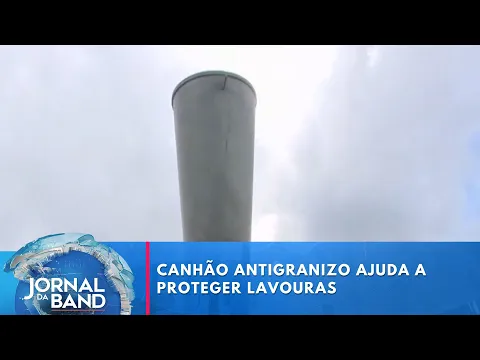

The operation of the hail cannon depends on constant weather monitoring.
Each time clouds with the potential for hail approach, the equipment is activated and begins to fire shock wave pulses at regular intervals.
Each explosion generates a column of air that propagates upwards, creating disturbances in the layer where the ice would consolidate.
According to sector technicians, these disturbances break or weaken the cores of forming ice, which begin to collide and fragment before reaching critical mass.
Instead of large stones, which can destroy roofs, pierce tarps, and tear leaves, the desired outcome is a rain of smaller particles, with lower impact energy.
The target is precisely the crops that are more sensitive to the climate, such as thin-skinned fruits and exposed bunches, in which a few minutes of hail is enough to ruin the commercial production.
In the case of grapes intended for fine wines, spots and cracks in the berries compromise not only the yield but also the quality and final price of the product.
Pressure on the Government: From Individual Cannon to Public Funding
The use of the hail cannon is still restricted, especially because of the high cost per unit.
Even so, the adoption in Gaucho wineries has already begun to generate a political movement.
With damages accumulated from successive storms and reports of total losses on unprotected properties, the government of Rio Grande do Sul has begun studies to finance equipment of this type to producers in more critical areas.
The proposal under discussion is to use public resources and specific lines of credit to enable the installation of cannons in regions with higher incidence of hail, reducing dependence only on rural insurance or emergency programs for crop reconstruction.
The logic is preventive: instead of compensating for a lost harvest, the State would help fund a technology aimed at preventing the damage before it happens.
In addition to direct funding, discussions are underway on how to integrate the hail cannon into broader policies for climate risk management in agriculture.
In sectors like viticulture, reliance on weather is absolute, and the unpredictability of extreme events has been cited by producers as a discouraging factor for new investments, expansion of areas, and modernization of facilities.
Collective Benefit or Solution for a Few?
The debate, however, is not merely technical.
The hail cannon raises questions about equity in agriculture.
On one side, structured wineries manage to concentrate resources and install expensive equipment to protect high-value crops.
On the other side, small producers of fruits, vegetables, and grains remain exposed to the same storms, without the same investment capacity.
There is also the discussion about the actual range of protection.
A single hail cannon covers a limited area.
In densely populated production regions, such as the grape, apple, or peach belts, the intelligent distribution of equipment becomes a challenge of collective planning, not just a decision of each farm.
Agricultural policy experts warn that if public funding is designed only for large enterprises, the technology may deepen inequalities in agriculture.
Meanwhile, producers who have taken the risk argue that each hail cannon installed is, in practice, an indirect insurance for neighbors, as the fragmentation of hail tends to benefit a larger area than just the individual property.
Future of Hail Protection in the Gaucho Countryside
Even in its early stages, the movement around the hail cannon indicates a shift in approach in Gaucho agriculture.
Instead of treating hail merely as a climatic fatality, part of the sector is starting to see the phenomenon as a risk that can be mitigated through technology, albeit with clear limits on cost and reach.
For grape producers, the equipment can mean the difference between maintaining contracts, honoring financing, and preserving local jobs or facing yet another cycle of destruction of vineyards and bank renegotiations.
For the government, the decision to fund or not to fund hail cannons at scale will have a direct impact on the budget, agricultural policy, and producers’ expectations regarding the role of the state in extreme weather events.
In the end, hail will continue to fall over the interior of Rio Grande do Sul.
The question is whether this rain of stones will find only unprotected vineyards or a set of tools, such as the hail cannon, coordinated with insurance, credit, and public planning.
In your opinion, should the government help finance hail cannons for rural producers, or should this type of climate protection continue to be an exclusive responsibility of each property?







Precisamos mais d o que nunca este beneficio publico. Para poder continuar plantando frutas
O canhão anti granizo no momento é a divisão mais correta para toda a agricultura. Na nossa região de Mato Perso. Município de Flores da Cunha se encontra um destes canhões. É de uma propriedade particular. Mas defende assim uma comunidade inteira que está próxima. Foi o que aconteceu no dia 24/11/2025 . Nesta comunidade próxima o granizo veio em tamanho ao sal grosso e não prejudicou a lavoura. Mas a uma distância de 5 km a outra comunidade que não tinha a perda fio de 70% . Fora o prejuízo de mais 3 anos para ficar tudo igual o que era antes. Temos seguro agrícola sim mas neste ano o governo não pagou ainda os 40% do subsídio onde torna mais um desafio para o agricultor ter que desembolsar um dinheiro que não contava em pagar.
Em fim tá cada dia mais difícil se manter na agricultura.